Beber Sabrina, Capasso Rita, Maffei Chiara, Tettamanti Marco, Miceli Gabriele
Center for Mind/Brain Sciences-CIMeC, University of Trento, Rovereto 38068, Italy.
Brain Associates, Roma 00195, Italy.
Brain Commun. 2025 Mar 24;7(2):fcaf093. doi: 10.1093/braincomms/fcaf093. eCollection 2025.
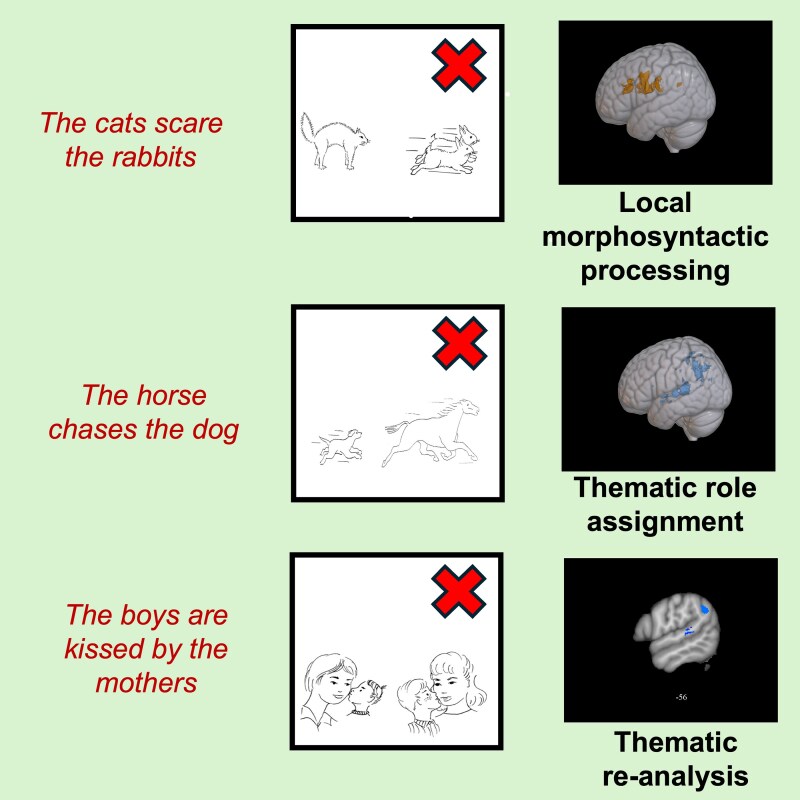
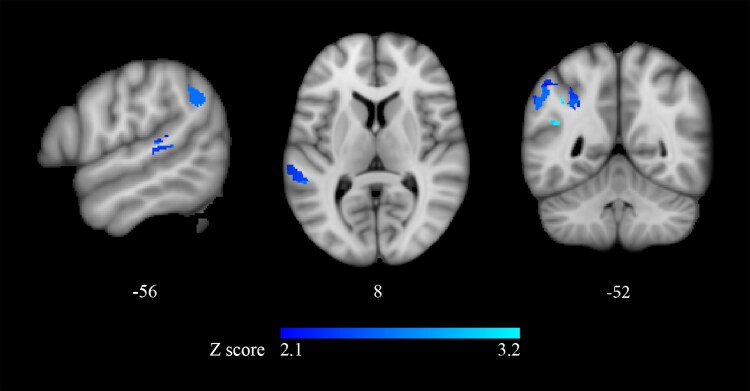
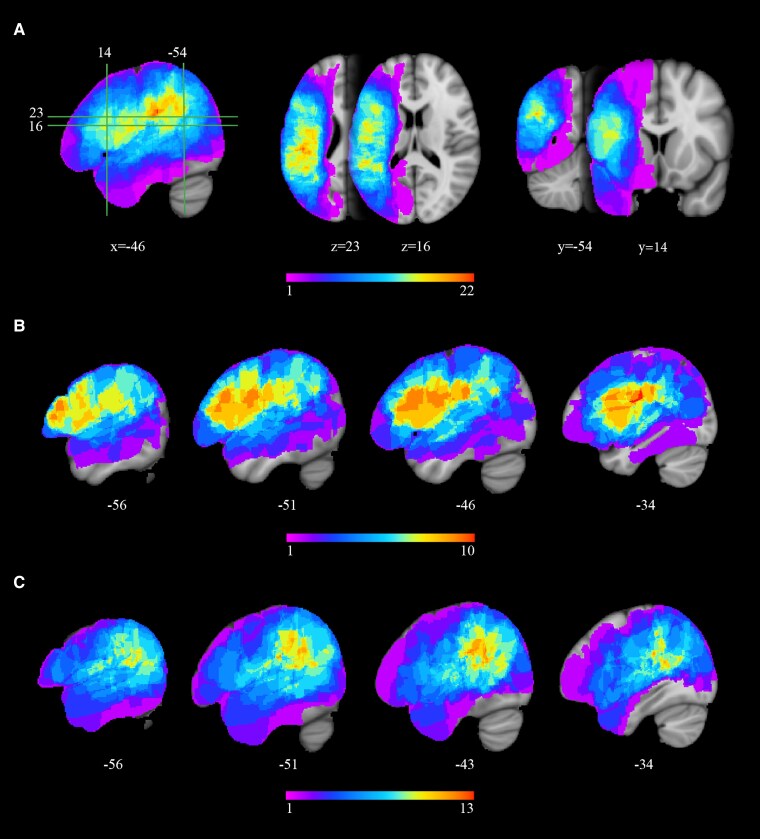
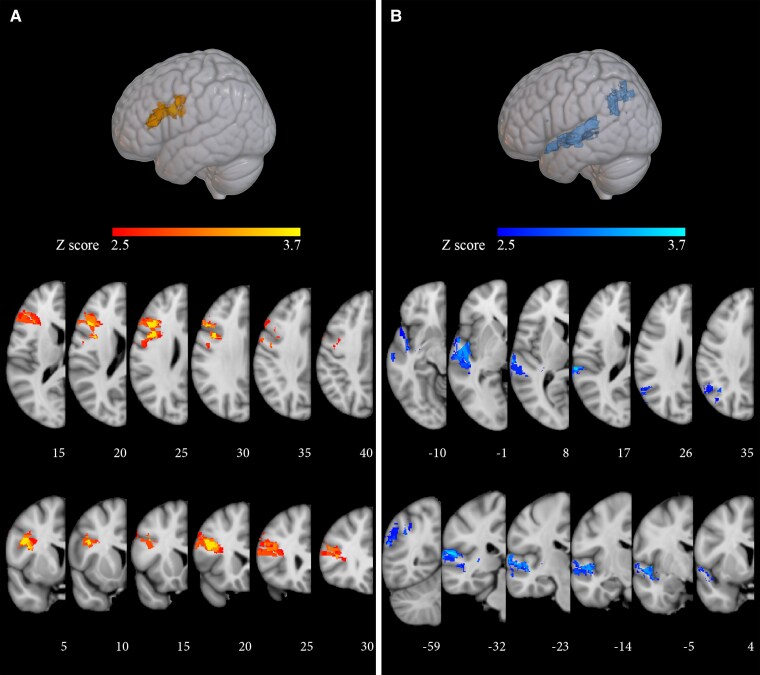
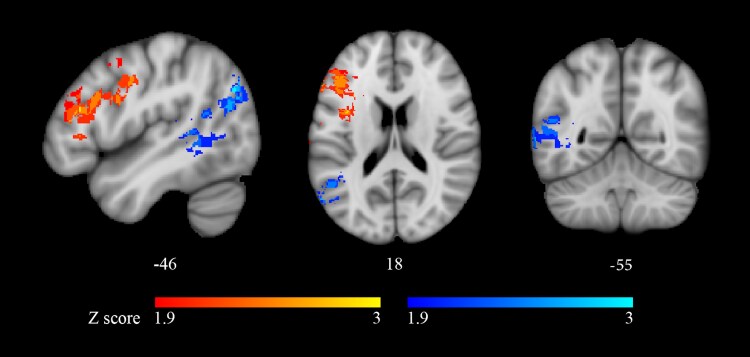
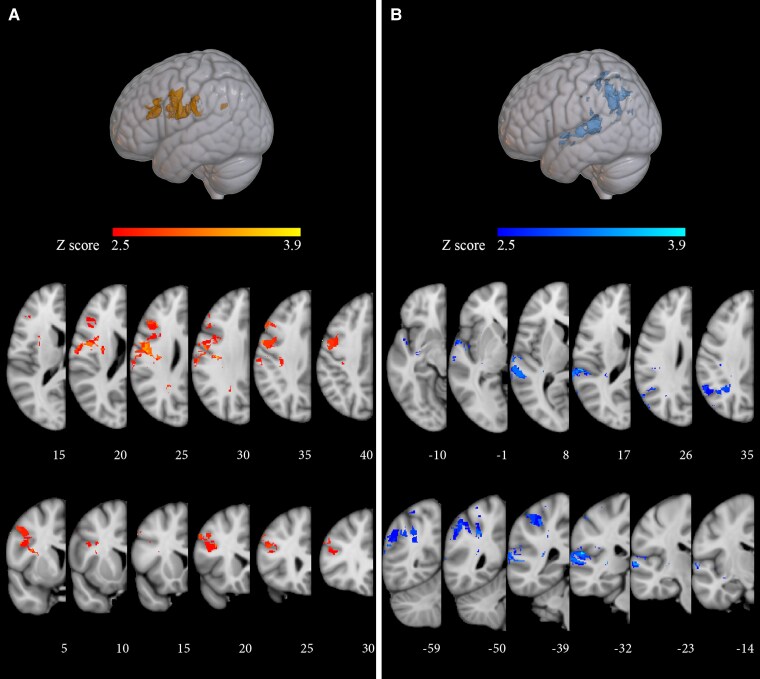
Functional neuroimaging studies in neurotypical subjects correlate sentence comprehension to a left fronto-temporo-parietal network. Recent voxel-based lesion-symptom mapping (VLSM) studies of aphasia confirm the link between sentence comprehension and a left posterior region including the angular gyrus, the supra-marginal gyrus and the postero-superior division of the temporal lobe but support left pre-frontal involvement inconsistently. However, these studies focus on thematic role assignment without considering morphosyntactic processes. Hence, available VLSM evidence could provide a partial view of the neurofunctional substrate of sentence comprehension. In the present VLSM study, both morphosyntactic and thematic processes were evaluated systematically and in the same sentence types in each participant, to provide a more detailed picture of the sentence comprehension network. Participants (33 patients with post-stroke aphasia and 90 healthy controls) completed a sentence-picture matching task in which active and passive, declarative reversible sentences were paired with morphosyntactic, thematic and lexical-semantic alternatives. Phonological short-term memory tasks were also administered. Aphasic participants were selected from an initial pool of 70 because they scored below norm on thematic foils ( = 18) or on thematic and morphological foils ( = 15), but within the norm on lexical-semantic foils. The neurofunctional correlates of morphosyntactic and thematic processes were starkly distinguishable. Pre-frontal areas including the inferior and middle frontal gyrus were involved directly in processing local morphosyntactic features and only indirectly in thematic processes. When these areas were damaged, morphosyntactic errors always co-occurred with thematic errors, probably because morphosyntactic damage disrupts the assignment of grammatical roles and ultimately that of thematic roles. Morphosyntactic errors were not influenced by word order canonicity. In contrast, selective thematic role reversals were linked to temporal and parietal damage and were significantly influenced by word order, occurring on passive more than on active sentences. An area including the angular and supra-marginal gyrus was critical for processing non-canonical word order. In sentence comprehension, pre-frontal regions are critical for processing local morphosyntactic features (at least in simple declarative sentences). Temporal and parietal regions are critical for thematic processes. Postero-superior temporal areas are involved in retrieving verb argument structure. Parietal areas are critical for assigning morphosyntactically analysed constituents to the appropriate thematic role, thus serving a crucial function in thematic re-analysis. Each area plays a prevailing but not exclusive role in these processes, interacting with other areas in the network and possibly providing both the language-specific and the domain-general resources needed at various stages of sentence comprehension.
针对神经典型受试者的功能性神经影像学研究,将句子理解与左侧额颞顶叶网络联系起来。近期关于失语症的基于体素的损伤-症状映射(VLSM)研究证实了句子理解与左侧后部区域之间的联系,该区域包括角回、缘上回以及颞叶后上部分,但对左侧前额叶的参与情况支持不一。然而,这些研究聚焦于题元角色分配,未考虑形态句法过程。因此,现有的VLSM证据可能仅提供了句子理解神经功能基质的部分观点。在本VLSM研究中,对每个参与者在相同句子类型中系统地评估了形态句法和题元过程,以更详细地描绘句子理解网络。参与者(33名中风后失语症患者和90名健康对照)完成了一项句子-图片匹配任务,其中主动和被动的陈述性可逆句子与形态句法、题元及词汇语义选项配对。还进行了语音短期记忆任务。失语症参与者从最初的70人中选出,因为他们在题元干扰项(n = 18)或题元与形态干扰项(n = 15)上得分低于正常水平,但在词汇语义干扰项上得分在正常范围内。形态句法和题元过程的神经功能相关性明显不同。包括额下回和额中回在内的前额叶区域直接参与处理局部形态句法特征,仅间接参与题元过程。当这些区域受损时,形态句法错误总是与题元错误同时出现,可能是因为形态句法损伤破坏了语法角色的分配,最终也破坏了题元角色的分配。形态句法错误不受词序规范性的影响。相比之下,选择性的题元角色反转与颞叶和顶叶损伤有关,并且受词序的显著影响,在被动句中比在主动句中更常出现。包括角回和缘上回的一个区域对于处理非规范词序至关重要。在句子理解中,前额叶区域对于处理局部形态句法特征至关重要(至少在简单陈述句中如此)。颞叶和顶叶区域对于题元过程至关重要。颞叶后上区域参与检索动词论元结构。顶叶区域对于将经过形态句法分析的成分分配到适当的题元角色至关重要,因此在题元重新分析中发挥关键作用。每个区域在这些过程中都发挥着主导但非排他性的作用,与网络中的其他区域相互作用,并可能在句子理解的各个阶段提供特定于语言和通用领域所需的资源。