Arizona State University.
University of Iowa.
J Cogn Neurosci. 2018 Feb;30(2):234-255. doi: 10.1162/jocn_a_01200. Epub 2017 Oct 24.
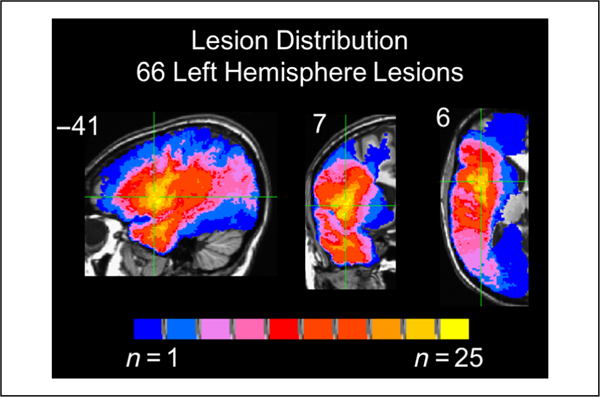
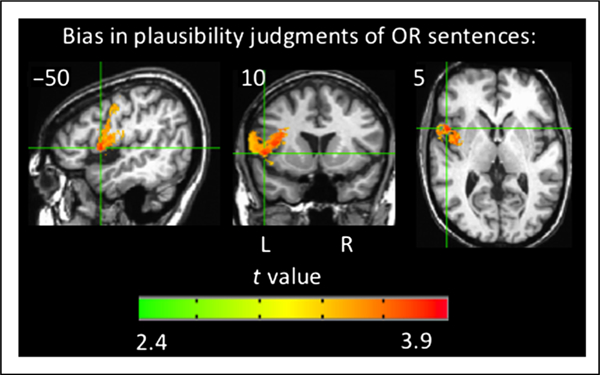
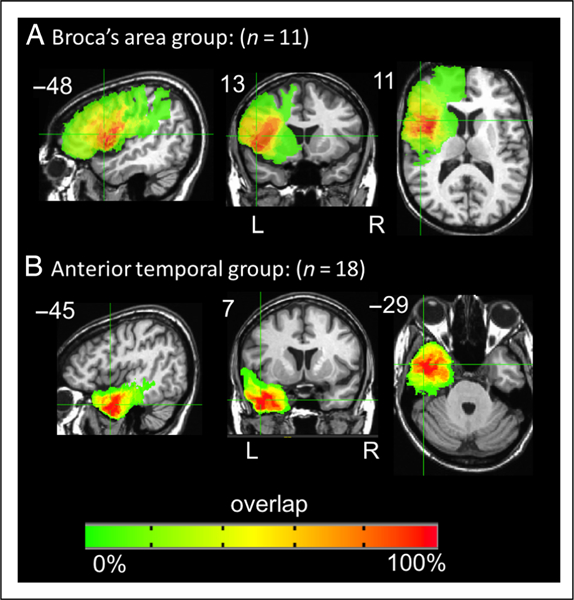
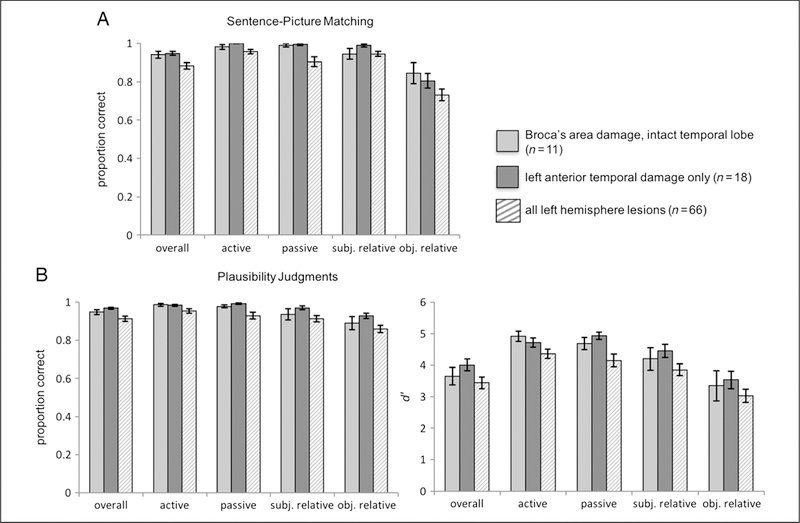
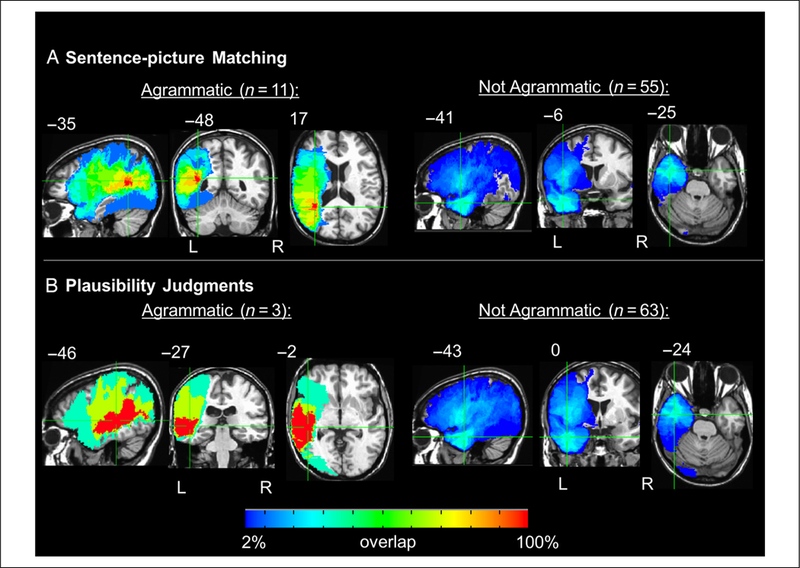
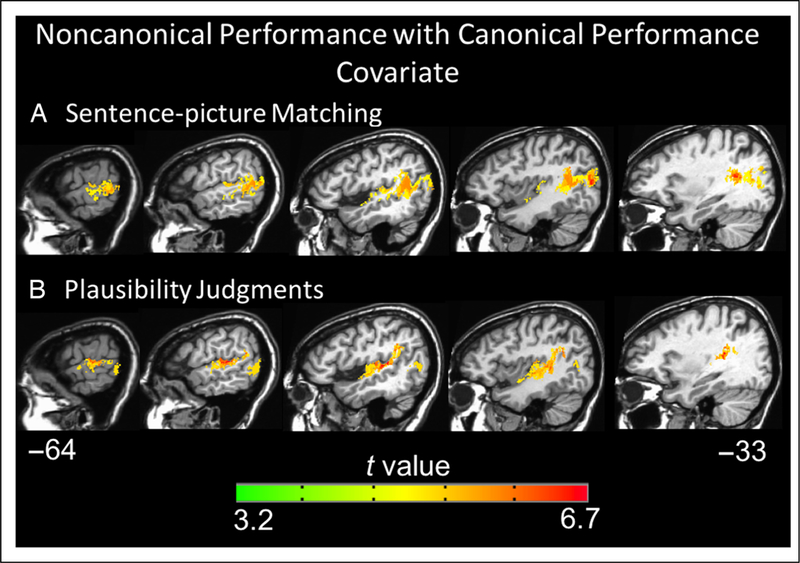
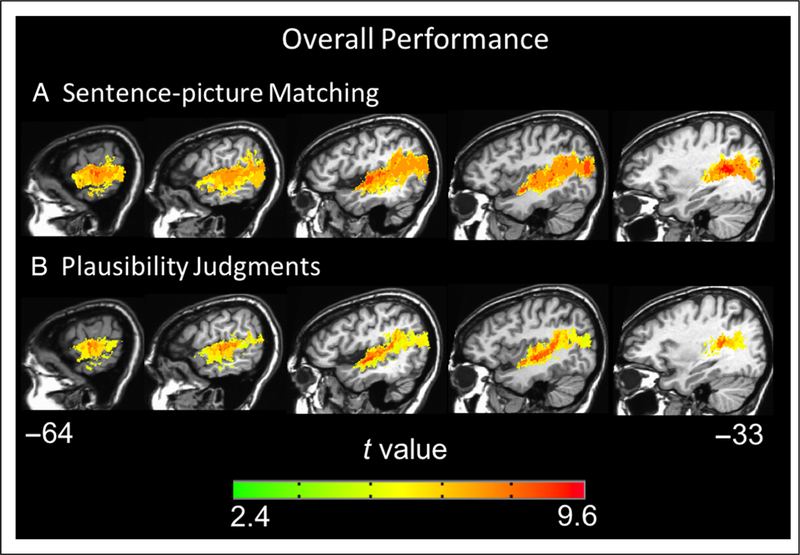
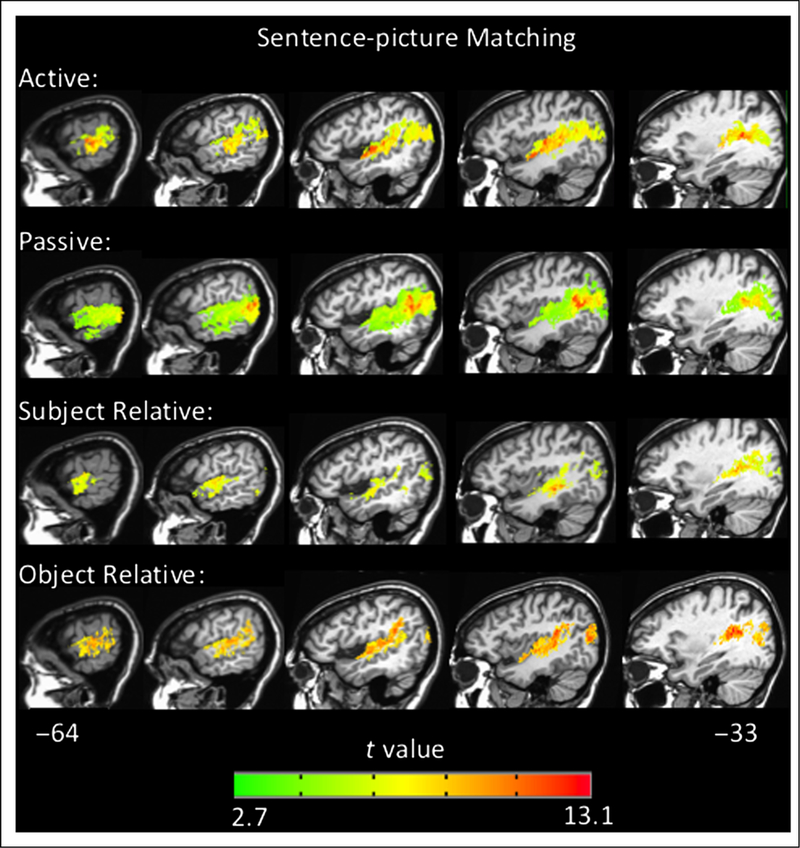
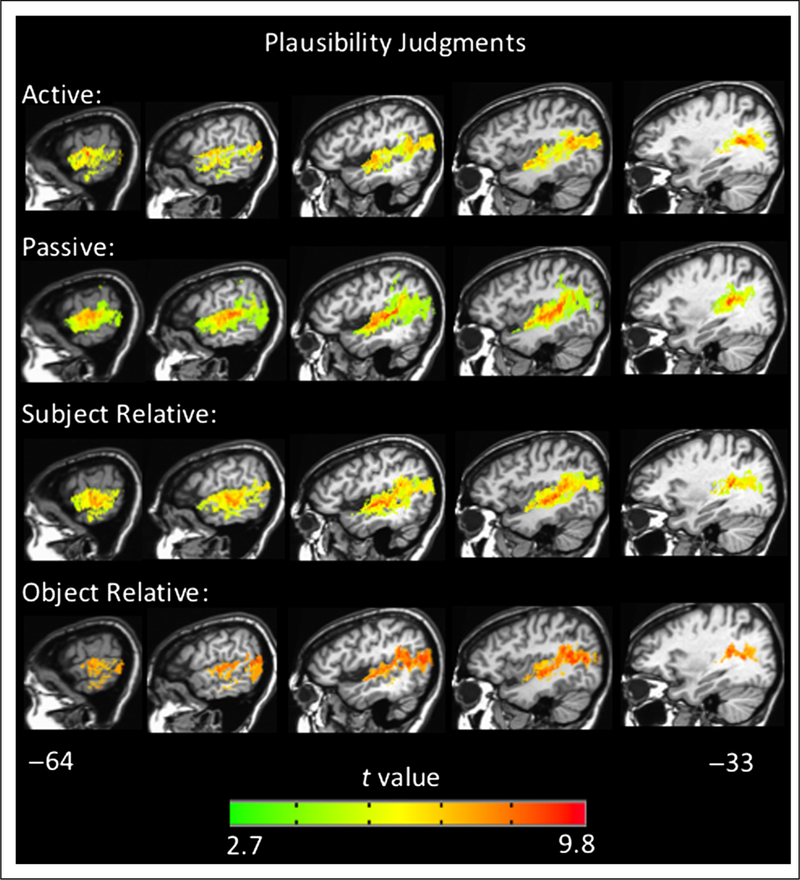
Broca's area has long been implicated in sentence comprehension. Damage to this region is thought to be the central source of "agrammatic comprehension" in which performance is substantially worse (and near chance) on sentences with noncanonical word orders compared with canonical word order sentences (in English). This claim is supported by functional neuroimaging studies demonstrating greater activation in Broca's area for noncanonical versus canonical sentences. However, functional neuroimaging studies also have frequently implicated the anterior temporal lobe (ATL) in sentence processing more broadly, and recent lesion-symptom mapping studies have implicated the ATL and mid temporal regions in agrammatic comprehension. This study investigates these seemingly conflicting findings in 66 left-hemisphere patients with chronic focal cerebral damage. Patients completed two sentence comprehension measures, sentence-picture matching and plausibility judgments. Patients with damage including Broca's area (but excluding the temporal lobe; n = 11) on average did not exhibit the expected agrammatic comprehension pattern-for example, their performance was >80% on noncanonical sentences in the sentence-picture matching task. Patients with ATL damage ( n = 18) also did not exhibit an agrammatic comprehension pattern. Across our entire patient sample, the lesions of patients with agrammatic comprehension patterns in either task had maximal overlap in posterior superior temporal and inferior parietal regions. Using voxel-based lesion-symptom mapping, we find that lower performances on canonical and noncanonical sentences in each task are both associated with damage to a large left superior temporal-inferior parietal network including portions of the ATL, but not Broca's area. Notably, however, response bias in plausibility judgments was significantly associated with damage to inferior frontal cortex, including gray and white matter in Broca's area, suggesting that the contribution of Broca's area to sentence comprehension may be related to task-related cognitive demands.
布罗卡区长期以来一直被认为与句子理解有关。该区域的损伤被认为是“语法理解”的主要来源,在这种情况下,与规范词序的句子相比,非规范词序的句子的表现(接近机会)要差得多(在英语中)。这一说法得到了功能神经影像学研究的支持,这些研究表明,非规范句子比规范句子在布罗卡区的激活程度更高。然而,功能神经影像学研究也经常将前颞叶(ATL)与更广泛的句子处理联系起来,最近的病变-症状映射研究也将 ATL 和中颞区与语法理解联系起来。这项研究调查了 66 名左半球慢性局灶性脑损伤患者的这些看似相互矛盾的发现。患者完成了两项句子理解测试,句子-图片匹配和合理性判断。包括布罗卡区在内的左半球损伤(但不包括颞叶;n = 11)的患者平均没有表现出预期的语法理解模式,例如,他们在句子-图片匹配任务中的非规范句子的表现>80%。ATL 损伤的患者(n = 18)也没有表现出语法理解模式。在我们所有的患者样本中,在两项任务中具有语法理解模式的患者的病变最大程度地重叠在后上颞叶和下顶叶区域。使用基于体素的病变-症状映射,我们发现,在每项任务中,规范句和非规范句的表现较低都与包括 ATL 在内的左颞上-下顶叶网络的损伤有关,但与布罗卡区无关。值得注意的是,然而,在合理性判断中的反应偏差与额下回的损伤显著相关,包括布罗卡区的灰质和白质,这表明布罗卡区对句子理解的贡献可能与任务相关的认知需求有关。