Charlesworth Carsten T, Homma Shota, Amaya Anais K, Dib Carla, Vaidyanathan Sriram, Tan Tze-Kai, Miyauchi Masashi, Nakauchi Yusuke, Suchy Fabian P, Wang Sicong, Igarashi Kyomi J, Cromer M Kyle, Dudek Amanda M, Amorin Alvaro, Czechowicz Agnieszka, Wilkinson Adam C, Nakauchi Hiromitsu
Institute for Stem Cell Biology and Regenerative Medicine, Stanford University School of Medicine, Lorry I. Lokey Stem Cell Research Building, 265 Campus Drive, Stanford, CA 94305, USA.
Department of Genetics, Stanford University School of Medicine, 279 Campus Drive, Stanford, CA 94305, USA.
Mol Ther Methods Clin Dev. 2025 Feb 21;33(1):101438. doi: 10.1016/j.omtm.2025.101438. eCollection 2025 Mar 13.
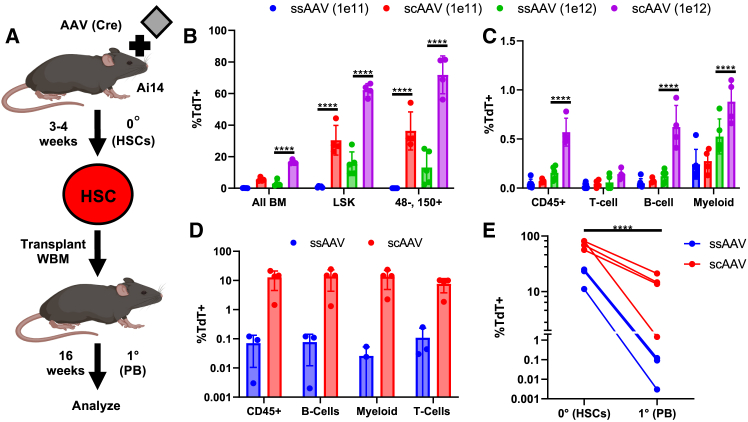
gene therapy targeting hematopoietic stem cells (HSCs) holds significant therapeutic potential for treating hematological diseases. This study uses adeno-associated virus serotype 6 (AAV6) vectors and Cre recombination to systematically optimize the parameters for effective HSC transduction. We evaluated various genetic architectures and delivery methods of AAV6, establishing an optimized protocol that achieved functional recombination in more than two-thirds of immunophenotypic HSCs. Our findings highlight that second-strand synthesis is a critical limiting factor for transgene expression in HSCs, leading to significant under-detection of HSC transduction with single-stranded AAV6 vectors. We also demonstrate that HSCs in the bone marrow (BM) are readily accessible to transduction, with neither localized injection nor mobilization of HSCs into the bloodstream, enhancing transduction efficacy. Additionally, we observed a surprising preference for HSC transduction over other BM cells, regardless of the AAV6 delivery route. Together, these findings not only underscore the potential of AAV vectors for HSC gene therapy but also lay a foundation that can inform the development of both AAV-based HSC gene therapies and potentially HSC gene therapies that employ alternative delivery modalities.
靶向造血干细胞(HSCs)的基因治疗在治疗血液疾病方面具有巨大的治疗潜力。本研究使用腺相关病毒6型(AAV6)载体和Cre重组来系统优化有效转导造血干细胞的参数。我们评估了AAV6的各种基因结构和递送方法,建立了一种优化方案,该方案在超过三分之二的免疫表型造血干细胞中实现了功能性重组。我们的研究结果表明,第二链合成是造血干细胞中转基因表达的关键限制因素,导致单链AAV6载体对造血干细胞转导的检测显著不足。我们还证明,骨髓(BM)中的造血干细胞易于转导,无需局部注射或动员造血干细胞进入血流,从而提高了转导效率。此外,我们观察到,无论AAV6的递送途径如何,与其他骨髓细胞相比,造血干细胞对转导具有惊人的偏好。总之,这些发现不仅强调了AAV载体在造血干细胞基因治疗中的潜力,也为基于AAV的造血干细胞基因治疗以及可能采用替代递送方式的造血干细胞基因治疗的发展奠定了基础。