Jeon Hyein, Wang Shuai, Song Junmin, Gill Harjot, Cheng Haiying
Department of Oncology, Albert Einstein College of Medicine, Bronx, NY, 10461, USA.
Department of Oncology, Montefiore Medical Center, Bronx, NY, 10461, USA.
Lung. 2025 Mar 25;203(1):53. doi: 10.1007/s00408-025-00801-x.
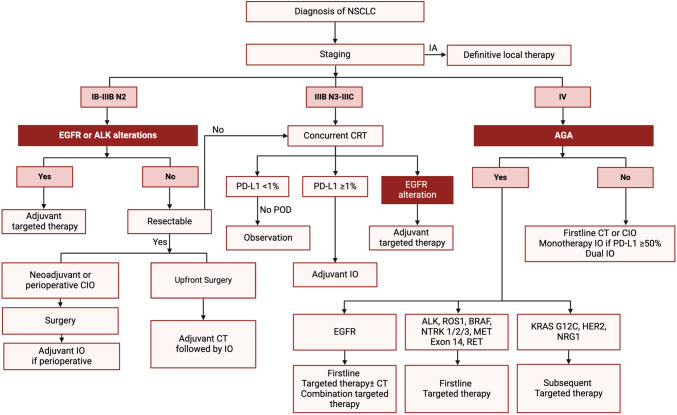
Lung cancer remains the leading cause of cancer-related mortality worldwide. Since 2024, the non-small-cell lung cancer (NSCLC) landscape has undergone a transformative shift, driven by 11 FDA approvals. Recent advances in molecular profiling, targeted therapies, and immunotherapies have revolutionized NSCLC management, ushering in an era of personalized treatment with improved patient outcomes. The increased adoption of low-dose computed tomography (LDCT) for screening has enhanced early detection, enabling intervention at more curable stages. Molecular diagnostics now play a pivotal role in guiding treatment strategies, with actionable genomic alterations (AGAs) informing the use of EGFR, ALK, ROS1, KRAS, NRG1, and other targeted inhibitors in both early and advanced settings. For instance, targeted therapies are increasingly being integrated into early-stage management, with adjuvant osimertinib for EGFR-mutated NSCLC and alectinib for ALK-positive NSCLC demonstrating substantial survival benefits. Immunotherapy, particularly immune checkpoint inhibitors, has become a cornerstone of treatment for AGA-negative NSCLC, either as monotherapy or in combination with chemotherapy, and is increasingly being utilized in the perioperative setting. Furthermore, emerging therapies such as bispecific antibodies, antibody-drug conjugates (ADCs), and novel immunotherapeutic agents show promise in addressing resistance mechanisms and improving outcomes in advanced-stage disease. Although new challenges arise, the evolving NSCLC treatment paradigm continues to prioritize precision medicine, offering hope for prolonged survival and enhanced quality of life for patients.
肺癌仍然是全球癌症相关死亡的主要原因。自2024年以来,在11项美国食品药品监督管理局(FDA)批准的推动下,非小细胞肺癌(NSCLC)领域发生了变革性转变。分子谱分析、靶向治疗和免疫治疗方面的最新进展彻底改变了NSCLC的治疗方式,迎来了一个个性化治疗的时代,患者预后得到改善。低剂量计算机断层扫描(LDCT)在筛查中的应用增加,提高了早期检测率,能够在更可治愈的阶段进行干预。分子诊断现在在指导治疗策略方面发挥着关键作用,可操作的基因组改变(AGAs)为早期和晚期环境中使用表皮生长因子受体(EGFR)、间变性淋巴瘤激酶(ALK)、ROS1、KRAS、神经调节蛋白1(NRG1)和其他靶向抑制剂提供了依据。例如,靶向治疗越来越多地被纳入早期治疗管理,用于EGFR突变NSCLC的辅助奥希替尼和用于ALK阳性NSCLC的阿来替尼显示出显著的生存益处。免疫治疗,特别是免疫检查点抑制剂,已成为AGA阴性NSCLC治疗的基石,无论是作为单一疗法还是与化疗联合使用,并且越来越多地用于围手术期。此外,双特异性抗体、抗体药物偶联物(ADCs)和新型免疫治疗药物等新兴疗法在解决耐药机制和改善晚期疾病预后方面显示出前景。尽管出现了新的挑战,但不断发展的NSCLC治疗模式继续将精准医学作为优先事项,为患者延长生存期和提高生活质量带来了希望。