Griswold Anthony J, Rajabli Farid, Gu Tianjie, Arvizu Jamie, Golightly Charles G, Whitehead Patrice L, Hamilton-Nelson Kara L, Adams Larry D, Sanchez Jose J, Mena Pedro R, Starks Takiyah D, Illanes-Manrique Maryenela, Silva Concepcion, Bush William S, Cuccaro Michael L, Vance Jeffery M, Cornejo-Olivas Mario R, Feliciano-Astacio Briseida E, Byrd Goldie S, Beecham Gary W, Haines Jonathan L, Pericak-Vance Margaret A
John P. Hussman Institute for Human Genomics, University of Miami, Miami, Florida, USA.
Dr. John T Macdonald Foundation Department of Human Genetics, University of Miami, Miami, Florida, USA.
Alzheimers Dement. 2025 Mar;21(3):e14367. doi: 10.1002/alz.14367.
Plasma phosphorylated threonine 181 of tau (pTau181) and amyloid beta (Aβ) are biomarkers for differential diagnosis and preclinical detection of Alzheimer disease (AD). Given differences in AD risk across diverse populations, the generalizability of existing biomarker data is not assured.
In 2086 individuals of diverse genetic ancestries (African American, Caribbean Hispanic, and Peruvian), we measured plasma pTau181 and Aβ42/Aβ40. Differences in biomarkers between cohorts and clinical diagnosis groups and the potential discriminative performance of the two biomarkers were assessed.
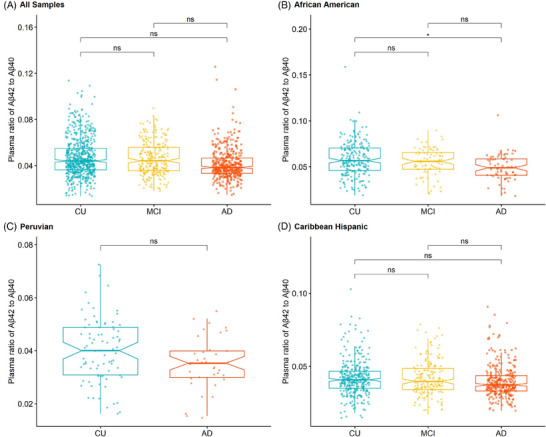
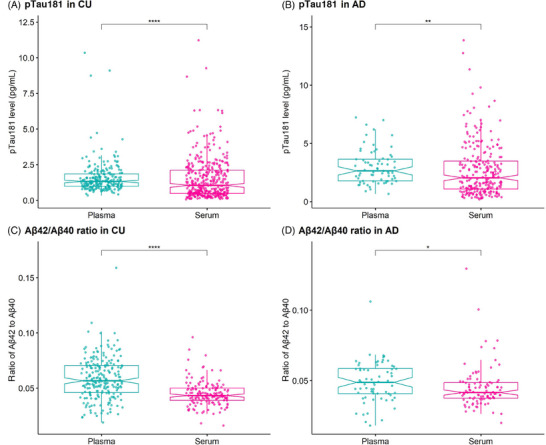
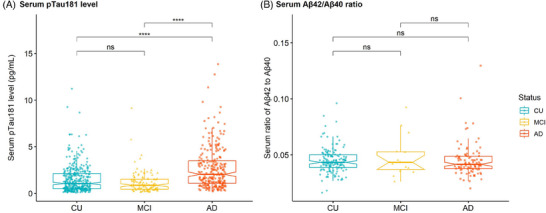
pTau181 and Aβ42/Aβ40 were consistent across cohorts. Higher levels of pTau181 were associated with AD, while Aβ42/Aβ40 had minimal differences. Correspondingly, pTau181 had a greater predictive value than Aβ42/Aβ40; however, the area under the curve differed between cohorts.
pTau181 as a plasma biomarker for clinical AD is generalizable across genetic ancestries, but its predictive value may vary. Combining genomic and biomarker data from diverse individuals will increase understanding of genetic risk and refine clinical diagnoses.
This is a diverse ancestry study of plasma biomarkers for AD. Plasma biomarkers were assessed in African Americans, Caribbean Hispanics, and Peruvians. Biomarker levels were consistent across the diverse cohorts. Plasma phosphorylated tau was higher in AD in all cohorts. Plasma biomarker findings in diverse cohorts largely generalize with existing European studies.
血浆中tau蛋白的磷酸化苏氨酸181(pTau181)和淀粉样β蛋白(Aβ)是用于阿尔茨海默病(AD)鉴别诊断和临床前检测的生物标志物。鉴于不同人群患AD的风险存在差异,现有生物标志物数据的可推广性尚无定论。
我们对2086名具有不同遗传血统的个体(非裔美国人、加勒比西班牙裔和秘鲁人)进行了血浆pTau181和Aβ42/Aβ40的检测。评估了不同队列和临床诊断组之间生物标志物的差异以及这两种生物标志物的潜在判别性能。
pTau181和Aβ42/Aβ40在各队列中表现一致。pTau181水平升高与AD相关,而Aβ42/Aβ40差异极小。相应地,pTau181的预测价值高于Aβ42/Aβ40;然而,曲线下面积在不同队列间有所不同。
pTau181作为临床AD的血浆生物标志物在不同遗传血统中具有可推广性,但其预测价值可能存在差异。整合来自不同个体的基因组和生物标志物数据将增进对遗传风险的理解并优化临床诊断。
这是一项关于AD血浆生物标志物的不同血统研究。在非裔美国人、加勒比西班牙裔和秘鲁人中评估了血浆生物标志物。生物标志物水平在不同队列中保持一致。所有队列中AD患者的血浆磷酸化tau水平更高。不同队列中的血浆生物标志物研究结果在很大程度上与现有的欧洲研究结果具有一致性。