Choaji Mathew, Samba-Louaka Ascel, Fechtali-Moute Zineb, Aucher Willy, Pomel Sébastien
Université Paris-Saclay, CNRS BioCIS, 91400 Orsay, France.
Université de Poitiers, UMR CNRS 7267, Laboratoire Ecologie et Biologie des Interactions, 86000 Poitiers, France.
Pathogens. 2025 Mar 10;14(3):268. doi: 10.3390/pathogens14030268.
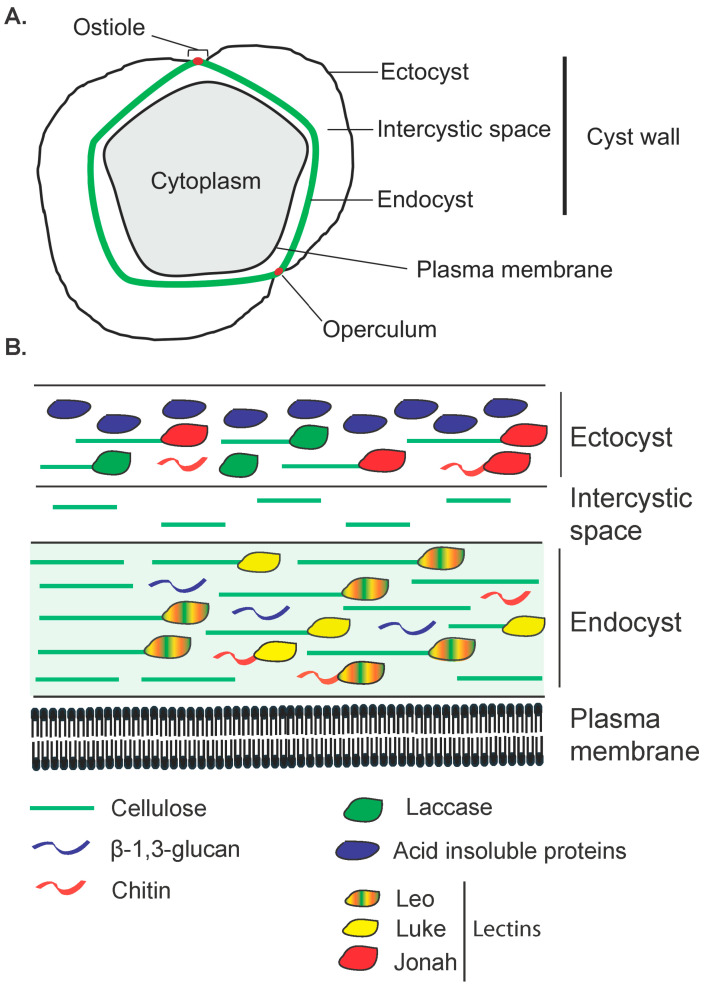
The free-living amoeba is a unicellular eukaryote distributed in a wide range of soil or aquatic environments, either natural or human-made, such as rivers, lakes, drinking water, or swimming pools. Besides its capacity to transport potential pathogens, such as bacteria or viruses, spp. can have intrinsic pathogenic properties by causing severe infections at the ocular and cerebral level, named granulomatous amoebic encephalitis and amoebic keratitis, respectively. During its life cycle, alternates between a vegetative and mobile form, named the trophozoite, and a resistant, latent, and non-mobile form, named the cyst. The cyst wall of is double-layered, with an inner endocyst and an outer ectocyst, and is mainly composed of cellulose and proteins. The resistance of cysts to many environmental stresses and disinfection treatments has been assigned to the presence of cellulose. The current review aims to present the importance of this glycopolymer in cysts and to further report the pathways involved in encystment and excystment.
自由生活阿米巴是一种单细胞真核生物,分布于广泛的自然或人为土壤或水生环境中,如河流、湖泊、饮用水或游泳池。除了具有运输潜在病原体(如细菌或病毒)的能力外,某些种类的自由生活阿米巴还可能具有内在致病性,分别在眼部和脑部引起严重感染,即肉芽肿性阿米巴脑炎和阿米巴角膜炎。在其生命周期中,自由生活阿米巴在营养性、可移动的滋养体形式和抗性、潜伏性、不可移动的包囊形式之间交替。自由生活阿米巴的包囊壁是双层的,有内层的内膜和外层的外膜,主要由纤维素和蛋白质组成。包囊对许多环境压力和消毒处理的抗性归因于纤维素的存在。本综述旨在阐述这种糖聚合物在自由生活阿米巴包囊中的重要性,并进一步报告包囊形成和脱囊过程中涉及的途径。