Kim Min-Jeong, Jo Hye-Jeong, Quan Fu-Shi, Chu Ki Back, Kong Hyun-Hee, Moon Eun-Kyung
Department of Biomedical Science, Graduate School, Kyung Hee University, Seoul 02447, Korea; 2Department of Medical Zoology, Kyung Hee University School of Medicine, Seoul 02447, Korea.
Department of Medical Zoology, Kyung Hee University School of Medicine, Seoul 02447, Korea.
Parasites Hosts Dis. 2024 Nov;62(4):399-407. doi: 10.3347/PHD.24062. Epub 2024 Nov 22.
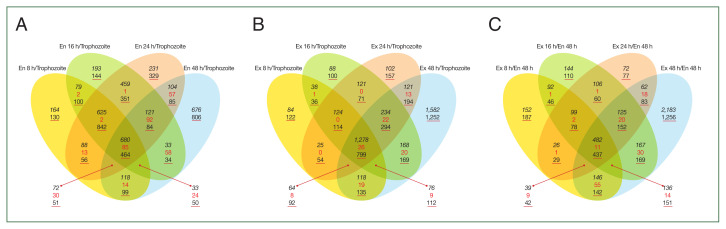
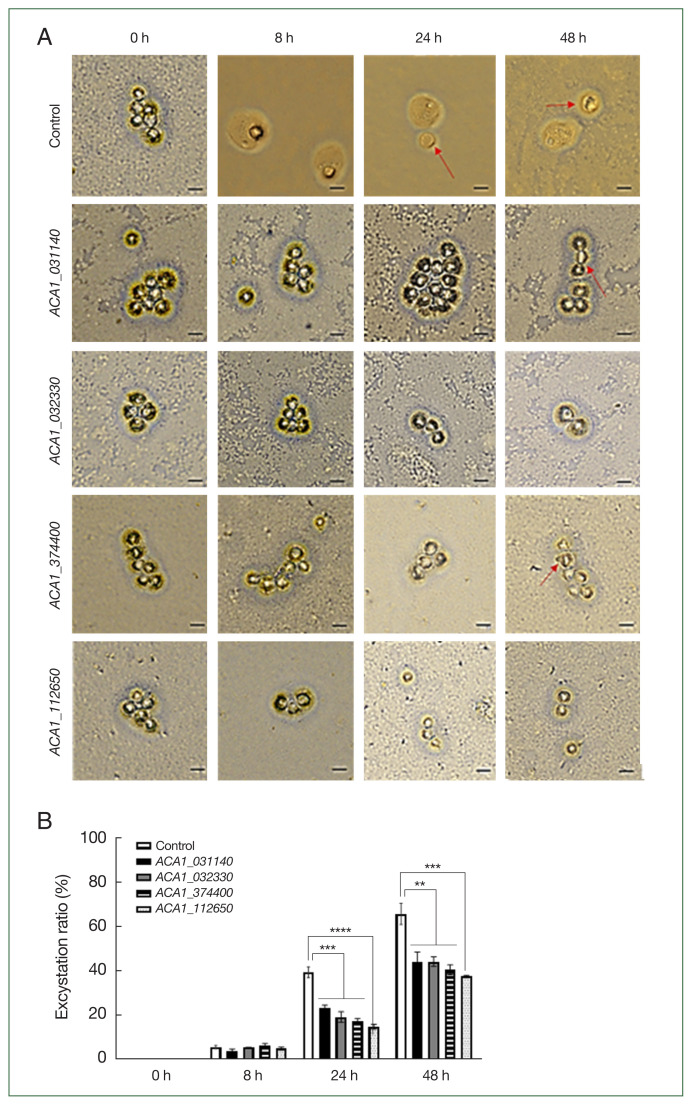
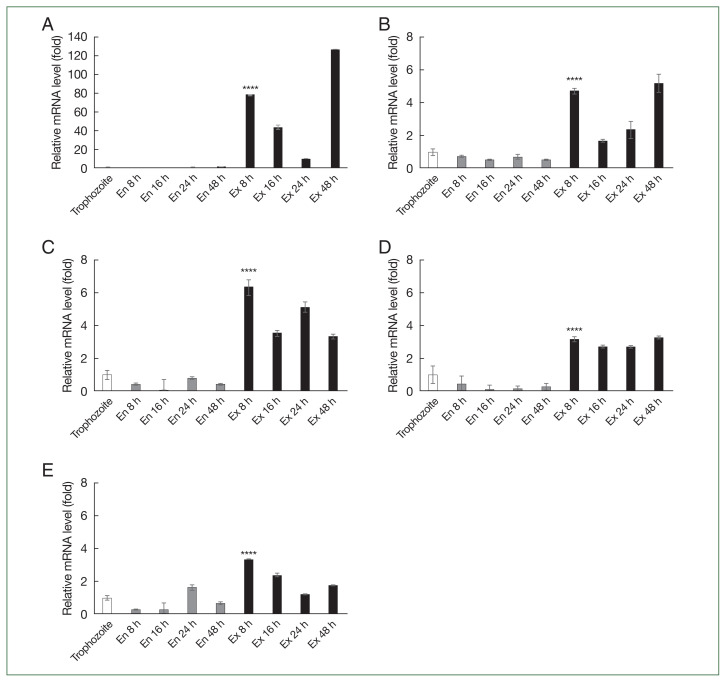
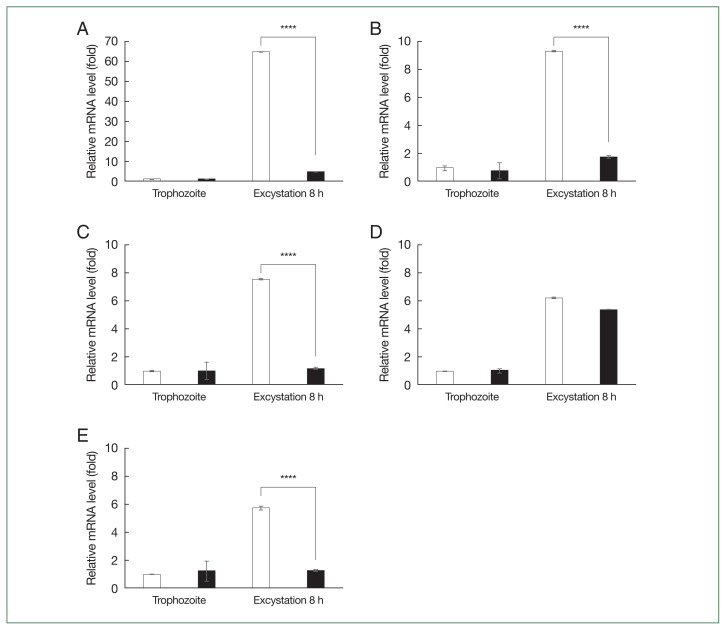
Acanthamoeba is an opportunistic pathogen that causes Acanthamoeba keratitis, granulomatous amoebic encephalitis, and other cutaneous diseases. The life cycle of Acanthamoeba consists of 2 stages of trophozoites and cysts. Under adverse environmental conditions, Acanthamoeba encysts, while the conditions become favorable for growth, it reverts to the trophozoite form. Acanthamoeba excystation is crucial for its proliferation and can lead to recurrent infections after incomplete treatment. To identify the factors involved in excystation, A. castellanii was subjected to either encystation- or excystation-inducing conditions, and gene expression profiles were compared using mRNA sequencing. A. castellanii samples were collected at 8 h intervals for analysis under both conditions. Differentially expressed gene analysis revealed that 1,214 and 1,163 genes were upregulated and downregulated, respectively, by more than 2-fold during early excystation. Five genes markedly upregulated in early excystation (ACA1_031140, ACA1_032330, ACA1_374400, ACA1_275740, and ACA1_112650) were selected, and their expression levels were confirmed via real-time PCR. Small interfering RNA (siRNA) targeting these 5 genes was transfected into Acanthamoeba and gene knockdown was validated through real-time PCR. The silencing of ACA1_031140, ACA1_032330, ACA1_374400, and ACA1_112650 inhibited excystation and suggested that these genes might be essential for excystation. Our findings provide valuable insights for suppressing Acanthamoeba proliferation and recurrence.
棘阿米巴是一种机会性病原体,可引起棘阿米巴角膜炎、肉芽肿性阿米巴脑炎和其他皮肤疾病。棘阿米巴的生命周期包括滋养体和包囊两个阶段。在不利的环境条件下,棘阿米巴形成包囊,而当条件有利于生长时,它又恢复为滋养体形式。棘阿米巴脱囊对其增殖至关重要,并且在治疗不彻底时可导致反复感染。为了确定参与脱囊的因素,将卡氏棘阿米巴置于诱导包囊或脱囊的条件下,并使用mRNA测序比较基因表达谱。在这两种条件下,每隔8小时收集一次卡氏棘阿米巴样本进行分析。差异表达基因分析显示,在早期脱囊过程中,分别有1214个和1163个基因上调和下调超过2倍。选择了在早期脱囊中显著上调的5个基因(ACA1_031140、ACA1_032330、ACA1_374400、ACA1_275740和ACA1_112650),并通过实时PCR确认它们的表达水平。将靶向这5个基因的小干扰RNA(siRNA)转染到棘阿米巴中,并通过实时PCR验证基因敲低。ACA1_031140、ACA1_032330、ACA1_374400和ACA1_112650的沉默抑制了脱囊,表明这些基因可能对脱囊至关重要。我们的研究结果为抑制棘阿米巴的增殖和复发提供了有价值的见解。