Reynolds B, Minahan C
South College School of Physical Therapy, 400 Goody's Lane, Suite 101, Knoxville, TN USA.
Med Sci Educ. 2024 Nov 15;35(1):437-446. doi: 10.1007/s40670-024-02215-5. eCollection 2025 Feb.
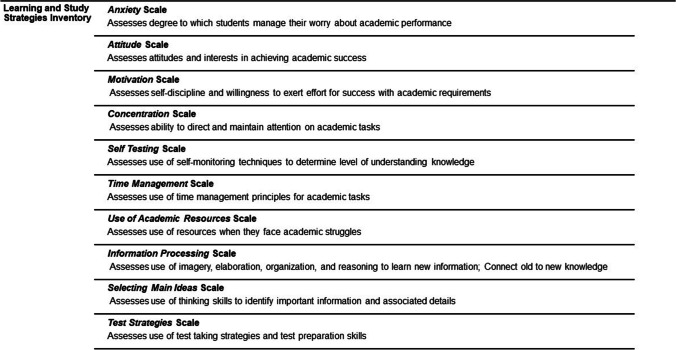
The Learning and Study Strategies Inventory (LASSI) is a self-assessment of strategic learning principles with scores representing areas for growth. The purpose of this study was to measure LASSI scores at 2 points in time for Doctor of Physical Therapy (DPT) students in a 2-year hybrid program to see if scores changed after a science of learning course and two quarters of the program. The authors then examined the relationship between LASSI scores and academic scores (DPT program GPA, anatomy, and physiology grades).
Retrospective descriptive analysis of LASSI scores with comparisons between baseline and after a science of learning course and two quarters of the program using a paired -test; bivariate correlations examined the relationship of LASSI scores to academic scores.
Data was collected for 259 matriculated DPT students. Three of the 10 LASSI scales had significant change after the science of learning course and two quarters of the program; however, the effect sizes were small (0.2 or less). Anxiety management ((258) = 2.340, = .020) scores improved, while both concentrations ((258) = - 3.229, = .001) and the use of academic resources ((258) = - 1.999, = .047) had lower scores. There were several LASSI scores with significant correlations to academic scores ( = .132 to .431).
DISCUSSION/CONCLUSION: LASSI was related to academic scores, although the strength of the relationship was low to negligible. LASSI showed small changes over time. There could be various reasons for scores improving or declining, but the awareness of scores and change in scores can provide a solid foundation for individualized coaching to DPT students as they navigate the rigor of a graduate level professional program.
The online version contains supplementary material available at 10.1007/s40670-024-02215-5.
学习与学习策略量表(LASSI)是对策略性学习原则的自我评估,其分数代表了有待提高的方面。本研究的目的是对参加两年混合课程的物理治疗博士(DPT)学生在两个时间点的LASSI分数进行测量,以了解在学习科学课程和课程的两个学季后分数是否发生变化。作者随后研究了LASSI分数与学业成绩(DPT课程平均绩点、解剖学和生理学成绩)之间的关系。
对LASSI分数进行回顾性描述分析,使用配对t检验比较基线、学习科学课程后以及课程的两个学季后的情况;双变量相关性分析研究了LASSI分数与学业成绩之间的关系。
收集了259名入学DPT学生的数据。在学习科学课程和课程的两个学季后,10个LASSI量表中有3个有显著变化;然而,效应量很小(0.2或更小)。焦虑管理(t(258)=2.340,p=0.020)分数有所提高,而注意力(t(258)= -3.229,p=0.001)和学术资源利用(t(258)= -1.999,p=0.047)的分数较低。有几个LASSI分数与学业成绩有显著相关性(r=0.132至0.431)。
讨论/结论:LASSI与学业成绩相关,尽管这种关系的强度较低至可忽略不计。LASSI随时间显示出微小变化。分数提高或下降可能有多种原因,但分数意识和分数变化可为DPT学生在应对研究生水平专业课程的严格要求时提供个性化辅导奠定坚实基础。
在线版本包含可在10.1007/s40670-024-02215-5获取的补充材料。