
通过结合眼动追踪的多模态认知评估和卷积神经网络分析增强轻度认知障碍辅助识别
Enhancing Mild Cognitive Impairment Auxiliary Identification Through Multimodal Cognitive Assessment with Eye Tracking and Convolutional Neural Network Analysis.
作者信息
Li Na, Wang Ziming, Ren Wen, Zheng Hong, Liu Shuai, Zhou Yi, Ju Kang, Chen Zhongting
机构信息
Shanghai Changning Mental Health Center, Affiliated Mental Health Center of East China Normal University, Shanghai 200335, China.
Psychology and Cognitive Science, East China Normal University, Shanghai 200062, China.
出版信息
Biomedicines. 2025 Mar 18;13(3):738. doi: 10.3390/biomedicines13030738.
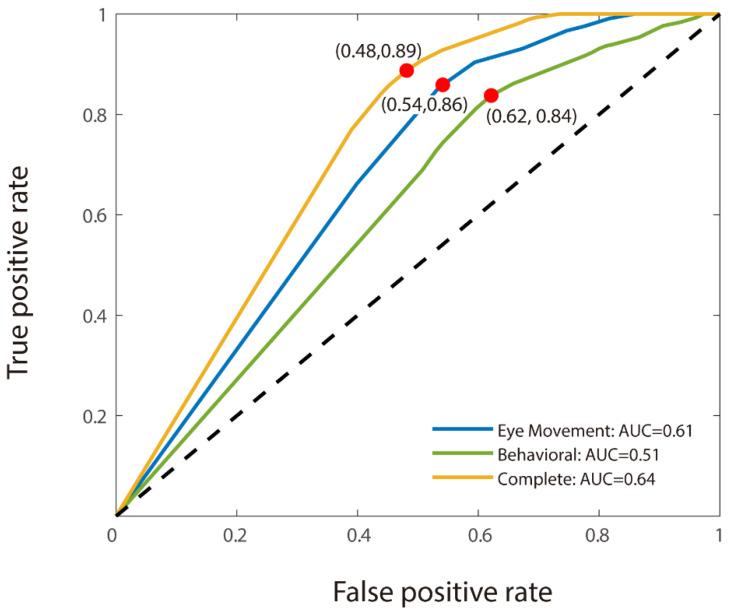
: Mild Cognitive Impairment (MCI) is a critical transitional phase between normal aging and dementia, and early detection is essential to mitigate cognitive decline. Traditional cognitive assessment tools, such as the Mini-Mental State Examination (MMSE) and the Montreal Cognitive Assessment (MoCA), exhibit limitations in feasibility, which potentially and partially affects results for early-stage MCI detection. This study developed and tested a supportive cognitive assessment system for MCI auxiliary identification, leveraging eye-tracking features and convolutional neural network (CNN) analysis. : The system employed eye-tracking technology in conjunction with machine learning to build a multimodal auxiliary identification model. Four eye movement tasks and two cognitive tests were administered to 128 participants (40 MCI patients, 57 elderly controls, 31 young adults as reference). We extracted 31 eye movement and 8 behavioral features to assess their contributions to classification accuracy using CNN analysis. Eye movement features only, behavioral features only, and combined features models were developed and tested respectively, to find out the most effective approach for MCI auxiliary identification. : Overall, the combined features model achieved a higher discrimination accuracy than models with single feature sets alone. Specifically, the model's ability to differentiate MCI from healthy individuals, including young adults, reached an average accuracy of 74.62%. For distinguishing MCI from elderly controls, the model's accuracy averaged 66.50%. : Results show that a multimodal model significantly outperforms single-feature models in identifying MCI, highlighting the potential of eye-tracking for early detection. These findings suggest that integrating multimodal data can enhance the effectiveness of MCI auxiliary identification, providing a novel potential pathway for community-based early detection efforts.
轻度认知障碍(MCI)是正常衰老与痴呆之间的关键过渡阶段,早期检测对于减轻认知衰退至关重要。传统的认知评估工具,如简易精神状态检查表(MMSE)和蒙特利尔认知评估量表(MoCA),在可行性方面存在局限性,这可能会部分影响早期MCI检测的结果。本研究利用眼动追踪特征和卷积神经网络(CNN)分析,开发并测试了一种用于MCI辅助识别的支持性认知评估系统。
该系统结合眼动追踪技术和机器学习构建了一个多模态辅助识别模型。对128名参与者(40名MCI患者、57名老年对照者、31名年轻人作为参照)进行了四项眼动任务和两项认知测试。我们提取了31个眼动特征和8个行为特征,以使用CNN分析评估它们对分类准确性的贡献。分别开发并测试了仅眼动特征模型、仅行为特征模型和组合特征模型,以找出MCI辅助识别的最有效方法。
总体而言,组合特征模型的判别准确率高于仅使用单一特征集的模型。具体来说,该模型区分MCI与健康个体(包括年轻人)的能力平均准确率达到74.62%。对于区分MCI与老年对照者,该模型的准确率平均为66.50%。
结果表明,在识别MCI方面,多模态模型明显优于单特征模型,凸显了眼动追踪在早期检测中的潜力。这些发现表明,整合多模态数据可以提高MCI辅助识别的有效性,为基于社区的早期检测工作提供了一条新的潜在途径。


 Zotero 插件