Hughes Mark, Russell Mark D, Roy Ritika, Mehta Daksh, Norton Sam, Atzeni Fabiola, Galloway James B
Centre for Rheumatic Diseases, King's College London, London, UK.
Psychology Department, Insitute of Psychiatry, King's College London, London, UK.
BMJ Open. 2025 Mar 29;15(3):e090301. doi: 10.1136/bmjopen-2024-090301.
To describe temporal trends in hospitalisation episodes for venous thromboembolic events (VTEs) in England, and compare hospitalisation rates for pulmonary emboli (PEs) and deep vein thrombosis (DVT).
Retrospective observational study.
Secondary care in England, UK, between April 1998 and March 2022.
Individuals with hospitalisations for VTE recorded in the NHS Digital Hospital Episode Statistics dataset.
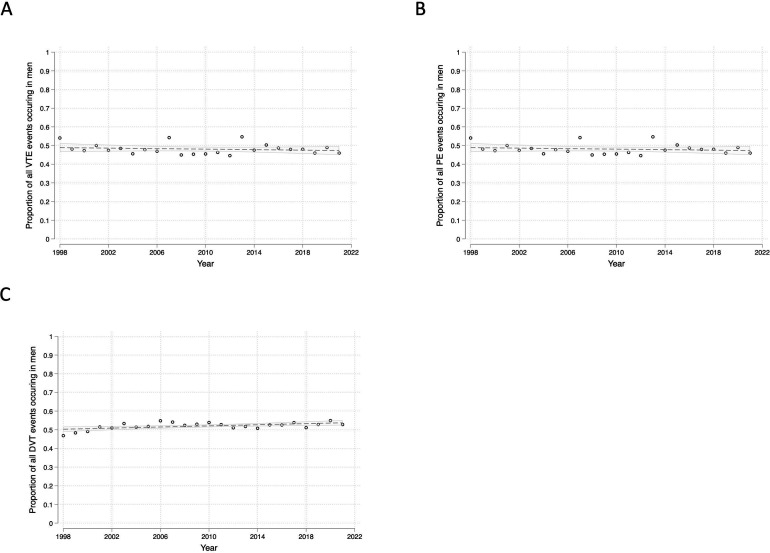
The primary outcome was temporal trends in hospitalisation episodes for PE, DVT and VTE overall between 1 April 1998 and 31 March 2022. Secondary outcomes included the proportion of all-cause hospital admissions that were due to VTE; the proportion of all VTE hospitalisations that were recorded as primary admission diagnoses; the male/female split in hospitalisation episodes for VTE; and temporal changes in hospitalisation rates by age.
Between 1998 and 2022, hospitalisations for VTE increased by 62.6%, from 109.5 to 178.1 per 100 000 population. This was driven by a 202% increase in hospitalisations for PE (from 40.4 to 122.2 per 100 000 population). In contrast, hospitalisations for DVT decreased by 19.1% over this period (from 69.1 to 55.9 per 100 000 population). Overall, VTE remained stable as a proportion of all-cause hospital admissions between 1998/1999 and 2019/2020 (0.45% and 0.43%, respectively), before increasing after the onset of the COVID-19 pandemic in England (0.59% in 2020/2021 and 0.51% in 2021/2022).
Hospitalisations for VTE increased markedly in England between 1998 and 2022, driven by large increases in hospitalisations for PE. In contrast, hospitalisations for DVT decreased overall, which may reflect the success of primary care DVT management pathways. Our findings suggest that preventative measures are needed to reduce the incidence of hospitalisations for PE.
描述英格兰静脉血栓栓塞事件(VTE)住院病例的时间趋势,并比较肺栓塞(PE)和深静脉血栓形成(DVT)的住院率。
回顾性观察研究。
1998年4月至2022年3月期间英国英格兰的二级医疗保健。
在英国国家医疗服务体系数字医院事件统计数据集中记录的因VTE住院的个体。
主要结果是1998年4月1日至2022年3月31日期间PE、DVT和总体VTE住院病例的时间趋势。次要结果包括因VTE导致的全因住院比例;记录为主要入院诊断的所有VTE住院病例的比例;VTE住院病例中的男女比例;以及按年龄划分的住院率的时间变化。
在1998年至2022年期间,VTE住院病例增加了62.6%,从每10万人口109.5例增至178.1例。这是由PE住院病例增加202%(从每10万人口40.4例增至122.2例)推动的。相比之下,在此期间DVT住院病例减少了19.1%(从每10万人口69.1例降至55.9例)。总体而言,在1998/1999年至2019/2020年期间,VTE占全因住院病例的比例保持稳定(分别为0.45%和0.43%),在英格兰新冠疫情爆发后有所上升(2020/2021年为0.59%,2021/2022年为0.51%)。
1998年至2022年期间,英格兰VTE住院病例显著增加,主要是由PE住院病例大幅增加所致。相比之下,DVT住院病例总体减少,这可能反映了初级保健DVT管理途径的成功。我们的研究结果表明,需要采取预防措施以降低PE住院病例的发生率。