Luo Audrey C, Meisler Steven L, Sydnor Valerie J, Alexander-Bloch Aaron, Bagautdinova Joëlle, Barch Deanna M, Bassett Dani S, Davatzikos Christos, Franco Alexandre R, Goldsmith Jeff, Gur Raquel E, Gur Ruben C, Hu Fengling, Jaskir Marc, Kiar Gregory, Keller Arielle S, Larsen Bart, Mackey Allyson P, Milham Michael P, Roalf David R, Shafiei Golia, Shinohara Russell T, Somerville Leah H, Weinstein Sarah M, Yeatman Jason D, Cieslak Matthew, Rokem Ariel, Satterthwaite Theodore D
Penn Lifespan Informatics and Neuroimaging Center (PennLINC), Department of Psychiatry, Perelman School of Medicine, University of Pennsylvania, Philadelphia, PA, USA.
Department of Psychiatry, Perelman School of Medicine, University of Pennsylvania, Philadelphia, PA, USA.
bioRxiv. 2025 Mar 20:2025.03.19.644049. doi: 10.1101/2025.03.19.644049.
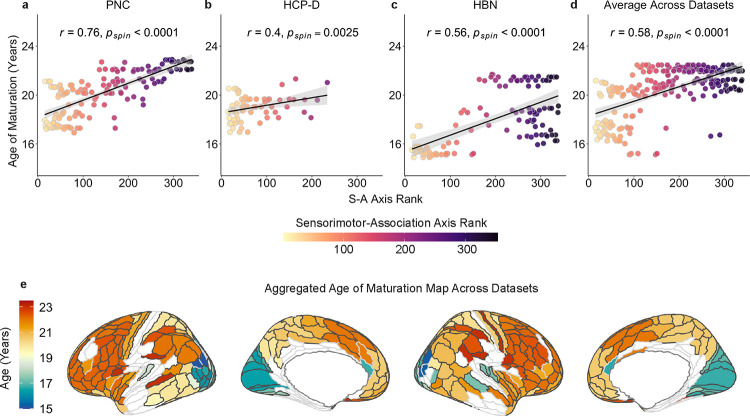
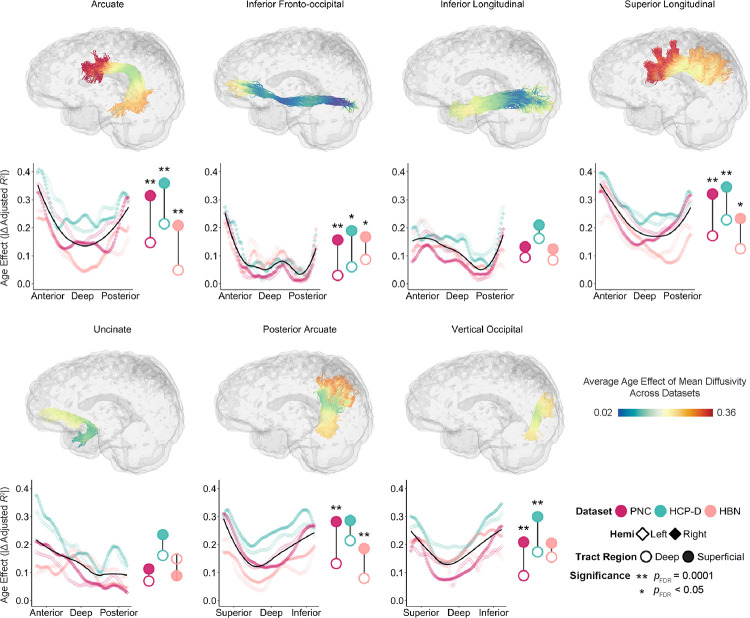
Despite decades of neuroimaging research, how white matter develops along the length of major tracts in humans remains unknown. Here, we identify fundamental patterns of white matter maturation by examining developmental variation along major, long-range cortico-cortical tracts in youth ages 5-23 years using diffusion MRI from three large-scale, cross-sectional datasets (total = 2,710). Across datasets, we delineate two replicable axes of human white matter development. First, we find a deep-to-superficial axis, in which superficial tract regions near the cortical surface exhibit greater age-related change than deep tract regions. Second, we demonstrate that the development of superficial tract regions aligns with the cortical hierarchy defined by the sensorimotor-association axis, with tract ends adjacent to sensorimotor cortices maturing earlier than those adjacent to association cortices. These results reveal developmental variation along tracts that conventional tract-average analyses have previously obscured, challenging the implicit assumption that white matter tracts mature uniformly along their length. Such developmental variation along tracts may have functional implications, including mitigating ephaptic coupling in densely packed deep tract regions and tuning neural synchrony through hierarchical development in superficial tract regions - ultimately refining neural transmission in youth.
尽管进行了数十年的神经影像学研究,但人类大脑主要神经束沿线的白质如何发育仍不清楚。在此,我们通过使用来自三个大规模横断面数据集(共2710例)的扩散磁共振成像,研究5至23岁青少年主要的长距离皮质-皮质神经束沿线的发育变化,从而确定白质成熟的基本模式。在各数据集中,我们描绘了人类白质发育的两个可重复轴。首先,我们发现了一个从深部到浅部的轴,其中靠近皮质表面的浅部神经束区域比深部神经束区域表现出更大的年龄相关变化。其次,我们证明浅部神经束区域的发育与由感觉运动-联合轴定义的皮质层级一致,与感觉运动皮质相邻的神经束末端比与联合皮质相邻的神经束末端成熟更早。这些结果揭示了传统神经束平均分析之前所掩盖的神经束沿线的发育变化,挑战了白质神经束沿其长度均匀成熟的隐含假设。这种神经束沿线的发育变化可能具有功能意义,包括减轻密集的深部神经束区域的电场耦合,以及通过浅部神经束区域的层级发育调节神经同步——最终优化青少年的神经传递。