Jazani Arman Moini, Yilmaz Gorkem, Baumer Mitchell, Sobieski Julian, Bernhard Stefan, Matyjaszewski Krzysztof
Department of Chemistry, Carnegie Mellon University, 4400 Fifth Avenue, Pittsburgh, Pennsylvania 15213, United States.
J Am Chem Soc. 2025 Apr 16;147(15):12562-12573. doi: 10.1021/jacs.4c18496. Epub 2025 Apr 2.
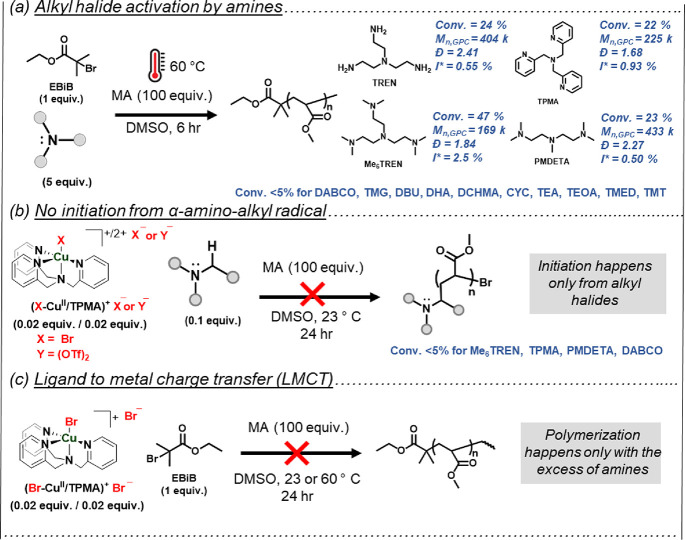
Multidentate amines have been widely used as ligands (L) for Cu-catalysts in atom transfer radical polymerization (ATRP) and as electron donors in photochemically induced polymerizations. However, mechanistic aspects of the role of amines in ATRP in the dark have remained elusive. Herein, the structure-activity relationship and the related electron transfer reactions with Br-Cu/L complexes and/or with alkyl bromides (R-Br) were investigated for 25 amines. Amines function as electron donors and reducing agents for Br-Cu/L complexes via an outer sphere electron transfer (OSET) mechanism, enabling slow but continuous generation of Cu/L activators and inducing controlled ATRP. However, two amines, diazabicyclo(5.4.0)undec-7-ene (DBU) and 1,1,3,3-tetramethylguanidine (TMG), reduced Br-Cu/L faster, suggesting an inner sphere electron transfer (ISET) process. ATRP, starting with initial deactivators (Br-Cu/L) species, proceeded in the dark in the presence of an excess of tertiary amines, such as tris[2-(dimethylamino)ethyl]amine (MeTREN), 1,4-diazabicyclo[2.2.2]octane (DABCO), and TMG at room temperature and afforded polymers with low dispersities ( ≤ 1.15). With copper(II) triflate complex (Cu/L, (OTf)), which has a more positive reduction potential, ATRP proceeded at room temperature with several inexpensive secondary and tertiary amines including triethylamine (TEA) and dimethylethanolamine (DMAE). Interestingly, multidentate amines also served as direct R-Br activators at elevated temperatures (60 °C). In all cases, chains were initiated with R-Br and not by the amine radical cations as byproducts of electron transfer. Amines also enabled ATRP in the presence of residual air in flasks with a large headspace, underpinning them as a robust and accessible reducing agent for practical applications.
多齿胺已被广泛用作原子转移自由基聚合(ATRP)中铜催化剂的配体(L),以及光化学诱导聚合中的电子供体。然而,胺在黑暗中ATRP中作用的机理方面仍然难以捉摸。在此,研究了25种胺与Br-Cu/L配合物和/或与烷基溴(R-Br)的构效关系及相关电子转移反应。胺通过外层球电子转移(OSET)机制作为Br-Cu/L配合物的电子供体和还原剂,能够缓慢但持续地生成Cu/L活化剂并引发可控的ATRP。然而,两种胺,即二氮杂双环(5.4.0)十一碳-7-烯(DBU)和1,1,3,3-四甲基胍(TMG),还原Br-Cu/L的速度更快,表明存在内层球电子转移(ISET)过程。以初始失活剂(Br-Cu/L)物种开始的ATRP,在过量叔胺(如三[2-(二甲氨基)乙基]胺(MeTREN)、1,4-二氮杂双环[2.2.2]辛烷(DABCO)和TMG)存在下于室温黑暗中进行,并得到低分散度(≤1.15)的聚合物。使用具有更正还原电位的三氟甲磺酸铜配合物(Cu/L,(OTf))时,ATRP在室温下可与包括三乙胺(TEA)和二甲基乙醇胺(DMAE)在内的几种廉价仲胺和叔胺进行。有趣的是,多齿胺在高温(60°C)下也可作为直接的R-Br活化剂。在所有情况下,链均由R-Br引发,而非由作为电子转移副产物的胺自由基阳离子引发。胺还能在具有大顶空的烧瓶中存在残留空气的情况下实现ATRP,这表明它们是用于实际应用的强大且易于获得的还原剂。