• 文献检索
  • 文档翻译
  • 深度研究
  • 学术资讯
  • Suppr Zotero 插件Zotero 插件
  • 邀请有礼
  • 套餐&价格
  • 历史记录
应用&插件
Suppr Zotero 插件Zotero 插件浏览器插件Mac 客户端Windows 客户端微信小程序
定价
高级版会员购买积分包购买API积分包
服务
文献检索文档翻译深度研究API 文档MCP 服务
关于我们
关于 Suppr公司介绍联系我们用户协议隐私条款
关注我们

Suppr 超能文献

核心技术专利:CN118964589B侵权必究
粤ICP备2023148730 号-1Suppr @ 2026

文献检索

告别复杂PubMed语法,用中文像聊天一样搜索,搜遍4000万医学文献。AI智能推荐,让科研检索更轻松。

立即免费搜索

文件翻译

保留排版,准确专业,支持PDF/Word/PPT等文件格式,支持 12+语言互译。

免费翻译文档

深度研究

AI帮你快速写综述,25分钟生成高质量综述,智能提取关键信息,辅助科研写作。

立即免费体验

黑暗多样性揭示的全球自然植被匮乏状况

Global impoverishment of natural vegetation revealed by dark diversity.

作者信息

Pärtel Meelis, Tamme Riin, Carmona Carlos P, Riibak Kersti, Moora Mari, Bennett Jonathan A, Chiarucci Alessandro, Chytrý Milan, de Bello Francesco, Eriksson Ove, Harrison Susan, Lewis Robert John, Moles Angela T, Öpik Maarja, Price Jodi N, Amputu Vistorina, Askarizadeh Diana, Atashgahi Zohreh, Aubin Isabelle, Azcárate Francisco M, Barrett Matthew D, Bashirzadeh Maral, Bátori Zoltán, Beenaerts Natalie, Bergholz Kolja, Birkeli Kristine, Biurrun Idoia, Blanco-Moreno José M, Bloodworth Kathryn J, Boisvert-Marsh Laura, Boldgiv Bazartseren, Brancalion Pedro H S, Brearley Francis Q, Brown Charlotte, Bueno C Guillermo, Buffa Gabriella, Cahill James F, Campos Juan A, Cangelmi Giacomo, Carbognani Michele, Carcaillet Christopher, Cerabolini Bruno E L, Chevalier Richard, Clavel Jan S, Costa José M, Cousins Sara A O, Čuda Jan, Dairel Mariana, Dalle Fratte Michele, Danilova Alena, Davison John, Deák Balázs, Del Vecchio Silvia, Dembicz Iwona, Dengler Jürgen, Dolezal Jiri, Domene Xavier, Dvorsky Miroslav, Ejtehadi Hamid, Enrico Lucas, Epikhin Dmitrii, Eskelinen Anu, Essl Franz, Fan Gaohua, Fantinato Edy, Fazlioglu Fatih, Fernández-Pascual Eduardo, Ferrara Arianna, Fidelis Alessandra, Fischer Markus, Flagmeier Maren, Forte T'ai G W, Fraser Lauchlan H, Fujinuma Junichi, Furquim Fernando F, Garris Berle, Garris Heath W, Giorgis Melisa A, Giusso Del Galdo Gianpietro, González-Robles Ana, Good Megan K, Guardiola Moisès, Guarino Riccardo, Guerrero Irene, Guillemot Joannès, Güler Behlül, Guo Yinjie, Haesen Stef, Hejda Martin, Heleno Ruben H, Høye Toke T, Hrivnák Richard, Huang Yingxin, Hunter John T, Iakushenko Dmytro, Ibáñez Ricardo, Ingerpuu Nele, Irl Severin D H, Janíková Eva, Jansen Florian, Jeltsch Florian, Jentsch Anke, Jiménez-Alfaro Borja, Jõks Madli, Jouri Mohammad H, Karami Sahar, Katal Negin, Kelemen András, Khairullin Bulat I, Khuroo Anzar A, Komatsu Kimberly J, Konečná Marie, Kook Ene, Korell Lotte, Koroleva Natalia, Korznikov Kirill A, Kozhevnikova Maria V, Kozub Łukasz, Laanisto Lauri, Lager Helena, Lanta Vojtech, Lasagno Romina G, Lembrechts Jonas J, Li Liping, Lisner Aleš, Liu Houjia, Liu Kun, Liu Xuhe, Lucas-Borja Manuel Esteban, Ludewig Kristin, Lukács Katalin, Luther-Mosebach Jona, Macek Petr, Marignani Michela, Michalet Richard, Miglécz Tamás, Moeslund Jesper Erenskjold, Moeys Karlien, Montesinos Daniel, Moreno-Jiménez Eduardo, Moysiyenko Ivan, Mucina Ladislav, Muñoz-Rojas Miriam, Murillo Raytha A, Nambahu Sylvia M, Neuenkamp Lena, Normand Signe, Nowak Arkadiusz, Nuche Paloma, Oja Tatjana, Onipchenko Vladimir G, Pachedjieva Kalina L, Paganeli Bruno, Peco Begoña, Peralta Ana M L, Pérez-Haase Aaron, Peri Pablo L, Petraglia Alessandro, Peyre Gwendolyn, Plaza-Álvarez Pedro Antonio, Plue Jan, Prentice Honor C, Prokhorov Vadim E, Radujković Dajana, Rahmanian Soroor, Reitalu Triin, Ristow Michael, Robin Agnès A, Robles Ana Belén, Rodríguez Ginart Daniel A, Román Raúl, Roos Ruben E, Rosati Leonardo, Sádlo Jiří, Salimbayeva Karina, Sánchez de Dios Rut, Sanchir Khaliun, Sattler Cornelia, Scasta John D, Schmiedel Ute, Schrader Julian, Schultz Nick L, Sellan Giacomo, Serra-Diaz Josep M, Silan Giulia, Skálová Hana, Skobel Nadiia, Sonkoly Judit, Štajerová Kateřina, Svitková Ivana, Świerszcz Sebastian, Tanentzap Andrew J, Tanentzap Fallon M, Tarifa Rubén, Tejero Pablo, Tekeev Dzhamal K, Tholin Michael, Thormodsæter Ruben S, Tian Yichen, Tokaryuk Alla, Tölgyesi Csaba, Tomaselli Marcello, Tordoni Enrico, Török Péter, Tóthmérész Béla, Toussaint Aurèle, Touzard Blaise, Trindade Diego P F, Tsakalos James L, Türkiş Sevda, Valencia Enrique, Valerio Mercedes, Valkó Orsolya, Van Meerbeek Koenraad, Vandvik Vigdis, Villellas Jesus, Virtanen Risto, Vítková Michaela, Vojík Martin, von Hessberg Andreas, von Oppen Jonathan, Wagner Viktoria, Wan Ji-Zhong, Wang Chun-Jing, Wani Sajad A, Weiss Lina, Wevill Tricia, Xiao Sa, Zárate Martínez Oscar, Zobel Martin

机构信息

Institute of Ecology and Earth Sciences, University of Tartu, Tartu, Estonia.

Department of Plant Sciences, University of Saskatchewan, Saskatoon, Saskatchewan, Canada.

出版信息

Nature. 2025 May;641(8064):917-924. doi: 10.1038/s41586-025-08814-5. Epub 2025 Apr 2.

DOI:10.1038/s41586-025-08814-5
PMID:40175550
原文链接:https://pmc.ncbi.nlm.nih.gov/articles/PMC12095060/
Abstract

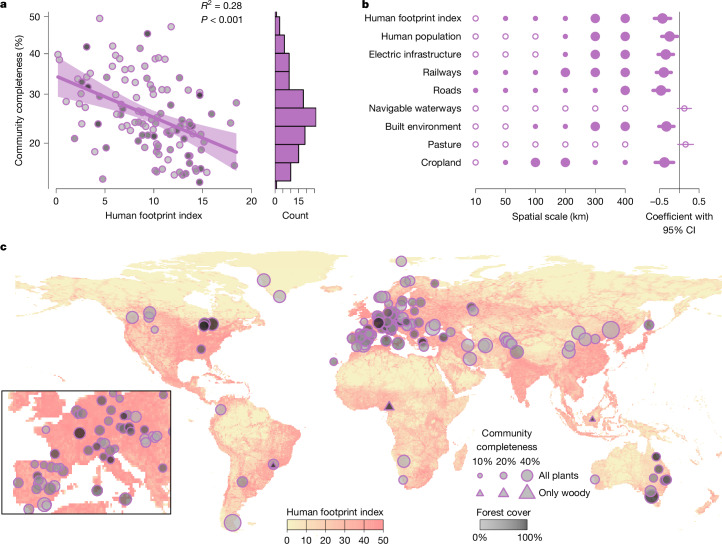
Anthropogenic biodiversity decline threatens the functioning of ecosystems and the many benefits they provide to humanity. As well as causing species losses in directly affected locations, human influence might also reduce biodiversity in relatively unmodified vegetation if far-reaching anthropogenic effects trigger local extinctions and hinder recolonization. Here we show that local plant diversity is globally negatively related to the level of anthropogenic activity in the surrounding region. Impoverishment of natural vegetation was evident only when we considered community completeness: the proportion of all suitable species in the region that are present at a site. To estimate community completeness, we compared the number of recorded species with the dark diversity-ecologically suitable species that are absent from a site but present in the surrounding region. In the sampled regions with a minimal human footprint index, an average of 35% of suitable plant species were present locally, compared with less than 20% in highly affected regions. Besides having the potential to uncover overlooked threats to biodiversity, dark diversity also provides guidance for nature conservation. Species in the dark diversity remain regionally present, and their local populations might be restored through measures that improve connectivity between natural vegetation fragments and reduce threats to population persistence.

摘要

人为导致的生物多样性下降威胁着生态系统的功能以及它们为人类提供的诸多益处。除了在直接受影响的地区造成物种损失外,如果深远的人为影响引发局部灭绝并阻碍重新定殖,那么人类影响还可能减少相对未受改变的植被中的生物多样性。我们在此表明,当地植物多样性在全球范围内与周边地区的人为活动水平呈负相关。只有当我们考虑群落完整性时,自然植被的 impoverishment 才明显:即该地区所有适宜物种中在某一地点出现的比例。为了估计群落完整性,我们将记录的物种数量与暗多样性(即生态适宜但在某一地点不存在却在周边地区存在的物种)进行了比较。在人类足迹指数最小的采样地区,平均有35%的适宜植物物种在当地存在,而在受影响严重的地区这一比例不到20%。除了有可能揭示对生物多样性被忽视的威胁外,暗多样性还为自然保护提供指导。暗多样性中的物种在区域内仍然存在,通过改善自然植被片段之间的连通性以及减少对种群持久性的威胁等措施,有可能恢复它们在当地的种群数量。 (注:这里“impoverishment”直译为“贫困化”,结合语境可能不太好理解,可根据上下文进一步优化表述,比如“减少、降低等”,但按照要求未做修改)

https://cdn.ncbi.nlm.nih.gov/pmc/blobs/3cab/12095060/dc04cc7f3f59/41586_2025_8814_Fig10_ESM.jpg
https://cdn.ncbi.nlm.nih.gov/pmc/blobs/3cab/12095060/251cdde2434a/41586_2025_8814_Fig1_HTML.jpg
https://cdn.ncbi.nlm.nih.gov/pmc/blobs/3cab/12095060/11d0de3d95e9/41586_2025_8814_Fig2_HTML.jpg
https://cdn.ncbi.nlm.nih.gov/pmc/blobs/3cab/12095060/b467cb21f4d8/41586_2025_8814_Fig3_ESM.jpg
https://cdn.ncbi.nlm.nih.gov/pmc/blobs/3cab/12095060/35835dba56d9/41586_2025_8814_Fig4_ESM.jpg
https://cdn.ncbi.nlm.nih.gov/pmc/blobs/3cab/12095060/c2cb134bbfbb/41586_2025_8814_Fig5_ESM.jpg
https://cdn.ncbi.nlm.nih.gov/pmc/blobs/3cab/12095060/a7a7abd84716/41586_2025_8814_Fig6_ESM.jpg
https://cdn.ncbi.nlm.nih.gov/pmc/blobs/3cab/12095060/f1b81dcd5ef0/41586_2025_8814_Fig7_ESM.jpg
https://cdn.ncbi.nlm.nih.gov/pmc/blobs/3cab/12095060/11fb51d0d50c/41586_2025_8814_Fig8_ESM.jpg
https://cdn.ncbi.nlm.nih.gov/pmc/blobs/3cab/12095060/ef0f9cfd8f18/41586_2025_8814_Fig9_ESM.jpg
https://cdn.ncbi.nlm.nih.gov/pmc/blobs/3cab/12095060/dc04cc7f3f59/41586_2025_8814_Fig10_ESM.jpg
https://cdn.ncbi.nlm.nih.gov/pmc/blobs/3cab/12095060/251cdde2434a/41586_2025_8814_Fig1_HTML.jpg
https://cdn.ncbi.nlm.nih.gov/pmc/blobs/3cab/12095060/11d0de3d95e9/41586_2025_8814_Fig2_HTML.jpg
https://cdn.ncbi.nlm.nih.gov/pmc/blobs/3cab/12095060/b467cb21f4d8/41586_2025_8814_Fig3_ESM.jpg
https://cdn.ncbi.nlm.nih.gov/pmc/blobs/3cab/12095060/35835dba56d9/41586_2025_8814_Fig4_ESM.jpg
https://cdn.ncbi.nlm.nih.gov/pmc/blobs/3cab/12095060/c2cb134bbfbb/41586_2025_8814_Fig5_ESM.jpg
https://cdn.ncbi.nlm.nih.gov/pmc/blobs/3cab/12095060/a7a7abd84716/41586_2025_8814_Fig6_ESM.jpg
https://cdn.ncbi.nlm.nih.gov/pmc/blobs/3cab/12095060/f1b81dcd5ef0/41586_2025_8814_Fig7_ESM.jpg
https://cdn.ncbi.nlm.nih.gov/pmc/blobs/3cab/12095060/11fb51d0d50c/41586_2025_8814_Fig8_ESM.jpg
https://cdn.ncbi.nlm.nih.gov/pmc/blobs/3cab/12095060/ef0f9cfd8f18/41586_2025_8814_Fig9_ESM.jpg
https://cdn.ncbi.nlm.nih.gov/pmc/blobs/3cab/12095060/dc04cc7f3f59/41586_2025_8814_Fig10_ESM.jpg

相似文献

1
Global impoverishment of natural vegetation revealed by dark diversity.黑暗多样性揭示的全球自然植被匮乏状况
Nature. 2025 May;641(8064):917-924. doi: 10.1038/s41586-025-08814-5. Epub 2025 Apr 2.
2
Dark diversity: shedding light on absent species.暗多样性:揭示缺失物种的奥秘。
Trends Ecol Evol. 2011 Mar;26(3):124-8. doi: 10.1016/j.tree.2010.12.004. Epub 2010 Dec 31.
3
Sustainable utilization and conservation of plant biodiversity in montane ecosystems: the western Himalayas as a case study.高山生态系统中植物生物多样性的可持续利用与保护:以喜马拉雅山西部为例。
Ann Bot. 2013 Aug;112(3):479-501. doi: 10.1093/aob/mct125. Epub 2013 Jul 3.
4
The influence of landscape characteristics on breeding bird dark diversity.景观特征对繁殖鸟类暗多样性的影响。
Oecologia. 2023 Apr;201(4):1039-1052. doi: 10.1007/s00442-023-05351-8. Epub 2023 Apr 5.
5
Global extent and change in human modification of terrestrial ecosystems from 1990 to 2022.1990年至2022年全球陆地生态系统人为改造的范围及变化
Sci Data. 2025 Apr 10;12(1):606. doi: 10.1038/s41597-025-04892-2.
6
Cumulative human impacts on global marine fauna highlight risk to biological and functional diversity.人类活动对全球海洋动物群的累积影响凸显了对生物和功能多样性的风险。
PLoS One. 2024 Sep 18;19(9):e0309788. doi: 10.1371/journal.pone.0309788. eCollection 2024.
7
Half a Century of Temperate Non-Forest Vegetation Changes: No Net Loss in Species Richness, but Considerable Shifts in Taxonomic and Functional Composition.半个世纪以来温带非森林植被的变化:物种丰富度无净损失,但分类和功能组成发生了显著变化。
Glob Chang Biol. 2025 Jan;31(1):e70030. doi: 10.1111/gcb.70030.
8
Assessing the effects of anthropogenic pressures on biodiversity: a multi-taxonomic approach in Basilicata, Italy.评估人为压力对生物多样性的影响:意大利巴斯利卡塔的多分类学方法。
Environ Sci Pollut Res Int. 2025 Feb;32(8):4879-4893. doi: 10.1007/s11356-025-35996-2. Epub 2025 Feb 1.
9
Anthropogenic disturbance has altered the habitat of two Azorean endemic coastal plants.人为干扰改变了两个亚速尔群岛特有沿海植物的栖息地。
BMC Ecol Evol. 2024 Aug 20;24(1):111. doi: 10.1186/s12862-024-02300-8.
10
A global analysis of the impacts of urbanization on bird and plant diversity reveals key anthropogenic drivers.一项关于城市化对鸟类和植物多样性影响的全球分析揭示了关键的人为驱动因素。
Proc Biol Sci. 2014 Feb 12;281(1780):20133330. doi: 10.1098/rspb.2013.3330. Print 2014 Apr 7.

引用本文的文献

1
Forest Management and the Colonization of Artificial Tree Holes by Aquatic Insect Larvae.森林管理与水生昆虫幼虫对人工树洞的定殖
Ecol Evol. 2025 Aug 15;15(8):e71962. doi: 10.1002/ece3.71962. eCollection 2025 Aug.
2
A lipid metabolism related gene signature predicts postoperative recurrence in pancreatic cancer through multicenter cohort validation.一种与脂质代谢相关的基因特征通过多中心队列验证预测胰腺癌术后复发。
Sci Rep. 2025 Apr 5;15(1):11683. doi: 10.1038/s41598-025-96855-1.

本文引用的文献

1
Ghost roads and the destruction of Asia-Pacific tropical forests.幽灵之路与亚太热带森林的毁灭
Nature. 2024 May;629(8011):370-375. doi: 10.1038/s41586-024-07303-5. Epub 2024 Apr 10.
2
Mixed effects of a national protected area network on terrestrial and freshwater biodiversity.国家保护区网络对陆地和淡水生物多样性的混合影响。
Nat Commun. 2023 Sep 13;14(1):5426. doi: 10.1038/s41467-023-41073-4.
3
Global models and predictions of plant diversity based on advanced machine learning techniques.基于先进机器学习技术的全球植物多样性模型与预测
New Phytol. 2023 Feb;237(4):1432-1445. doi: 10.1111/nph.18533. Epub 2022 Nov 14.
4
The direct drivers of recent global anthropogenic biodiversity loss.近期全球人为生物多样性丧失的直接驱动因素。
Sci Adv. 2022 Nov 11;8(45):eabm9982. doi: 10.1126/sciadv.abm9982. Epub 2022 Nov 9.
5
Global patterns of vascular plant alpha diversity.全球维管束植物α多样性模式。
Nat Commun. 2022 Sep 1;13(1):4683. doi: 10.1038/s41467-022-32063-z.
6
Agriculture and climate change are reshaping insect biodiversity worldwide.农业和气候变化正在重塑全球昆虫生物多样性。
Nature. 2022 May;605(7908):97-102. doi: 10.1038/s41586-022-04644-x. Epub 2022 Apr 20.
7
The role of fire in global forest loss dynamics.火灾在全球森林损失动态中的作用。
Glob Chang Biol. 2021 Jun;27(11):2377-2391. doi: 10.1111/gcb.15591. Epub 2021 Mar 27.
8
Grassland-to-crop conversion in agricultural landscapes has lasting impact on the trait diversity of bees.农业景观中草地向农田的转变对蜜蜂的性状多样性具有持久影响。
Landsc Ecol. 2021;36(1):281-295. doi: 10.1007/s10980-020-01141-2. Epub 2020 Oct 18.
9
Bending the curve of terrestrial biodiversity needs an integrated strategy.扭转陆地生物多样性曲线需要综合战略。
Nature. 2020 Sep;585(7826):551-556. doi: 10.1038/s41586-020-2705-y. Epub 2020 Sep 10.
10
Ecosystem decay exacerbates biodiversity loss with habitat loss.生态系统衰退随着栖息地丧失加剧了生物多样性丧失。
Nature. 2020 Aug;584(7820):238-243. doi: 10.1038/s41586-020-2531-2. Epub 2020 Jul 29.