Fu Yangyang, Wang Qiuju, Wang Xiaofeng, Zhong Haoxuan, Chen Junqi, Fei Haoyu, Yao Yipeng, Xiao Yao, Li Wenfu, Li Na
School of Mental Health, Jining Medical University, Jining, 272013, China.
Office of Student Work, Jining Medical University, Jining, 272013, China.
BMC Psychol. 2025 Apr 2;13(1):323. doi: 10.1186/s40359-025-02619-x.
In this study, the purpose was to examine the impact of time management on college students' study engagement and to determine the mechanisms involved. Consequently, we examined the relationship between time management and engagement in study, as well as self-control and mobile phone dependence.
The Adolescence Time Management Disposition Scale (ATMD), College Student Mobile Phone Dependence Questionnaire (CSMPDQ), Utrecht Work Engagement Scale-student (UWES-S), and Self-Control Scale (SCS) were administered to 1016 college students. A Pearson's correlation analysis and a mediation analysis using bootstrapping were performed in order to test for standard method bias using SPSS 22.0.
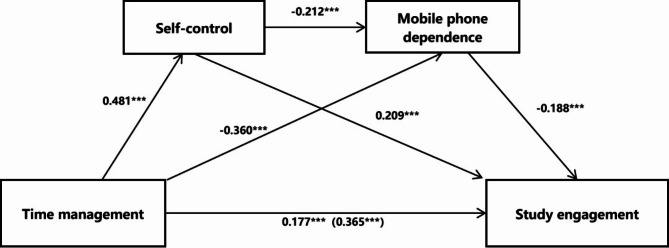
①Time management was positively associated with self-control and study engagement, and negatively associated with mobile phone dependence (p <.001). self-control was positively associated with study engagement, and negatively associated with mobile phone dependence (p <.001). Mobile phone dependence was negatively associated with study engagement (p <.01). ②Time management can not only directly predict study engagement (95%CI, 0.102 - 0.208) but also affects study engagement through three indirect paths: self-control was a mediator (95%CI, 0.066 - 0.158), mobile phone dependence was a mediator (95%CI, 0.043 - 0.109), and self-control and mobile phone dependence were a chain mediator (95%CI, 0.012 - 0.032).
Time management not only influences study engagement directly, but also through the mediating effect of self-control and mobile phone dependence indirectly.
本研究旨在探讨时间管理对大学生学习投入的影响,并确定其中涉及的机制。因此,我们考察了时间管理与学习投入之间的关系,以及自我控制与手机依赖之间的关系。
对1016名大学生施测青少年时间管理倾向量表(ATMD)、大学生手机依赖问卷(CSMPDQ)、乌得勒支工作投入量表-学生版(UWES-S)和自我控制量表(SCS)。使用SPSS 22.0进行Pearson相关分析和采用自抽样法的中介分析,以检验标准方法偏差。
①时间管理与自我控制和学习投入呈正相关,与手机依赖呈负相关(p <.001)。自我控制与学习投入呈正相关,与手机依赖呈负相关(p <.001)。手机依赖与学习投入呈负相关(p <.01)。②时间管理不仅能直接预测学习投入(95%CI,0.102 - 0.208),还能通过三条间接路径影响学习投入:自我控制起中介作用(95%CI,0.066 - 0.158),手机依赖起中介作用(95%CI,0.043 - 0.109),自我控制和手机依赖起链式中介作用(95%CI,0.012 - 0.032)。
时间管理不仅直接影响学习投入,还通过自我控制和手机依赖的中介作用间接影响学习投入。