Bian Yan, Zhang Chi, Wang Shaohua, Zhang Lili, Cai Hong
Department of Dermatology, Air Force Medical Center, PLA, Beijing, People's Republic of China.
Beijing Integrated Traditional Chinese and Western Medicine Hospital, Beijing, People's Republic of China.
J Cosmet Dermatol. 2025 Apr;24(4):e70145. doi: 10.1111/jocd.70145.
Cosmetic botulinum toxin type A (BTX-A) injections have been widely used for improving facial aesthetics. Although the procedure is generally safe, immune-mediated adverse events, such as hypersensitivity reactions and secondary treatment failures, may rarely occur. We report the first case in which repeated BTX-A injections resulted in both a delayed-onset cutaneous hypersensitivity reaction and complete secondary treatment failure.
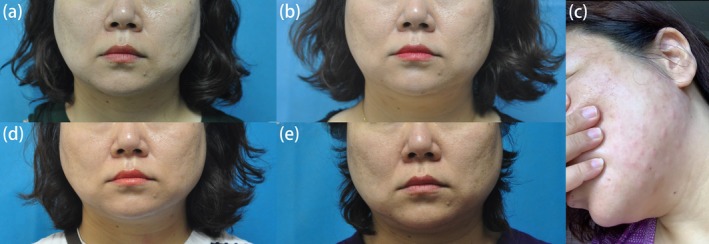
CASE REPORT/METHODS: A 42-year-old female, with a history of successful BTX-A treatments for glabellar lines and masseter hypertrophy, experienced diminished efficacy following a treatment session. Ten hours after a touch-up injection, she developed facial swelling and edematous erythema localized to the injection sites. These manifestations persisted for over one month without any observable aesthetic improvement, indicating complete secondary treatment failure. The therapeutic effect was not restored even after switching to an alternative BTX-A formulation. We hypothesize that the patient's local hypersensitivity reaction represents a type III immune complex-mediated response (Arthus reaction) driven by IgG antibodies. The repeated BTX-A injections may have induced neutralizing IgG antibodies that, in concert with the cutaneous hypersensitivity reaction, contributed synergistically to both the cutaneous reaction and the complete treatment failure. The short interval between the injections may have facilitated these immunologic events.
This case underscores the importance for clinicians to remain vigilant regarding the potential for delayed-onset cutaneous allergic reactions and complete secondary treatment failure following repeated BTX-A injections.
A型肉毒杆菌毒素(BTX-A)注射已广泛用于改善面部美观。尽管该操作通常是安全的,但免疫介导的不良事件,如过敏反应和二次治疗失败,可能很少发生。我们报告首例重复注射BTX-A导致迟发性皮肤过敏反应和完全性二次治疗失败的病例。
病例报告/方法:一名42岁女性,有使用BTX-A成功治疗眉间纹和咬肌肥大的病史,在一次治疗后疗效减弱。在进行补打注射10小时后,她出现面部肿胀以及注射部位局限性的水肿性红斑。这些表现持续了一个多月,没有任何明显的美观改善,表明完全性二次治疗失败。即使改用另一种BTX-A制剂后,治疗效果仍未恢复。我们推测患者的局部过敏反应代表由IgG抗体驱动的III型免疫复合物介导的反应(阿瑟斯反应)。重复注射BTX-A可能诱导了中和性IgG抗体,该抗体与皮肤过敏反应协同作用,导致了皮肤反应和完全治疗失败。注射之间的短间隔可能促进了这些免疫事件。
该病例强调了临床医生对于重复注射BTX-A后迟发性皮肤过敏反应和完全性二次治疗失败的可能性保持警惕的重要性。