Jia Hao, Gong Sha-Sha, Zhang Yong-Xin, Xie Ying-Xia, Chu Naying
Department of Pharmacy, The First People's Hospital of Shangqiu Suiyang District, 292 Kaixuan Road Shangqiu 476000 China
School of Pharmaceutical Sciences, Zhengzhou University Zhengzhou 450001 China.
RSC Adv. 2025 Apr 2;15(13):10170-10182. doi: 10.1039/d5ra00461f. eCollection 2025 Mar 28.
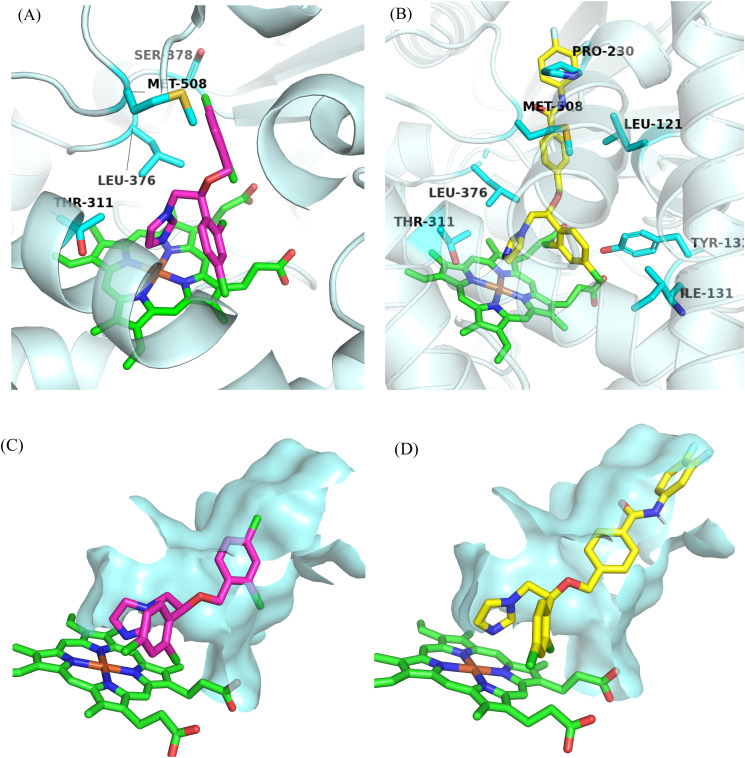
As fungal resistance to existing antifungal drugs continues to rise, there is an urgent need for new drugs with anti-resistance activity. In this study, a series of newly designed and synthesized benzanilide-containing azoles exhibited promising antifungal activity against fluconazole-sensitive . Importantly, the newly synthesized compounds also displayed potent activity against azole-resistant strains, surpassing the performance of the positive control fluconazole. This suggests that these compounds may have the potential to combat drug-resistant fungal infections. Subsequent studies on the antifungal mechanisms revealed that the compound can inhibit fungal CYP51, thereby blocking ergosterol biosynthesis. Morphological observations of fungal cells further confirmed CYP51 as the target of action. Resistance mechanisms elucidated that these compounds can inhibit biofilm formation and the expression of resistance-related genes ERG11 and efflux pump gene CDR1, thereby reversing resistance. Meanwhile, the most potent compound A11 demonstrated the ability to stimulate reactive oxygen species, thereby exhibiting potent fungicidal activity. Furthermore, the compound A11 also showed good stability in liver microsomes and plasma metabolism. Cytotoxicity studies demonstrated low toxicity of the compounds against MRC-5 cells, indicating their potential safety for therapeutic use. experimental results indicated that the representative compound A11 significantly inhibited fungal infections caused by resistant strains. Molecular docking studies further supported the efficacy of compound A11, showing its ability to bind to CYP51. These findings highlight the promising antifungal activity and minimal cytotoxicity of the benzanilide-containing azoles, making them potential candidates for the treatment of drug-resistant fungal infections.
随着真菌对现有抗真菌药物的耐药性持续上升,迫切需要具有抗耐药活性的新药。在本研究中,一系列新设计合成的含苯甲酰苯胺的唑类化合物对氟康唑敏感菌株表现出有前景的抗真菌活性。重要的是,新合成的化合物对唑类耐药菌株也显示出强效活性,超过了阳性对照氟康唑的性能。这表明这些化合物可能有对抗耐药真菌感染的潜力。随后对其抗真菌机制的研究表明,该化合物可抑制真菌CYP51,从而阻断麦角固醇的生物合成。对真菌细胞的形态学观察进一步证实CYP51是其作用靶点。耐药机制阐明这些化合物可抑制生物膜形成以及耐药相关基因ERG11和外排泵基因CDR1的表达,从而逆转耐药性。同时,最有效的化合物A11表现出刺激活性氧产生的能力,从而展现出强效的杀菌活性。此外,化合物A11在肝微粒体和血浆代谢中也显示出良好的稳定性。细胞毒性研究表明该化合物对MRC-5细胞的毒性较低,表明其在治疗应用中的潜在安全性。实验结果表明代表性化合物A11能显著抑制耐药菌株引起的真菌感染。分子对接研究进一步支持了化合物A11的疗效,显示出其与CYP51结合的能力。这些发现突出了含苯甲酰苯胺的唑类化合物有前景的抗真菌活性和最小的细胞毒性,使其成为治疗耐药真菌感染的潜在候选药物。