Mosquera-Olano Camila, Quimbaya Carolina, López-Pérez Santiago, Castellón-Castrillón Elkin, Navarro Sandra, Rojas John, Acosta Jorge, Torres-Palma Ricardo A, Ávila-Torres Yenny P
Grupo de Investigación en Remediación Ambiental y Biocatálisis (GIRAB), Instituto de Química, Facultad de Ciencias Exactas y Naturales, Universidad de Antioquia UdeA, Calle 70 No. 52-21, Medellín, Colombia.
Grupo de Investigación Cecoltec, Cecoltec Services, Cra 43 A 18 sur 135, Medellín, Colombia.
MethodsX. 2025 Mar 13;14:103252. doi: 10.1016/j.mex.2025.103252. eCollection 2025 Jun.
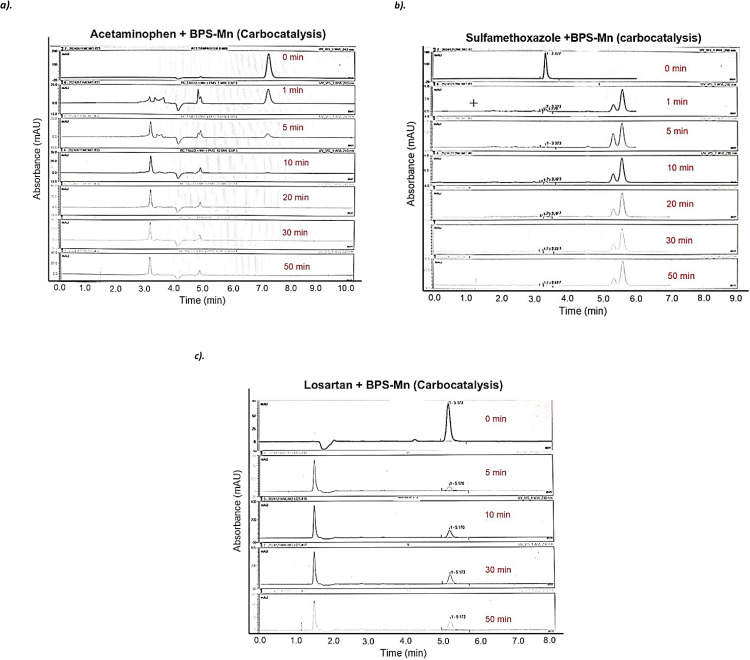
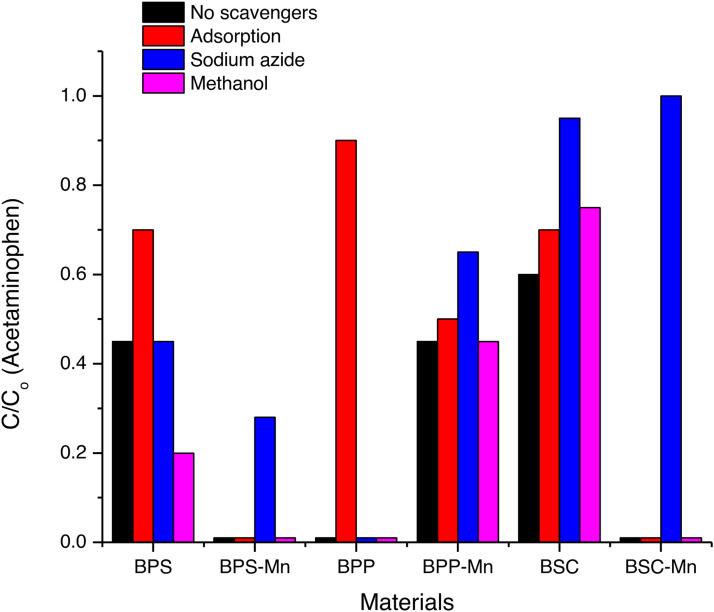
This approach examines several agriculture wastes (shell coconut, pseudo-steam banana, potato) as precursors of carbonaceous materials to produce O. The materials were modified with manganese carbonate at 800 °C and then, characterized using DLS (Dynamic Laser Scattering), BET (Brunauer-Emmett-Teller) Method, and zeta potential. Subsequently, the materials were activated via-peroxymonosulfate (PMS, HSO), and a scavenger to evidence the singlet oxygen formation was used. Acetaminophen, sulphamethoxazole, and losartan were employed as the pharmaceutical targets, evaluating the effects of ROS (reactive oxygen species) in the acetaminophen degradation processes. The methodology of computational calculations was developed to obtain HOMO-LUMO for all systems of modified and unmodified materials in the presence of PMS and acetaminophen to understand both the adsorption and the carbocatalysis processes. This method allows an understanding of the presence of manganese carbonate in thermal synthesis, which determines the modulation of reactive oxygen species depending on the pH of the treatment. This method is significant as follows:•Low-cost carbonaceous materials activated with PMS demonstrated significant efficiency in degrading organic molecules, utilizing singlet oxygen as the primary oxidant.•Theoretical computational approaches investigate the interaction between material and molecule.•The role of carbonate ions in influencing singlet oxygen production in materials derived from residual biomass was examined.
该方法研究了几种农业废弃物(椰壳、假茎香蕉、土豆)作为含碳材料前驱体来制备O。这些材料在800℃下用碳酸锰进行改性,然后使用动态激光散射(DLS)、布鲁诺尔-埃米特-泰勒(BET)法和zeta电位进行表征。随后,通过过一硫酸盐(PMS,HSO)对材料进行活化,并使用一种清除剂来证明单线态氧的形成。对乙酰氨基酚、磺胺甲恶唑和氯沙坦被用作药物靶点,评估活性氧(ROS)在对乙酰氨基酚降解过程中的作用。开发了计算计算方法,以获得在存在PMS和对乙酰氨基酚的情况下改性和未改性材料的所有体系的最高占据分子轨道(HOMO)-最低未占分子轨道(LUMO),以了解吸附和碳催化过程。该方法能够理解热合成中碳酸锰的存在情况,这取决于处理的pH值来决定活性氧的调制。该方法的重要意义如下:
• 用PMS活化的低成本含碳材料在降解有机分子方面表现出显著效率,利用单线态氧作为主要氧化剂。
• 理论计算方法研究材料与分子之间的相互作用。
• 研究了碳酸根离子在影响源自残余生物质的材料中单线态氧产生方面的作用。