Alshehri Fahad S, Ashour Ahmed M, Alorfi Nasser M
Pharmacology and Toxicology Department, College of Pharmacy, Umm Al-Qura University, Makkah, Saudi Arabia.
King Salman Center for Disability Research, Riyadh, 11614, Saudi Arabia.
Risk Manag Healthc Policy. 2025 Mar 28;18:1069-1083. doi: 10.2147/RMHP.S513016. eCollection 2025.
This cross-sectional study aimed to assess the public awareness, knowledge, and perception of congenital disabilities in Saudi Arabia, with a focus on identifying demographic factors that influence these perceptions.
A structured questionnaire was distributed to 1007 participants across various regions of Saudi Arabia. The questionnaire covered demographic information, knowledge of congenital disabilities, awareness of genetic and pharmacological risk factors, and engagement in preventive practices. Statistical analysis included descriptive statistics, correlation coefficients, and general linear modeling to understand the impact of demographic variables on awareness and preventive behaviors.
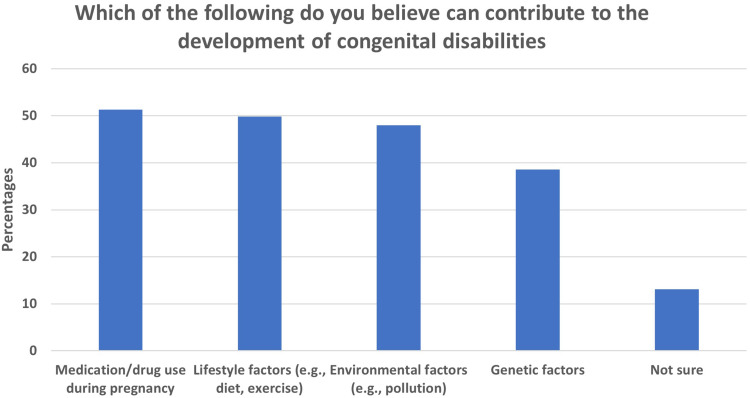
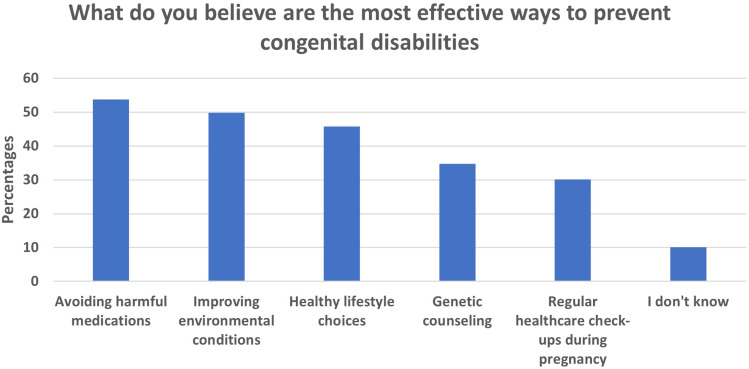
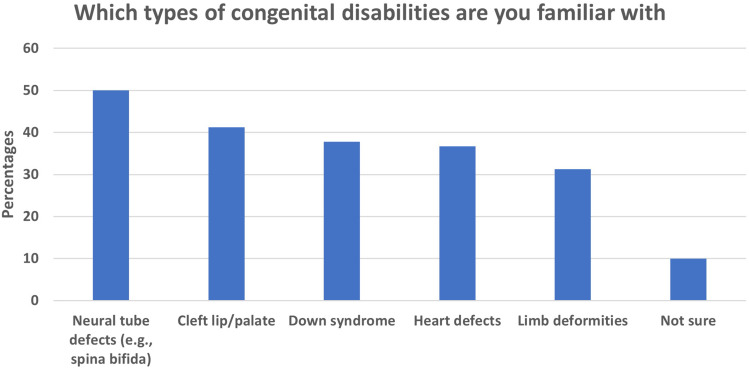
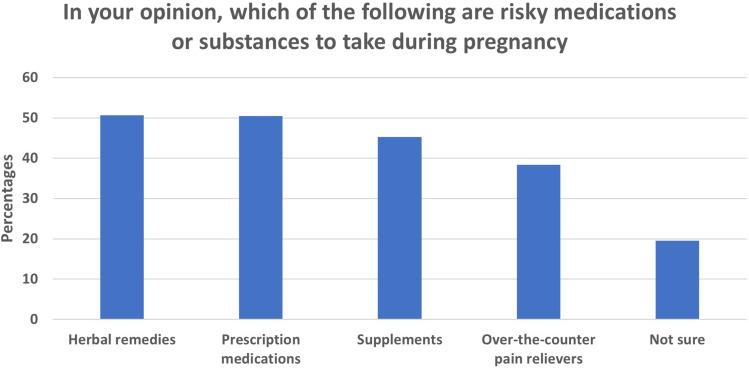
The study showed moderate public awareness and knowledge about congenital disabilities, with 49.6% of respondents acknowledging awareness and only 8.3% demonstrating excellent understanding. Perceived risks associated with genetic and environmental factors were recognized by over half of the participants. The awareness did not consistently translate into engagement in preventive practices, which remained suboptimal across the population. Demographic factors such as age and having children significantly influenced both risk perception and engagement in preventive behaviors.
Despite moderate levels of awareness, there remains a significant gap in comprehensive knowledge and active engagement in preventive practices against congenital disabilities in Saudi Arabia. The findings suggest the need for targeted educational programs and public health initiatives to enhance understanding and proactive management of risk factors associated with congenital disabilities. These efforts should particularly focus on younger populations and those without children, where risk perception and engagement were lower.
这项横断面研究旨在评估沙特阿拉伯公众对先天性残疾的认识、知识和看法,重点是确定影响这些看法的人口统计学因素。
向沙特阿拉伯各地区的1007名参与者发放了一份结构化问卷。问卷涵盖人口统计学信息、先天性残疾知识、对遗传和药理学风险因素的认识以及预防措施的参与情况。统计分析包括描述性统计、相关系数和一般线性模型,以了解人口统计学变量对认识和预防行为的影响。
研究表明,公众对先天性残疾的认识和知识水平中等,49.6%的受访者表示知晓,只有8.3%的人表现出良好的理解。超过一半的参与者认识到与遗传和环境因素相关的感知风险。这种认识并没有始终转化为对预防措施的参与,在整个人口中,预防措施的参与情况仍不理想。年龄和是否有孩子等人口统计学因素对风险感知和预防行为的参与都有显著影响。
尽管认识水平中等,但沙特阿拉伯在先天性残疾的综合知识和积极参与预防措施方面仍存在显著差距。研究结果表明,需要有针对性的教育项目和公共卫生倡议,以加强对与先天性残疾相关的风险因素的理解和积极管理。这些努力应特别关注年轻人群体和没有孩子的人群,他们的风险感知和参与度较低。