Soardo Federica, Spini Andrea, Pellegrini Giorgia, Costa Giorgio, Mathieu Clément, Bellitto Chiara, L'Abbate Luca, Ingrasciotta Ylenia, Leoni Olivia, Zanforlini Martina, Ancona Domenica, Stella Paolo, Cavazzana Anna, Scapin Angela, Lopes Sara, Belleudi Valeria, Ledda Stefano, Carta Paolo, Rossi Paola, Ejlli Lucian, Sapigni Ester, Puccini Aurora, Scarpelli Rita Francesca, De Sarro Giovambattista, Allotta Alessandra, Pollina Sebastiano Addario, Da Cas Roberto, Bucaneve Giampaolo, Mangano Antea Maria Pia, Balducci Francesco, Sorrentino Carla, Senesi Ilenia, Tuccori Marco, Gini Rosa, Spila-Alegiani Stefania, Massari Marco, Urru Silvana Anna Maria, Campomori Annalisa, Trifirò Gianluca
Department of Diagnostics and Public Health, University of Verona, P. le L.A. Scuro 10, 37134, Verona, Italy.
Hospital Pharmacy Unit, Azienda Provinciale Per i Servizi Sanitari, Trento, Italy.
BioDrugs. 2025 May;39(3):499-512. doi: 10.1007/s40259-025-00716-2. Epub 2025 Apr 3.
Limited real-world data on biological drug use in older patients with immune-mediated inflammatory diseases (IMIDs) exist despite these drugs carrying serious risks in this population.
We aimed to describe the frequency and persistence of biological drug use in older patients (≥ 65 years) with IMID, including inflammatory bowel diseases (IBDs), psoriatic arthritis/psoriasis, rheumatoid arthritis (RA), and ankylosing spondylitis, in a large Italian population.
A retrospective cohort study using the VALORE distributed claims database network from 13 Italian regions in the years 2010-2022 was performed. Older patients with IMID receiving biological drugs were included. Yearly prevalence of biological drug use and treatment persistence among incident users, from first dispensing to discontinuation/switching to another drug, was measured. Multivariable logistic regression was employed to identify treatment discontinuation predictors.
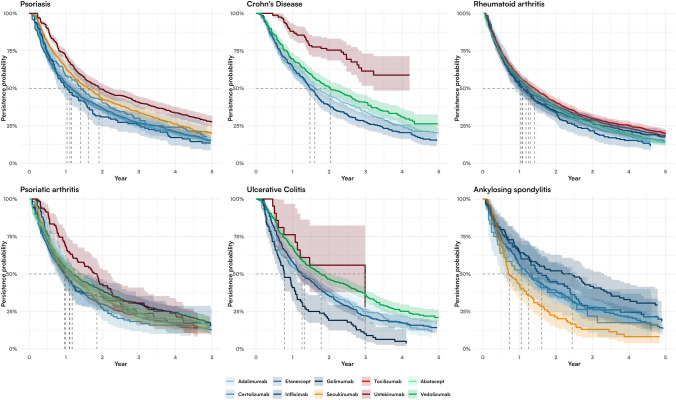
The prevalence of biological drug use in older patients with IMID increased dramatically from 2010 (0.44 per 1000 residents) to 2022 (2.48 per 1000 residents). Overall, 25,284 incident users of biological drugs were identified, with a female/male ratio of 1.6 and a mean age of 71.0 (standard deviation ± 5.2) years. The median duration of follow-up was 4.2 (2.5-6.6) years, and the most common indication for use was RA (n = 8371; 33.1%). Overall, biological drug persistence was 54.4% at 1 year from treatment start. The highest persistence rates were found for vedolizumab and ustekinumab in patients with IBD (ulcerative colitis, 68.1% and 76.2%, respectively; Crohn's disease, 69.6% and 88.1%, respectively). Polypharmacy, advanced age, and female sex were identified as predictors of treatment discontinuation.
This study documented a significant rise in biological drug use among older patients with IMID in Italy over the last decade. Around 50% of users discontinued treatment after the first year, with even higher rates observed in very old patients with polypharmacy. These findings highlight potential concerns about the use of biological therapies in older patients and underscore the urgent need for large-scale cohort studies to address the current knowledge gaps regarding their safety and effectiveness in this vulnerable population.
尽管生物药物在老年免疫介导的炎症性疾病(IMID)患者中存在严重风险,但关于此类药物使用的真实世界数据有限。
我们旨在描述意大利一大群老年(≥65岁)IMID患者(包括炎症性肠病(IBD)、银屑病关节炎/银屑病、类风湿关节炎(RA)和强直性脊柱炎)使用生物药物的频率和持续性。
利用2010 - 2022年来自意大利13个地区的VALORE分布式索赔数据库网络进行了一项回顾性队列研究。纳入接受生物药物治疗的老年IMID患者。测量了生物药物使用的年度患病率以及新使用者从首次配药到停药/换用另一种药物期间的治疗持续性。采用多变量逻辑回归来确定治疗停药的预测因素。
老年IMID患者中生物药物的使用率从2010年(每1000名居民中0.44人)急剧上升至2022年(每1000名居民中2.48人)。总体而言,共识别出25284名生物药物新使用者,女性/男性比例为1.6,平均年龄为71.0(标准差±5.2)岁。中位随访时间为4.2(2.5 - 6.6)年,最常见的使用指征是RA(n = 8371;33.1%)。总体而言,从治疗开始1年后生物药物的持续性为54.4%。在IBD患者(溃疡性结肠炎,分别为68.