Liu Na, Ostertag-Henning Christian, Fernø Martin A, Dopffel Nicole
Department of Physics and Technology, University of Bergen, Allegaten 55, 5007 Bergen, Norway.
Bundesanstalt für Geowissenschaften und Rohstoffe, Geozentrum Hannover Stilleweg 2, 30655 Hannover, Germany.
Environ Sci Technol. 2025 Apr 15;59(14):7095-7105. doi: 10.1021/acs.est.4c13893. Epub 2025 Apr 4.
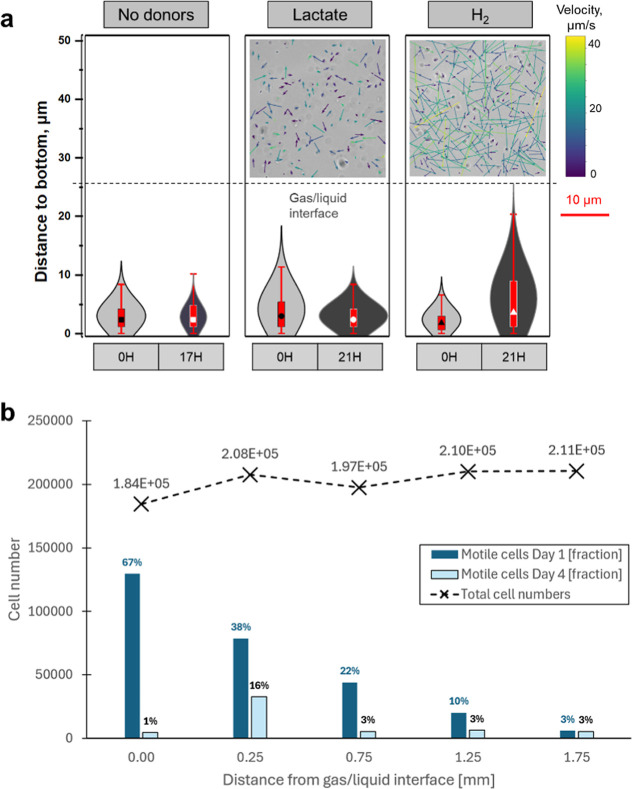
Hydrogen is a versatile energy carrier for human activity but is also a ubiquitous electron donor for subsurface microorganisms. During underground hydrogen storage operations, it is expected that microbial communities will use the injected hydrogen as electron donor for diverse metabolisms, and induce a variety of microbial-triggered risks. A significant concern is the formation of biofilm and induced bioclogging, which may reduce the hydrogen injectivity and storage operation efficiency by altering the subsurface hydrogen flow. This study investigates how different electron donors─specifically hydrogen and lactate─affect the growth dynamics of a sulfate-reducing bacterium ( G20) and the associated biofilm formation in porous media. The pore-scale observations reveal that lactate promotes robust biofilms resulting in bioclogging, compared to hydrogen promoting increased microbial motility with less biomass production. Potential hydrogen chemotaxis leads to biofilm dispersal and detachment over time as the cells seemingly favor a planktonic lifestyle over biofilm formation. Multiple hydrogen injections enhanced biofilm detachment and reduced the risk of pore blockage associated with microbial growth. Three hydrogen injections resulted in 69% biofilm detachment, while nitrogen injection caused only 31% detachment over three cycles. The combination of increased cell motility and reduced biofilm attachment indicates that the risk of bioclogging during cyclic UHS operation might be low for this model bacterial strain.
氢气是人类活动中一种多功能的能量载体,但也是地下微生物普遍存在的电子供体。在地下储氢作业期间,预计微生物群落将利用注入的氢气作为各种代谢的电子供体,并引发各种微生物引发的风险。一个重大问题是生物膜的形成和诱导性生物堵塞,这可能会通过改变地下氢气流动来降低氢气注入能力和储存作业效率。本研究调查了不同的电子供体——特别是氢气和乳酸——如何影响硫酸盐还原菌(G20)的生长动力学以及多孔介质中相关生物膜的形成。孔隙尺度的观察结果表明,与氢气促进微生物运动增加但生物量产生较少相比,乳酸促进形成坚固的生物膜,导致生物堵塞。随着时间的推移,潜在的氢气趋化性导致生物膜分散和脱落,因为细胞似乎更喜欢浮游生活方式而不是生物膜形成。多次注入氢气增强了生物膜的脱落,并降低了与微生物生长相关的孔隙堵塞风险。三次注入氢气导致69%的生物膜脱落,而在三个循环中注入氮气仅导致31%的脱落。细胞运动性增加和生物膜附着减少的综合结果表明,对于这种模型细菌菌株,循环地下储氢作业期间生物堵塞的风险可能较低。