
刺激映射和全脑建模揭示了皮质网络中兴奋性和循环性的梯度。
Stimulation mapping and whole-brain modeling reveal gradients of excitability and recurrence in cortical networks.
作者信息
Momi Davide, Wang Zheng, Parmigiani Sara, Mikulan Ezequiel, Bastiaens Sorenza P, Oveisi Mohammad P, Kadak Kevin, Gaglioti Gianluca, Waters Allison C, Hill Sean, Pigorini Andrea, Keller Corey J, Griffiths John D
机构信息
Krembil Centre for Neuroinformatics, Centre for Addiction and Mental Health (CAMH), Toronto, Canada.
Department of Psychiatry and Behavioral Sciences, Stanford University Medical Center, Stanford, CA, USA.
出版信息
Nat Commun. 2025 Apr 4;16(1):3222. doi: 10.1038/s41467-025-58187-6.
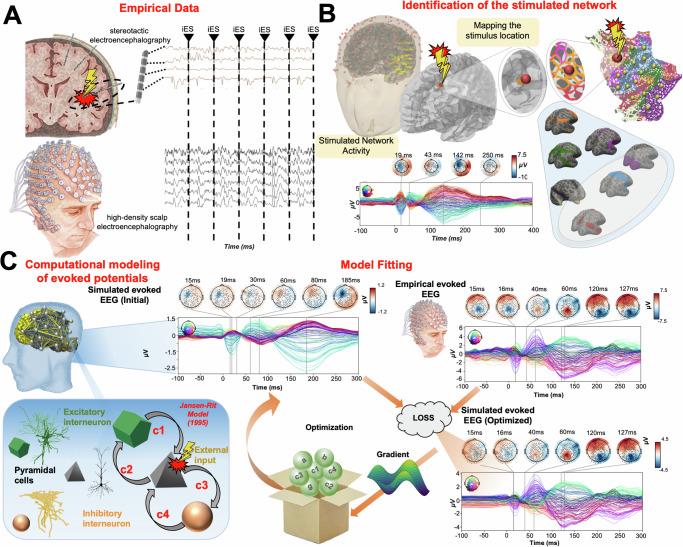
The human brain exhibits a modular and hierarchical structure, spanning low-order sensorimotor to high-order cognitive/affective systems. What is the mechanistic significance of this organization for brain dynamics and information processing properties? We investigated this question using rare simultaneous multimodal electrophysiology (stereotactic and scalp electroencephalography - EEG) recordings in 36 patients with drug-resistant focal epilepsy during presurgical intracerebral electrical stimulation (iES) (323 stimulation sessions). Our analyses revealed an anatomical gradient of excitability across the cortex, with stronger iES-evoked EEG responses in high-order compared to low-order regions. Mathematical modeling further showed that this variation in excitability levels results from a differential dependence on recurrent feedback from non-stimulated regions across the anatomical hierarchy, and could be extinguished by suppressing those connections in-silico. High-order brain regions/networks thus show an activity pattern characterized by more inter-network functional integration than low-order ones, which manifests as a spatial gradient of excitability that is emergent from, and causally dependent on, the underlying hierarchical network structure. These findings offer new insights into how hierarchical brain organization influences cognitive functions and could inform strategies for targeted neuromodulation therapies.
人类大脑呈现出模块化和层次化结构,涵盖从低阶感觉运动到高阶认知/情感系统。这种组织对于脑动力学和信息处理特性的机制意义是什么?我们在36例耐药性局灶性癫痫患者术前进行脑内电刺激(iES)(323次刺激 session)期间,使用罕见的同步多模态电生理学(立体定向和头皮脑电图 - EEG)记录来研究这个问题。我们的分析揭示了整个皮层兴奋性的解剖学梯度,与低阶区域相比,高阶区域中iES诱发的EEG反应更强。数学建模进一步表明,这种兴奋性水平的变化源于对跨解剖层次结构中未受刺激区域的递归反馈的差异依赖性,并且可以通过在计算机模拟中抑制这些连接来消除。因此,高阶脑区/网络显示出一种活动模式,其特征是比低阶脑区/网络具有更多的网络间功能整合,这表现为一种兴奋性的空间梯度,它源自并因果依赖于潜在的层次网络结构。这些发现为层次化脑组织结构如何影响认知功能提供了新的见解,并可为靶向神经调节疗法的策略提供参考。


 Zotero 插件