Xiao Shihua, Li Jing
State Key Laboratory of Cognitive Science and Mental Health, Institute of Psychology, Chinese Academy of Sciences, Beijing, 100101, China.
Department of Psychology, University of Chinese Academy of Sciences, Beijing, 100049, China.
Mol Autism. 2025 Apr 4;16(1):23. doi: 10.1186/s13229-025-00656-2.
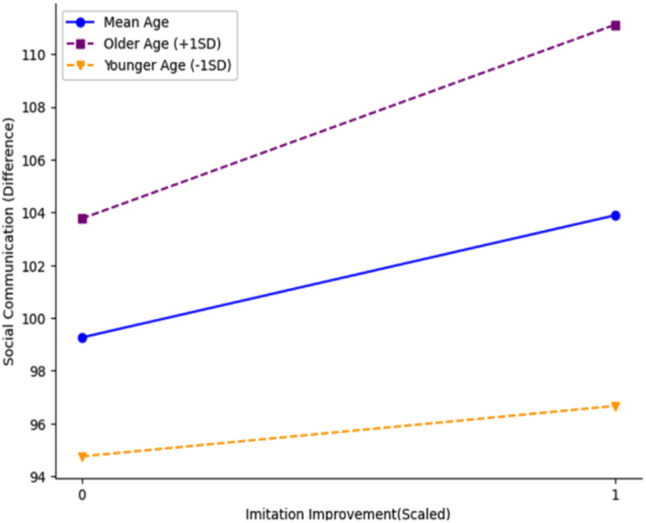
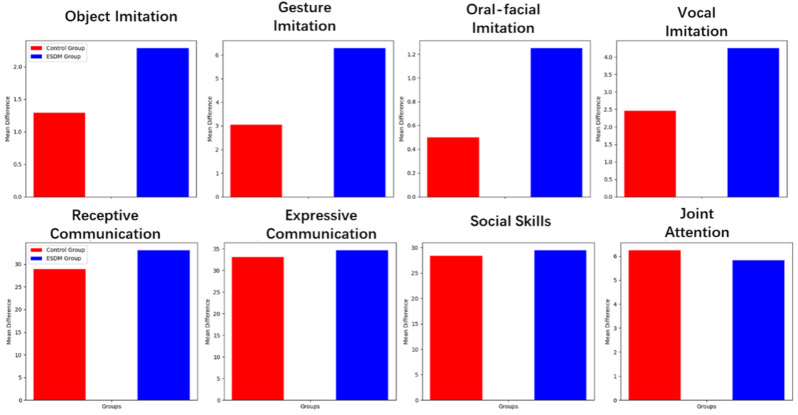
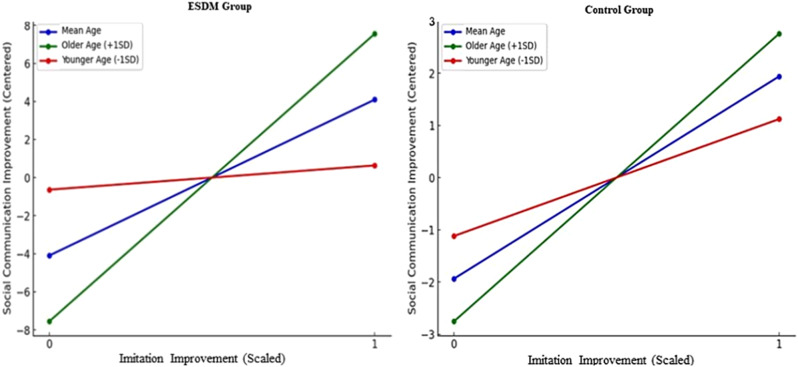
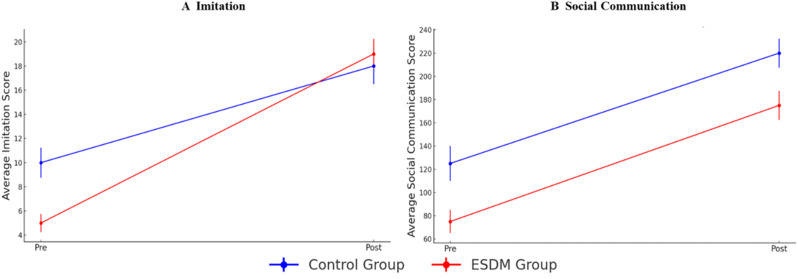
Imitation is foundational to early social learning, yet autistic children often exhibit significant impairments in imitation, potentially impacting their social communication skills. This study examined the relationship between imitation abilities and social communication in autistic children and evaluated the effectiveness of the Early Start Denver Model (ESDM) intervention. The study included 52 autistic children aged 2-5, divided into an experimental group receiving ESDM intervention and a control group undergoing standard rehabilitation. We assessed the children's imitation and social communication skills before and after the intervention. Results indicated a significant positive correlation between imitation and social communication skills both before and after the intervention. Specifically, various forms of imitation (e.g., vocal, gestural, object-related) were closely linked to different domains of social communication (e.g., expressive communication, joint attention, social skills). Baseline imitation levels and improvements in imitation were significant predictors of enhanced social communication, jointly accounting for over half of the observed improvements in social communication, with imitation improvement being the strongest predictor. Age positively moderated the relationship between imitation and social communication, with older children showing a stronger impact of imitation on social communication. Although these effects were evident across groups, the ESDM group showed greater gains in imitation skills compared to the control group. However, we did not find evidence of an intervention effect on social communication skills. This study underscores the critical role of imitation in the social communication development of autistic children. These findings support the enhancement of imitation skills in early interventions for autistic children, highlighting the effectiveness of ESDM in fostering imitation abilities.
模仿是早期社会学习的基础,但自闭症儿童在模仿方面往往表现出显著缺陷,这可能会影响他们的社会沟通能力。本研究考察了自闭症儿童模仿能力与社会沟通之间的关系,并评估了早期丹佛启动模式(ESDM)干预的效果。该研究纳入了52名2至5岁的自闭症儿童,分为接受ESDM干预的实验组和接受标准康复治疗的对照组。我们在干预前后评估了儿童的模仿和社会沟通技能。结果表明,干预前后模仿与社会沟通技能之间均存在显著正相关。具体而言,各种形式的模仿(如发声、手势、与物体相关的模仿)与社会沟通的不同领域(如表达性沟通、共同注意、社交技能)密切相关。基线模仿水平和模仿能力的提高是社会沟通增强的重要预测因素,共同解释了观察到的社会沟通改善的一半以上,其中模仿能力的提高是最强的预测因素。年龄对模仿与社会沟通之间的关系起到正向调节作用,年龄较大的儿童中模仿对社会沟通的影响更强。尽管这些效应在各小组中都很明显,但与对照组相比,ESDM组在模仿技能方面有更大的提升。然而,我们没有发现干预对社会沟通技能有效果的证据。本研究强调了模仿在自闭症儿童社会沟通发展中的关键作用。这些发现支持在自闭症儿童的早期干预中增强模仿技能,突出了ESDM在培养模仿能力方面的有效性。