Asta Lisa, Di Bella Tiziana, La Fauci Belponer Francesca, Bruschetta Marianna, Martines Silvia, Basile Enrica, Boncoddo Maria, Bellomo Fabiana, Cucinotta Francesca, Ricciardello Arianna, Turriziani Laura, Colombi Costanza, Banchelli Federico, Cuoghi Costantini Riccardo, D'Amico Roberto, Persico Antonio M
Department of Biomedical, Metabolic and Neural Sciences, University of Modena and Reggio Emilia, Modena, Italy.
Interdepartmental Program "Autism 0-90", "G. Martino" University Hospital, Messina, Italy.
Front Psychiatry. 2024 May 30;15:1358419. doi: 10.3389/fpsyt.2024.1358419. eCollection 2024.
The effectiveness of early interventions in young autistic children is well established, but there is great interindividual variability in treatment response. Predictors of response to naturalistic developmental behavioral interventions (NDBI), like the Early Start Denver Model (ESDM), are needed.
We conducted an exploratory study to prospectively seek predictors of response in 32 young children treated with ESDM after receiving an ASD diagnosis. All children were less than 39 months old (mean age: 29.7 mo), and received individualized ESDM for nine months. Tests were administered at the beginning, after 4 months, and at the end of treatment.
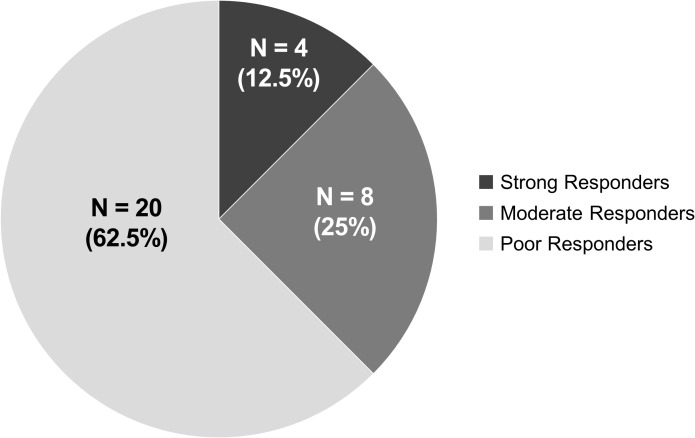
Four children (12.5%) were "strong responders", 8 children (25.0%) were "moderate responders", and 20 children (62.5%) were "poor responders". A more favorable response to ESDM was significantly predicted by higher PEP-3 Expressive Language, Receptive Language, Cognitive Verbal/Preverbal, Visuo-Motor Imitation scores, higher GMDS-ER Personal/Social, and VABS-II Communication scores, by lower ADI-R C restricted/stereotypic behaviors, and by joint attention level.
Most predictors showed a linear association with increasing response to ESDM, but GMDS-ER Personal-Social and joint attention level predicted strong response, while PEP-3 receptive language equally predicted moderate or strong response. Although larger samples will be necessary to reach definitive conclusions, in conjunction with prior reports our findings begin providing information able to assist clinicians in choosing the most appropriate treatment program for young autistic children.
早期干预对年幼自闭症儿童的有效性已得到充分证实,但个体对治疗的反应存在很大差异。因此,需要找出像早期丹佛模式(ESDM)这类自然发展行为干预(NDBI)反应的预测因素。
我们进行了一项探索性研究,前瞻性地寻找32名确诊为自闭症谱系障碍(ASD)后接受ESDM治疗的幼儿反应的预测因素。所有儿童年龄均小于39个月(平均年龄:29.7个月),并接受了为期九个月的个性化ESDM治疗。在治疗开始时、4个月后和治疗结束时进行测试。
4名儿童(12.5%)为“强反应者”,8名儿童(25.0%)为“中度反应者”,20名儿童(62.5%)为“弱反应者”。PEP-3表达性语言、接受性语言、认知语言/前语言、视觉运动模仿得分较高,GMDS-ER个人/社交和VABS-II沟通得分较高,ADI-R C受限/刻板行为得分较低,以及联合注意水平较高,显著预测了对ESDM的更有利反应。
大多数预测因素与对ESDM反应的增加呈线性关系,但GMDS-ER个人-社交和联合注意水平预测了强反应,而PEP-3接受性语言同样预测了中度或强反应。尽管需要更大的样本量才能得出明确结论,但结合先前的报告,我们的研究结果开始提供信息,帮助临床医生为年幼自闭症儿童选择最合适的治疗方案。