Zhu Suqin, Huang Zhiqing, Chen Xiaojing, Jiang Wenwen, Zhou Yuan, Zheng Beihong, Sun Yan
Center of Reproductive Medicine, College of Clinical Medicine for Obstetrics & Gynecology and Pediatrics, Fujian Maternity and Child Health Hospital, Fujian Medical University, No. 18 Daoshan Road, Fuzhou City, 350001, Fujian Province, China.
Fujian Maternal-Fetal Clinical Medicine Research Center, Fuzhou, 350001, China.
J Ovarian Res. 2025 Apr 4;18(1):70. doi: 10.1186/s13048-025-01654-x.
To investigate the determinants affecting live birth outcomes in fresh embryo transfer among polycystic ovary syndrome (PCOS) patients using various machine learning (ML) algorithms and to construct predictive models, offering novel insights for enhancing live birth rates in this specific group.
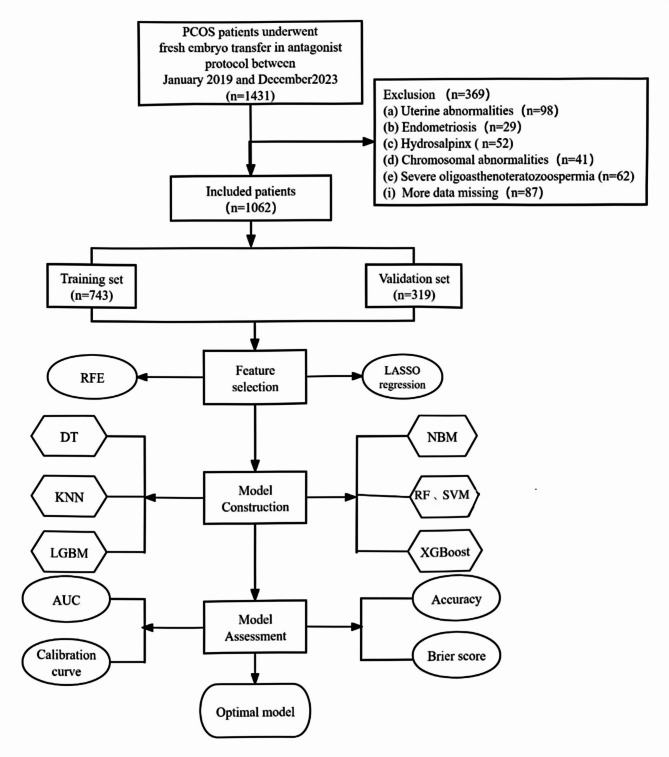
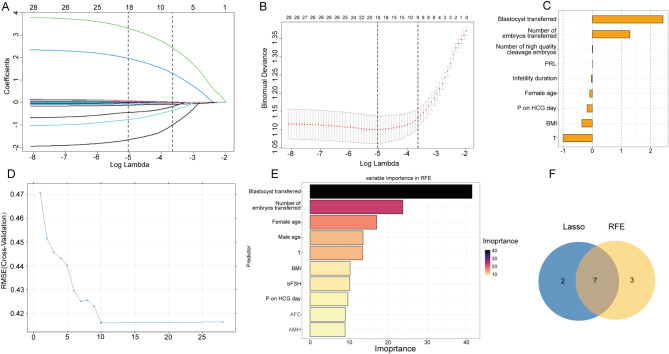
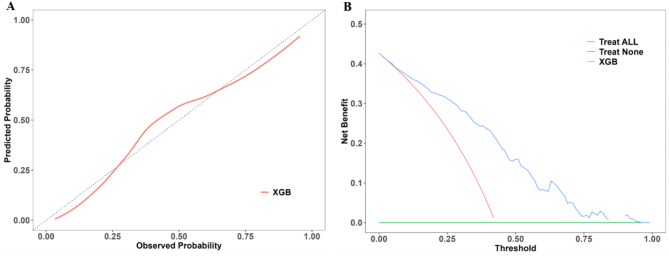
A sum of 1,062 fresh embryo transfer cycles involving PCOS patients were analyzed, with 466 resulting in live births. The dataset was split randomly into training and testing subsets at a 7:3 ratio. Least absolute shrinkage and selection operator and recursive feature elimination methods were utilized for feature selection within the training data. A grid search strategy identified the optimal parameters for seven ML models: decision tree (DT), K-nearest neighbors (KNN), light gradient boosting machine (LightGBM), naive Bayes model(NBM), random forest (RF), support vector machine (SVM) and extreme gradient boosting (XGBoost). The evaluation of model effectiveness incorporated diverse metrics, encompassing area under the curve (AUC), accuracy, positive predictive value, negative predictive value, F1 score, and Brier score. Calibration curves and decision curve analysis were employed to ascertain the optimal model. Furthermore, Shapley additive explanations were applied to elucidate the importance of predictor variables in the top-performing model.
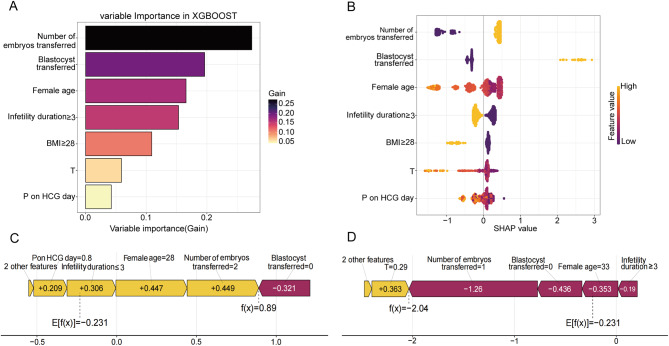
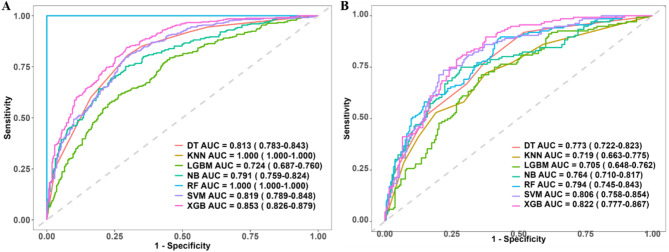
The AUC values of DT, KNN, LightGBM, NBM, RF, SVM and XGBoost models in the training set were 0.813, 1.000, 0.724, 0.791, 1.000, 0.819 and 0.853, respectively. Corresponding values in the testing set were 0.773, 0.719, 0.705, 0.764, 0.794, 0.806 and 0.822. XGBoost emerged as the most effective ML model. SHAP analysis revealed that variables encompassing embryo transfer count, embryo type, maternal age, infertility duration, body mass index, serum testosterone (T) levels, and progesterone (P) levels on the day of human chorionic gonadotropin administration were pivotal predictors of live birth outcomes in individuals with PCOS receiving fresh embryo transfer.
This study developed a live birth prediction model tailored for PCOS fresh embryo transfer cycles, leveraging ML algorithms to compare the efficacy of multiple models. The XGBoost model demonstrated superior predictive capacity, enabling prompt and precise identification of critical risk factors influencing live birth outcomes in PCOS patients. These findings offer actionable insights for clinical intervention, guiding strategies to improve pregnancy outcomes in this population.
Not applicable.
使用各种机器学习(ML)算法研究影响多囊卵巢综合征(PCOS)患者新鲜胚胎移植活产结局的决定因素,并构建预测模型,为提高这一特定群体的活产率提供新见解。
分析了1062个涉及PCOS患者的新鲜胚胎移植周期,其中466个导致活产。数据集以7:3的比例随机分为训练子集和测试子集。在训练数据中使用最小绝对收缩和选择算子以及递归特征消除方法进行特征选择。网格搜索策略确定了七个ML模型的最佳参数:决策树(DT)、K近邻(KNN)、轻梯度提升机(LightGBM)、朴素贝叶斯模型(NBM)、随机森林(RF)、支持向量机(SVM)和极端梯度提升(XGBoost)。模型有效性评估纳入了多种指标,包括曲线下面积(AUC)、准确性、阳性预测值、阴性预测值、F1分数和布里尔分数。采用校准曲线和决策曲线分析来确定最佳模型。此外,应用夏普利加性解释来阐明预测变量在表现最佳模型中的重要性。
DT、KNN、LightGBM、NBM、RF、SVM和XGBoost模型在训练集中的AUC值分别为0.813、1.000、0.724、0.791、1.000、0.819和0.853。测试集中的相应值为0.773、0.719、0.705、0.764、0.794、0.806和0.822。XGBoost成为最有效的ML模型。SHAP分析表明,包括胚胎移植次数、胚胎类型、产妇年龄、不孕持续时间、体重指数、人绒毛膜促性腺激素给药当天的血清睾酮(T)水平和孕酮(P)水平等变量是接受新鲜胚胎移植的PCOS个体活产结局的关键预测因素。
本研究利用ML算法开发了一种针对PCOS新鲜胚胎移植周期的活产预测模型,以比较多个模型的疗效。XGBoost模型显示出卓越的预测能力,能够迅速准确地识别影响PCOS患者活产结局的关键风险因素。这些发现为临床干预提供了可操作的见解,指导改善该人群妊娠结局的策略。
不适用。