Adamik Larissa, Dou Paul Samir, Philippe Géraldine, Blanc Richard, Vásquez-Ocmín Pedro, Marti Guillaume, Langin Thierry, Bonhomme Ludovic
Université Clermont Auvergne, INRAE, GDEC, 63000, Clermont-Ferrand, France.
Université Clermont Auvergne, INRAE, UMR Herbivores, VetAgroSup, Saint-Genès- Champanelle, France.
Sci Rep. 2025 Apr 6;15(1):11773. doi: 10.1038/s41598-025-96159-4.
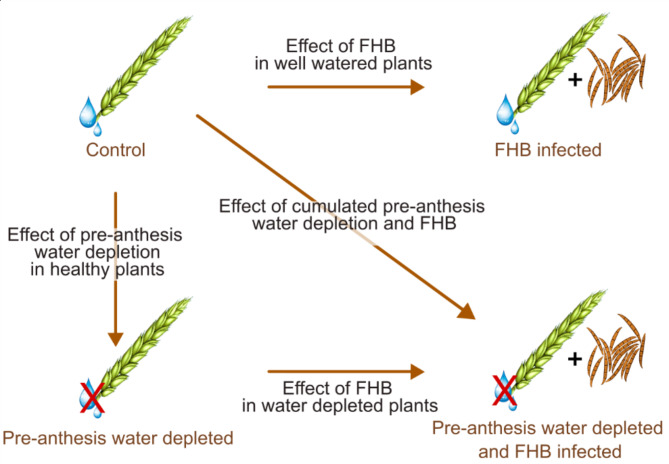
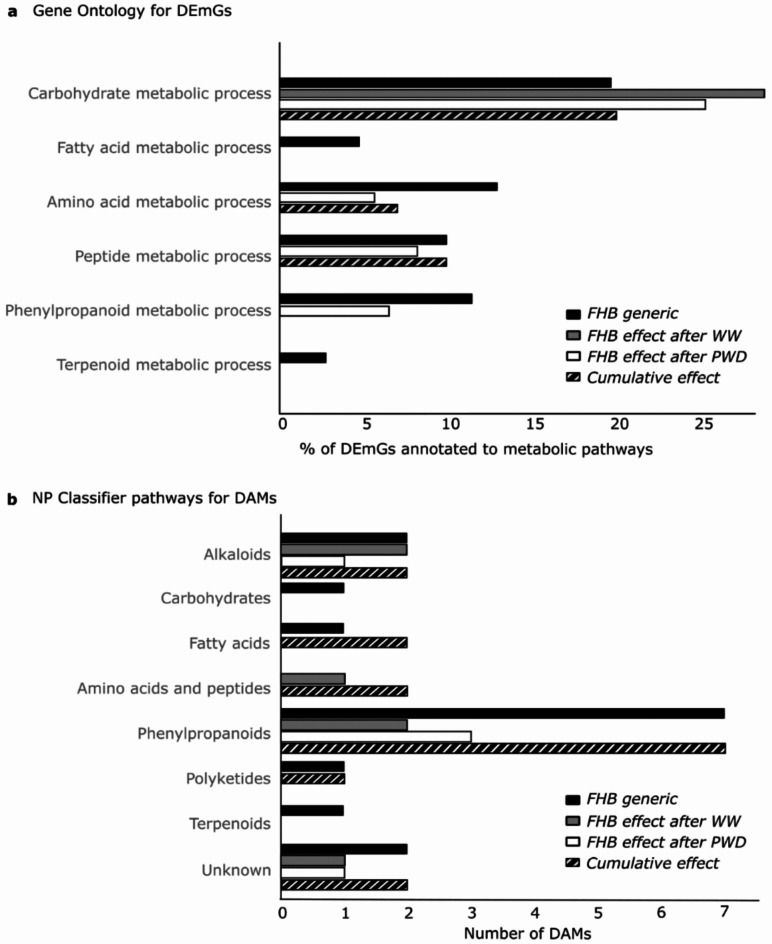
The impact of abiotic challenges on plant physiology reshapes plant-pathogen interactions by modulating the plant immune responses. In wheat, the development of Fusarium Head Blight (FHB) is heavily influenced by environmental conditions, especially during the pre-anthesis stage, just before fungal infection occurs. The early stages of infection are thus likely conditioned by prior environmental changes with consequences on the disease outcome that require further characterization. In this study, we aimed to assess the impact of pre-anthesis water depletion followed by rapid rehydration at inoculation on the expression of FHB-related molecular determinants with emphasis on susceptibility factors and metabolism-related processes. Water depletion altered plant physiology and its effects remained detectable after three days after rehydration, leading to significantly reduced FHB symptoms. Dual-transcriptomics, combined with untargeted metabolomics, revealed two key findings including (i) extensive metabolic changes specific to prior water stress, and (ii) the strong conservation of previously identified candidate susceptibility genes regulation. Considering the combined stress effects, a unique response signature emerged, highlighting that immune responses are strongly interwoven with physiological adjustments. Our findings provide new insights into the trade-offs that plants make under multiple challenges and identify original wheat metabolic determinants that may improve FHB resistance even in suboptimal physiological conditions.
非生物胁迫对植物生理的影响通过调节植物免疫反应重塑了植物与病原体的相互作用。在小麦中,赤霉病(FHB)的发生受环境条件的严重影响,尤其是在花期前阶段,即真菌感染发生之前。因此,感染的早期阶段可能受先前环境变化的影响,其对疾病结果的影响需要进一步表征。在本研究中,我们旨在评估花期前水分亏缺随后在接种时快速复水对接种FHB相关分子决定因素表达的影响,重点关注感病因子和代谢相关过程。水分亏缺改变了植物生理,其影响在复水三天后仍可检测到,导致FHB症状显著减轻。双转录组学结合非靶向代谢组学揭示了两个关键发现,包括(i)先前水分胁迫特有的广泛代谢变化,以及(ii)先前鉴定的候选感病基因调控的高度保守性。考虑到复合胁迫效应,出现了一种独特的反应特征,突出表明免疫反应与生理调节紧密交织。我们的研究结果为植物在多重挑战下的权衡提供了新见解,并确定了即使在次优生理条件下也可能提高FHB抗性的原始小麦代谢决定因素。