Jiangsu Key Laboratory of Crop Genomics and Molecular Breeding/Key Laboratory of Plant Functional Genomics of the Ministry of Education/Jiangsu Key Laboratory of Crop Genetics and Physiology, Yangzhou University, Yangzhou 225009, China.
Joint International Research Laboratory of Agriculture and Agri-Product Safety, The Ministry of Education of China, Yangzhou University, Yangzhou 225009, China.
Int J Mol Sci. 2024 Aug 30;25(17):9452. doi: 10.3390/ijms25179452.
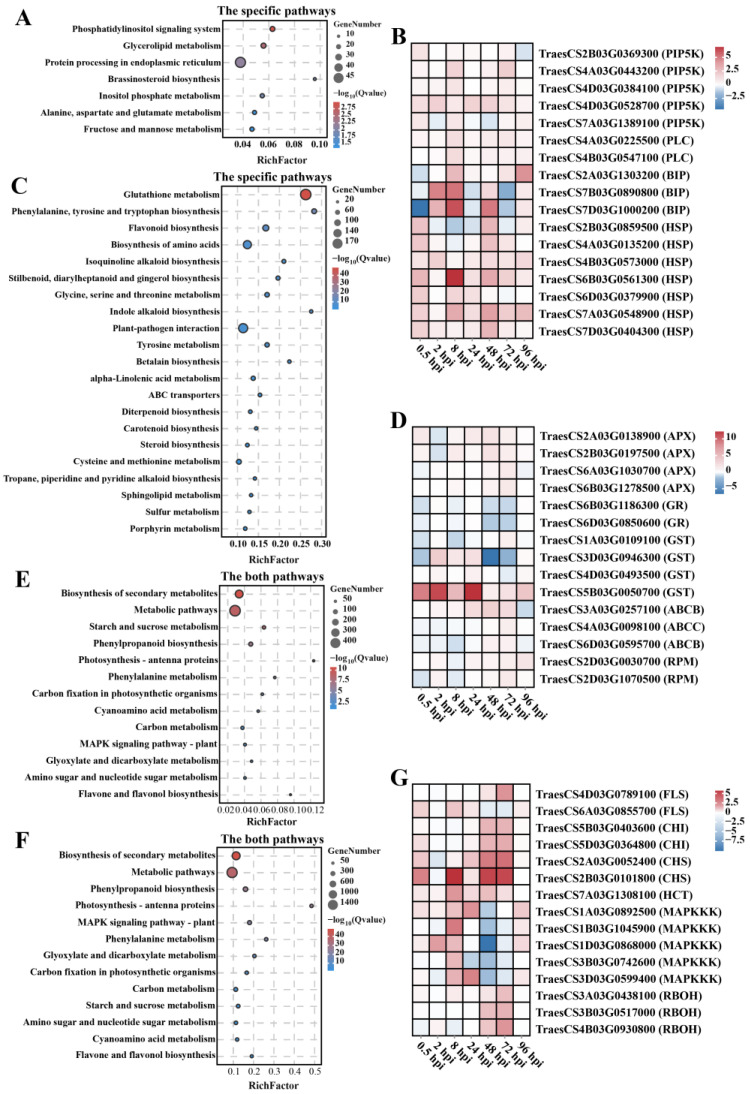
Fusarium head blight (FHB), caused by the species complex, is a destructive disease in wheat worldwide. The lack of FHB-resistant germplasm is a barrier in wheat breeding for resistance to FHB. is an important relative that has been successfully used for the genetic improvement of wheat. In this study, a translocation line, YNM158, with the YM158 genetic background carrying a fragment of diploid 7EL chromosome created using Co-γ radiation, showed high resistance to FHB under both field and greenhouse conditions. Transcriptome analysis confirmed that the horizontal transfer gene, encoding glutathione S-transferase (), is an important contributor to FHB resistance in the pathogen infection stage, whereas the 7EL chromosome fragment carries other genes regulated by during the colonization stage. Introgression of the 7EL fragment affected the expression of wheat genes that were enriched in resistance pathways, including the phosphatidylinositol signaling system, protein processing in the endoplasmic reticulum, plant-pathogen interaction, and the mitogen-activated protein kinase (MAPK) signaling pathway at different stages after infection. This study provides a novel germplasm for wheat resistance to FHB and new insights into the molecular mechanisms of wheat resistance to FHB.
镰刀菌穗腐病(FHB)是由 种复合体引起的一种破坏性疾病,在世界范围内广泛影响小麦。缺乏抗 FHB 的种质资源是小麦抗 FHB 育种的一个障碍。 是一个重要的近缘物种,已成功用于小麦的遗传改良。本研究中,一个易位系 YNM158,携带有 Co-γ 辐射创制的来自二倍体 7EL 染色体的片段,在田间和温室条件下均表现出对 FHB 的高抗性。转录组分析证实,水平转移基因,编码谷胱甘肽 S-转移酶(),在病原菌侵染阶段是 FHB 抗性的一个重要贡献者,而 7EL 染色体片段则携带其他在定植阶段受 调节的基因。7EL 片段的导入影响了在 感染后不同阶段富集在抗性途径中的小麦基因的表达,包括磷酸肌醇信号系统、内质网中的蛋白质加工、植物-病原体相互作用和丝裂原活化蛋白激酶(MAPK)信号通路。本研究为小麦抗 FHB 提供了一种新的种质资源,并为小麦抗 FHB 的分子机制提供了新的见解。