Netzler Luka, Lovell Brian
Department of Psychology, Northumbria University, Newcastle Upon Tyne, UK.
Hum Psychopharmacol. 2025 May;40(3):e70005. doi: 10.1002/hup.70005.
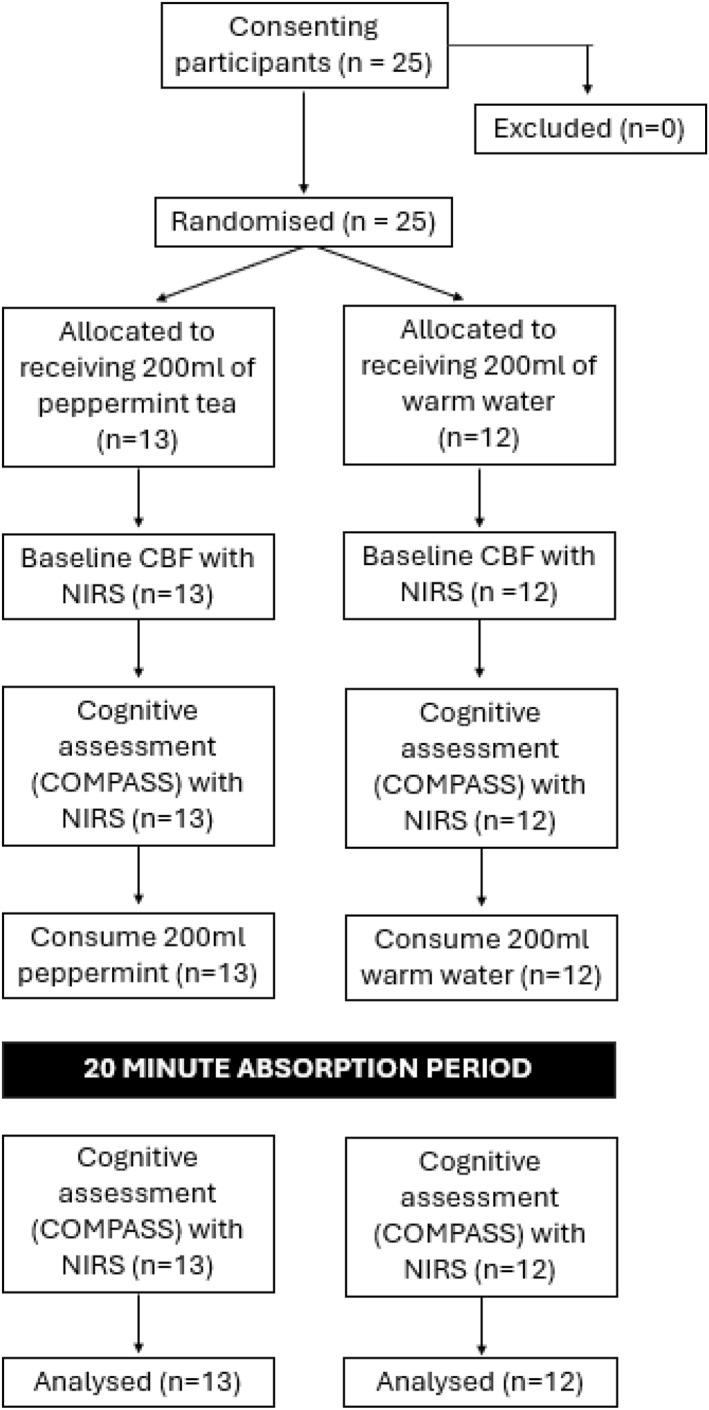
The cognitive-enhancing effects of peppermint have been widely reported. Vasodilation, causing an increase in cerebral blood flow (CBF) in the prefrontal cortex, has been implicated as a possible mediator. We tested this here. A total of N = 25 individuals, all aged over 18 years, were recruited via convenience sampling. A randomized, single blind placebo-controlled, independent groups design was used to assess whether groups (peppermint vs. placebo control) could be differentiated with respect to change in cognition, assessed via a computerized battery, and change in cerebral blood flow, assessed with Near-Infrared-Spectroscopy (NIRS), from pre-post intervention. Groups disparities in both cognitive and cerebrovascular change scores (from pre-post intervention) emerged. Improvements in cognitive performance were better in the peppermint group. Increases in hemodynamic activity, indexed by Oxygenated (Oxy-Hb) and Total hemoglobin (Total-Hb), were also greater in the peppermint group. Cerebrovascular changes from pre-to post-intervention were unrelated to cognitive changes over the same period, ruling out mediation effects. In conclusion, 200 mL of peppermint, consumed as tea, effectively boosted cognition and cerebral blood flow in otherwise healthy adults. Increased cerebral blood flow, however, did not mediate the cognitive-enhancing effects of peppermint. Future research incorporating larger samples and exploring other neurophysiological mediators is encouraged.
薄荷的认知增强作用已有广泛报道。血管舒张会导致前额叶皮质的脑血流量(CBF)增加,这被认为是一种可能的介导因素。我们在此进行了测试。通过便利抽样招募了总共N = 25名年龄均超过18岁的个体。采用随机、单盲、安慰剂对照、独立组设计,以评估薄荷组与安慰剂对照组在认知变化(通过计算机化测试组合评估)以及脑血流量变化(通过近红外光谱法(NIRS)评估)方面从干预前到干预后的差异。两组在认知和脑血管变化评分(从干预前到干预后)上均出现了差异。薄荷组的认知表现改善更明显。以氧合血红蛋白(Oxy-Hb)和总血红蛋白(Total-Hb)为指标的血流动力学活动增加在薄荷组中也更为显著。从干预前到干预后的脑血管变化与同期的认知变化无关,排除了介导作用。总之,200毫升作为茶饮用的薄荷有效地提高了健康成年人的认知和脑血流量。然而,脑血流量增加并未介导薄荷的认知增强作用。鼓励未来开展纳入更大样本并探索其他神经生理介导因素的研究。