Hou Zi-Xuan, Li Wen-Jing, Pi Rong, Wang Han-Wen-Xi, Dai Meng-Na, Ouyang Yan, Li Su-Yun
Department of Nursing, Union Hospital, Tongji Medical College, Huazhong University of Science and Technology, Wuhan, 430022, China.
Curr Med Sci. 2025 Apr;45(2):321-330. doi: 10.1007/s11596-025-00038-y. Epub 2025 Apr 7.
Vitamin deficiencies, particularly in vitamins A, B12, and D, are prevalent across populations and contribute significantly to a range of health issues. While these deficiencies are well documented, the underlying etiology remains complex. Recent studies suggest a close link between the gut microbiota and the synthesis, absorption, and metabolism of these vitamins. However, the specific causal relationships between the gut microbiota composition and vitamin deficiencies remain poorly understood. Identifying key bacterial species and understanding their role in vitamin metabolism could provide critical insights for targeted interventions.
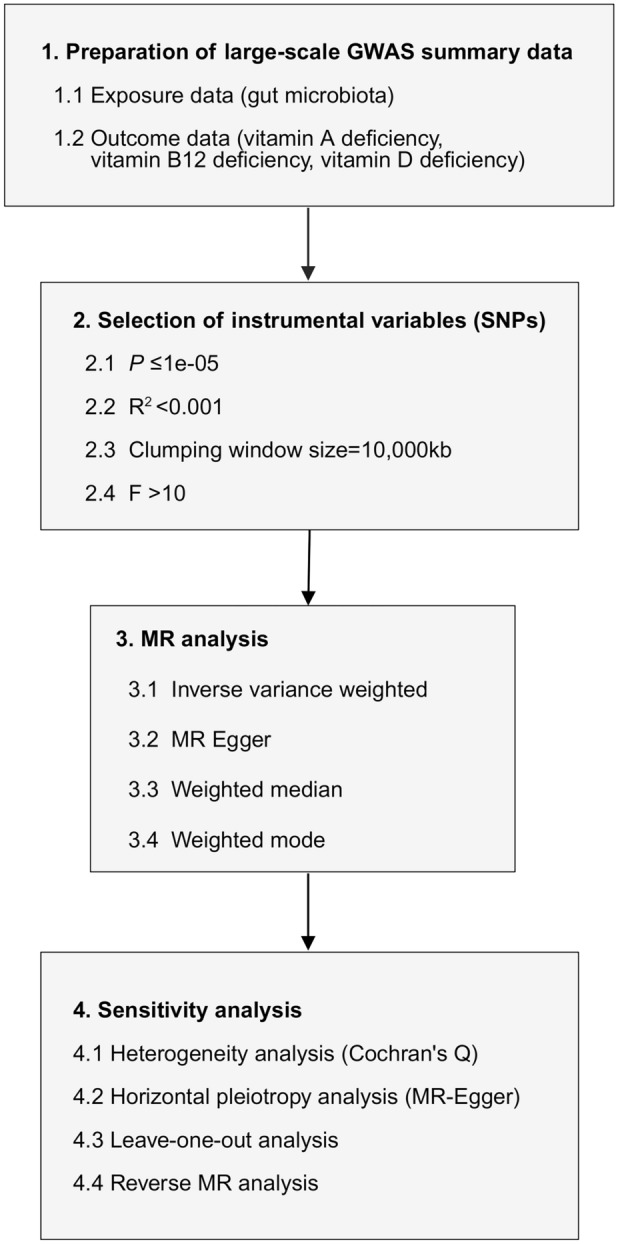
We conducted a two-sample Mendelian randomization (MR) study to assess the causal relationship between the gut microbiota and vitamin deficiencies (A, B12, D). The genome-wide association study data for vitamin deficiencies were sourced from the FinnGen biobank, and the gut microbiota data were from the MiBioGen consortium. MR analyses included inverse variance-weighted (IVW), MR‒Egger, weighted median, and weighted mode approaches. Sensitivity analyses and reverse causality assessments were performed to ensure robustness and validate the findings.
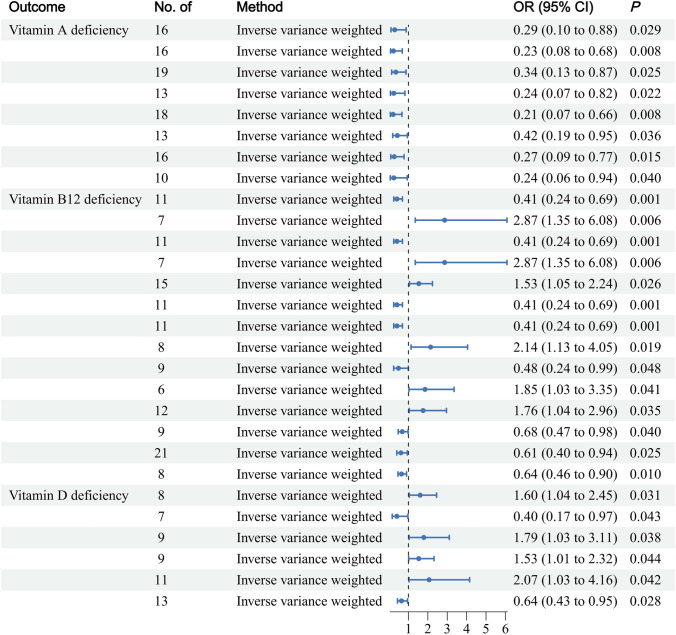
After FDR adjustment, vitamin B12 deficiency was associated with the class Verrucomicrobiae, order Verrucomicrobiales, family Verrucomicrobiaceae, and genus Akkermansia. Vitamin A deficiency was associated with the phylum Firmicutes and the genera Fusicatenibacter and Ruminiclostridium 6. Additional associations for vitamin B12 deficiency included the Enterobacteriaceae and Rhodospirillaceae and the genera Coprococcus 2, Lactococcus, and Ruminococcaceae UCG002. Vitamin D deficiency was associated with the genera Allisonella, Eubacterium, and Tyzzerella 3. Lachnospiraceae and Lactococcus were common risk factors for both B12 and D deficiency. Sensitivity analyses confirmed the robustness of the findings against heterogeneity and horizontal pleiotropy, and reverse MR tests indicated no evidence of reverse causality.
Our findings reveal a possible causal relationship between specific gut microbiota characteristics and vitamin A, B12 and D deficiencies, providing a theoretical basis for addressing these nutritional deficiencies through the modulation of the gut microbiota in the future and laying the groundwork for related interventions.
维生素缺乏,尤其是维生素A、B12和D的缺乏,在人群中普遍存在,并对一系列健康问题有重大影响。虽然这些缺乏情况已有充分记录,但其潜在病因仍然复杂。最近的研究表明,肠道微生物群与这些维生素的合成、吸收和代谢之间存在密切联系。然而,肠道微生物群组成与维生素缺乏之间的具体因果关系仍知之甚少。识别关键细菌种类并了解它们在维生素代谢中的作用可为靶向干预提供关键见解。
我们进行了一项两样本孟德尔随机化(MR)研究,以评估肠道微生物群与维生素缺乏(A、B12、D)之间的因果关系。维生素缺乏的全基因组关联研究数据来自芬兰基因生物银行,肠道微生物群数据来自微生物基因组联盟。MR分析包括逆方差加权(IVW)、MR-Egger、加权中位数和加权模式方法。进行了敏感性分析和反向因果关系评估,以确保结果的稳健性并验证研究结果。
经过FDR校正后,维生素B12缺乏与疣微菌门、疣微菌目、疣微菌科和阿克曼氏菌属有关。维生素A缺乏与厚壁菌门以及梭菌属和瘤胃梭菌属6有关。维生素B12缺乏的其他关联包括肠杆菌科和红螺菌科以及粪球菌属2、乳球菌属和瘤胃球菌科UCG002。维生素D缺乏与Allisonella属、真杆菌属和泰泽菌属3有关。毛螺菌科和乳球菌属是维生素B12和D缺乏的共同危险因素。敏感性分析证实了研究结果对异质性和水平多效性的稳健性,反向MR检验表明没有反向因果关系的证据。
我们的研究结果揭示了特定肠道微生物群特征与维生素A、B12和D缺乏之间可能存在的因果关系,为未来通过调节肠道微生物群解决这些营养缺乏问题提供了理论基础,并为相关干预措施奠定了基础。