Moat Genevieve Jiawei, Gaudet-Trafit Maxime, Paul Julian, Bacardit Jaume, Ben Hamed Suliann, Poirier Colline
School of Computing, Newcastle University, Newcastle upon Tyne, UK.
Institut des Sciences Cognitives Marc Jeannerod, UMR5229, CNRS-Université Claude Bernard Lyon I, Bron, France.
Sci Rep. 2025 Apr 7;15(1):11883. doi: 10.1038/s41598-025-95180-x.
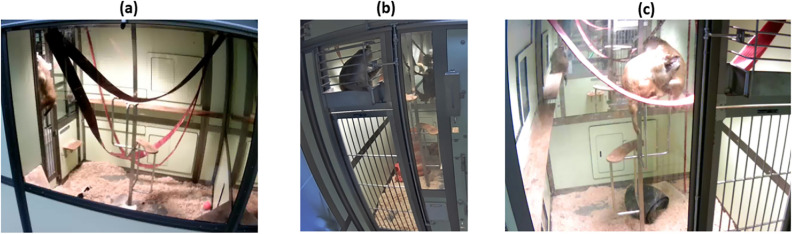
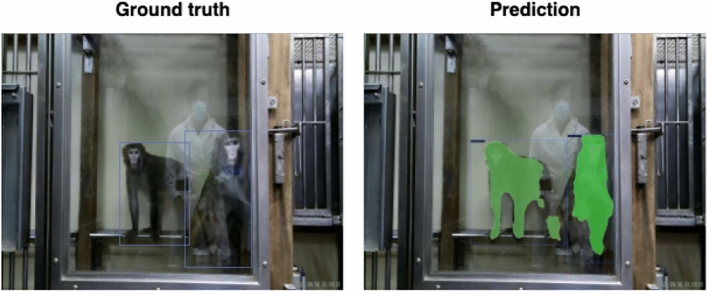
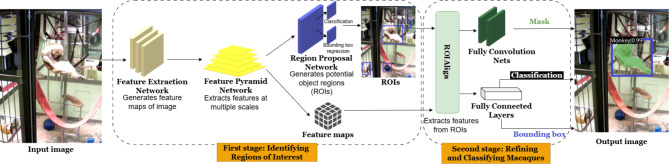
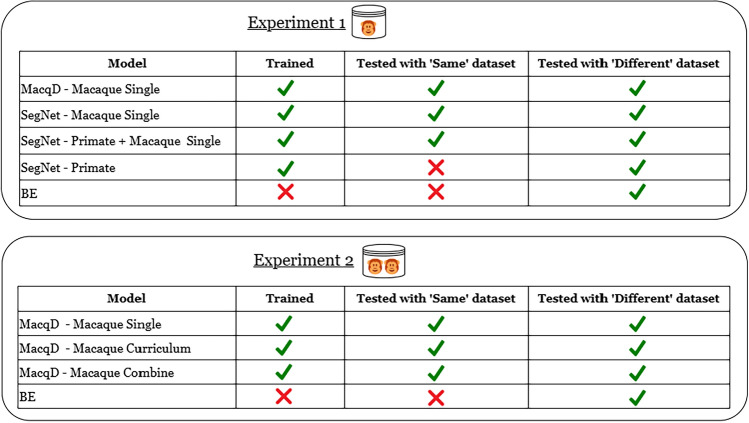
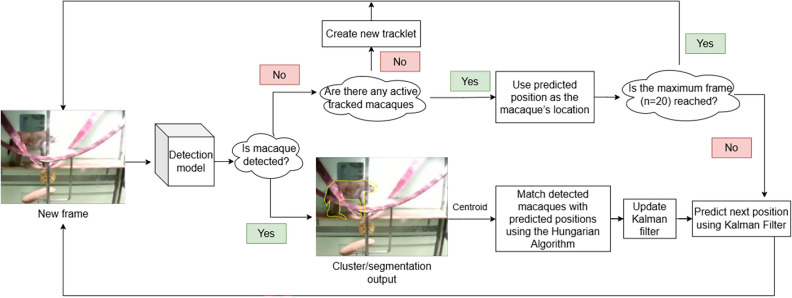
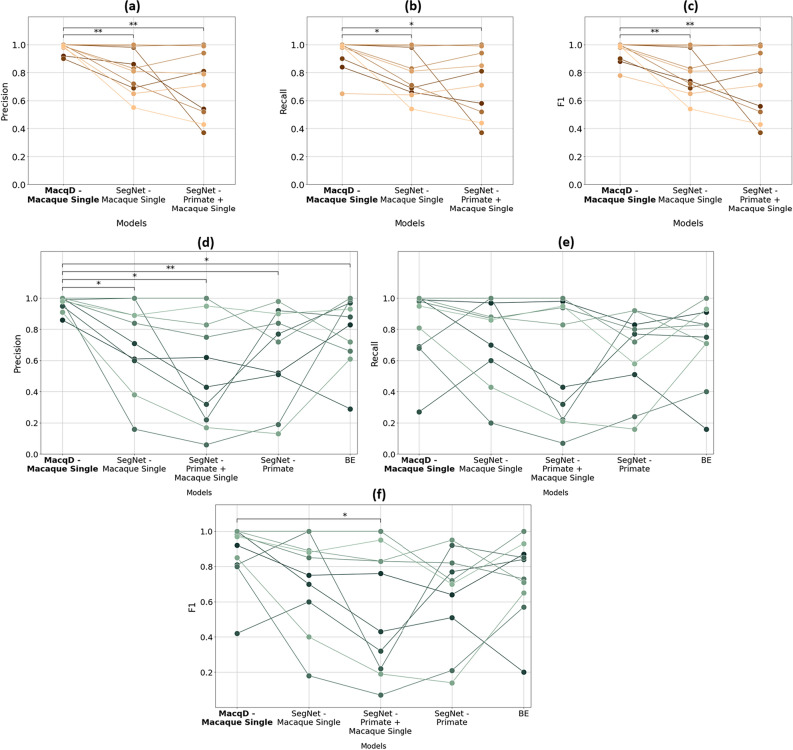
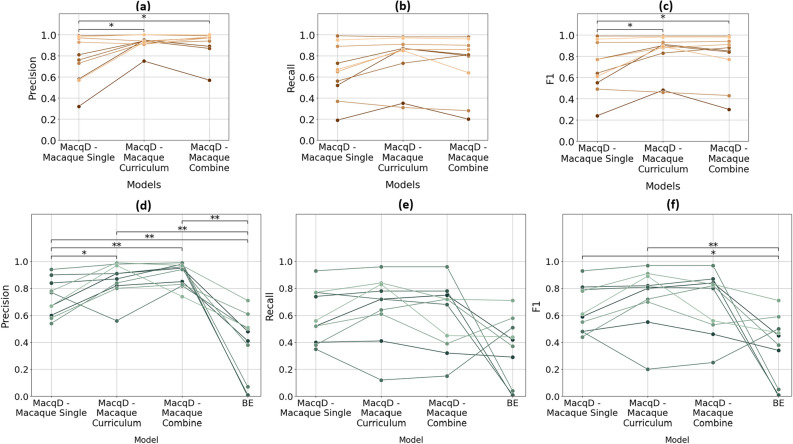
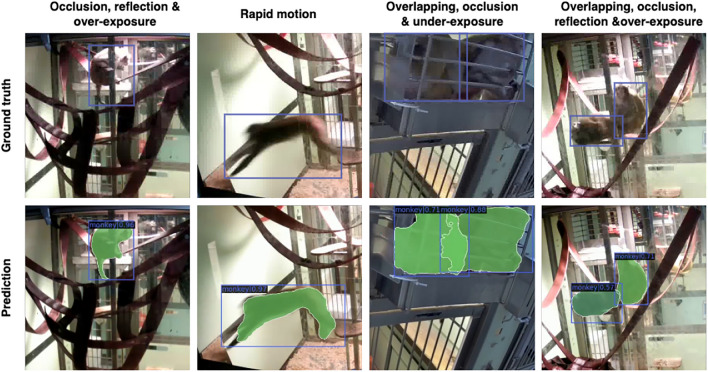
Despite advancements in video-based behaviour analysis and detection models for various species, existing methods are suboptimal to detect macaques in complex laboratory environments. To address this gap, we present MacqD, a modified Mask R-CNN model incorporating a SWIN transformer backbone for enhanced attention-based feature extraction. MacqD robustly detects macaques in their home-cage under challenging scenarios, including occlusions, glass reflections, and overexposure to light. To evaluate MacqD and compare its performance against pre-existing macaque detection models, we collected and analysed video frames from 20 caged rhesus macaques at Newcastle University, UK. Our results demonstrate MacqD's superiority, achieving a median F1-score of 99% for frames with a single macaque in the focal cage (surpassing the next-best model by 21%) and 90% for frames with two macaques. Generalisation tests on frames from a different set of macaques from the same animal facility yielded median F1-scores of 95% for frames with a single macaque (surpassing the next-best model by 15%) and 81% for frames with two macaques (surpassing the alternative approach by 39% ). Finally, MacqD was applied to videos of paired macaques from another facility and resulted in F1-score of 90%, reflecting its strong generalisation capacity. This study highlights MacqD's effectiveness in accurately detecting macaques across diverse settings.
尽管基于视频的行为分析和针对各种物种的检测模型取得了进展,但现有方法在复杂实验室环境中检测猕猴仍不尽人意。为了弥补这一差距,我们提出了MacqD,这是一种经过改进的Mask R-CNN模型,它结合了SWIN变压器主干,用于增强基于注意力的特征提取。MacqD能够在具有挑战性的场景下,包括遮挡、玻璃反射和光线过度曝光等情况下,稳健地检测笼舍中的猕猴。为了评估MacqD并将其性能与现有的猕猴检测模型进行比较,我们收集并分析了英国纽卡斯尔大学20只圈养恒河猴的视频帧。我们的结果证明了MacqD的优越性,对于焦点笼中只有一只猕猴的帧,其F1分数中位数达到99%(比次优模型高出21%),对于有两只猕猴的帧,F1分数中位数为90%。对来自同一动物设施的另一组猕猴的帧进行泛化测试,对于只有一只猕猴的帧,F1分数中位数为95%(比次优模型高出15%),对于有两只猕猴的帧,F1分数中位数为81%(比替代方法高出39%)。最后,MacqD应用于来自另一个设施的成对猕猴的视频,F1分数为90%,反映了其强大的泛化能力。这项研究突出了MacqD在不同环境中准确检测猕猴的有效性。