Wallace Zachary S, Park Jenny Y, Serra Elizabeth, Gagnon-Sanschagrin Patrick, Guérin Annie, Patterson Kristina, Patel Haridarshan, Singh Vikesh K
Division of Rheumatology, Allergy, and Immunology, Rheumatology and Allergy Clinical Epidemiology Research Center, Massachusetts General Hospital, 100 Cambridge Street, 16th Floor, Boston, MA, 02114, USA.
Amgen Inc, 1 Amgen Center Drive, Thousand Oaks, CA, 91320, USA.
Rheumatol Ther. 2025 Jun;12(3):547-560. doi: 10.1007/s40744-025-00763-9. Epub 2025 Apr 8.
Glucocorticoids are commonly used to treat immunoglobulin G4-related disease (IgG4-RD), but there is limited real-world evidence describing glucocorticoid-related toxicities in this population. This study assessed glucocorticoid use and toxicities during the first year after diagnosis among patients with IgG4-RD.
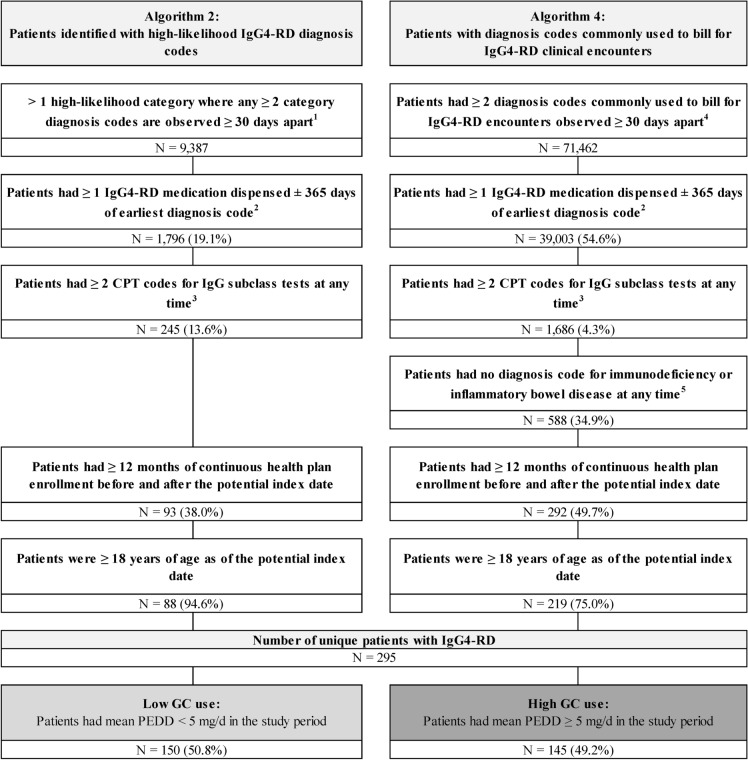
The IQVIA PharMetrics® Plus database was used to identify adults with IgG4-RD using a validated algorithm. Patients were stratified according to glucocorticoid use during the 12-month study period following the first observed IgG4-RD-related diagnosis (index date): low glucocorticoid use (prednisone equivalent daily dose [PEDD] < 5 mg/day) or high glucocorticoid use (PEDD ≥ 5 mg/day). Incident glucocorticoid-related toxicities were assessed during the study period and incidence was compared between groups using Chi-square tests.
Among 295 patients with IgG4-RD, 150 (50.8%) had low glucocorticoid use, and 145 (49.2%) had high glucocorticoid use during the study period. In each glucocorticoid group, mean PEDD was highest in the 3 months post-index and subsequently decreased. At 12 months post-index, 24.7% of the low glucocorticoid use group and 60.7% of the high glucocorticoid use group were receiving glucocorticoids. The high glucocorticoid use group had a significantly higher mean (± standard deviation) number of incident glucocorticoid-related toxicities (1.8 ± 1.7 vs. 1.2 ± 1.3) and more frequently had ≥ 3 glucocorticoid-related toxicities (29.0% vs. 13.3%; both p < 0.01) compared to the low glucocorticoid use group. Specifically, cardiovascular- (29.0% vs. 18.7%), gastrointestinal- (29.7% vs. 16.0%), and infection-related (31.0% vs. 17.3%) toxicities were significantly more common in the high glucocorticoid use group than the low glucocorticoid use group (all p < 0.05).
In this retrospective, claims-based analysis, high glucocorticoid use was seen in half of patients with IgG4-RD during the first year following diagnosis. Patients with high glucocorticoid use experienced significantly more incident glucocorticoid-related toxicities than those with low use during this first year.
糖皮质激素常用于治疗免疫球蛋白G4相关疾病(IgG4-RD),但在这一人群中,描述糖皮质激素相关毒性的真实世界证据有限。本研究评估了IgG4-RD患者确诊后第一年糖皮质激素的使用情况及毒性。
使用IQVIA PharMetrics® Plus数据库,通过经过验证的算法识别患有IgG4-RD的成年人。根据首次观察到的IgG4-RD相关诊断(索引日期)后的12个月研究期间的糖皮质激素使用情况对患者进行分层:低糖皮质激素使用(泼尼松等效日剂量[PEDD]<5毫克/天)或高糖皮质激素使用(PEDD≥5毫克/天)。在研究期间评估新发生的糖皮质激素相关毒性,并使用卡方检验比较两组之间的发生率。
在295例IgG4-RD患者中,150例(50.8%)在研究期间糖皮质激素使用量低,145例(49.2%)糖皮质激素使用量高。在每个糖皮质激素组中,索引后3个月的平均PEDD最高,随后下降。索引后12个月,低糖皮质激素使用组的24.7%和高糖皮质激素使用组的60.7%仍在接受糖皮质激素治疗。与低糖皮质激素使用组相比,高糖皮质激素使用组新发生的糖皮质激素相关毒性的平均(±标准差)数量显著更高(1.8±1.7对1.2±1.3),且更频繁地出现≥3种糖皮质激素相关毒性(29.0%对13.3%;均p<0.01)。具体而言,高糖皮质激素使用组的心血管毒性(29.0%对18.7%)、胃肠道毒性(29.7%对16.0%)和感染相关毒性(31.0%对17.3%)明显比低糖皮质激素使用组更常见(均p<0.05)。
在这项基于索赔的回顾性分析中,在确诊后的第一年,一半的IgG4-RD患者使用了高剂量糖皮质激素。在这第一年中,高糖皮质激素使用患者比低使用患者经历的新发生的糖皮质激素相关毒性明显更多。