Rossetti Renata Ariza Marques, Tordesillas Leticia, Beatty Matthew S, Cianne Junior, Martinez Planes Elena, Du Dongliang, Snedal Sebastian, Wang Chao, Perez Bradford A, Berglund Anders, Chen Yian Ann, Sarnaik Amod, Mulé James J, Creelan Benjamin, Pilon-Thomas Shari, Abate-Daga Daniel
Department of Immunology, H Lee Moffitt Cancer Center and Research Center Inc, Tampa, Florida, USA.
Department of Biostatistics and Bioinformatics, H Lee Moffitt Cancer Center and Research Center Inc, Tampa, Florida, USA.
J Immunother Cancer. 2025 Apr 8;13(4):e011066. doi: 10.1136/jitc-2024-011066.
Adoptive transfer of tumor-infiltrating lymphocytes (TIL) is now a Food and Drug Administration (FDA)-approved treatment for melanoma. While this is a major milestone, there is room for improvement to increase clinical response rates and to further optimize the manufacturing of TIL products. In this study, we characterized the association of tumor-infiltrating B-cells (TIL-B) and tertiary lymphoid structures (TLSs) with clinical response to TIL therapy and tested whether the presence of B-cells in the tumor can be leveraged to optimize TIL manufacture.
Tumor sections from TIL responders (R, n=9) and non-responders (NR, n=11) were analyzed by RNA sequencing, and immune cell content was estimated in silico. To study the association between B-cells and TIL expansion, we quantified B-cell subsets and TIL phenotype by flow cytometry. CD40L-induced effects on melanoma-infiltrating B-cells were analyzed by flow cytometry and scRNA-sequencing.
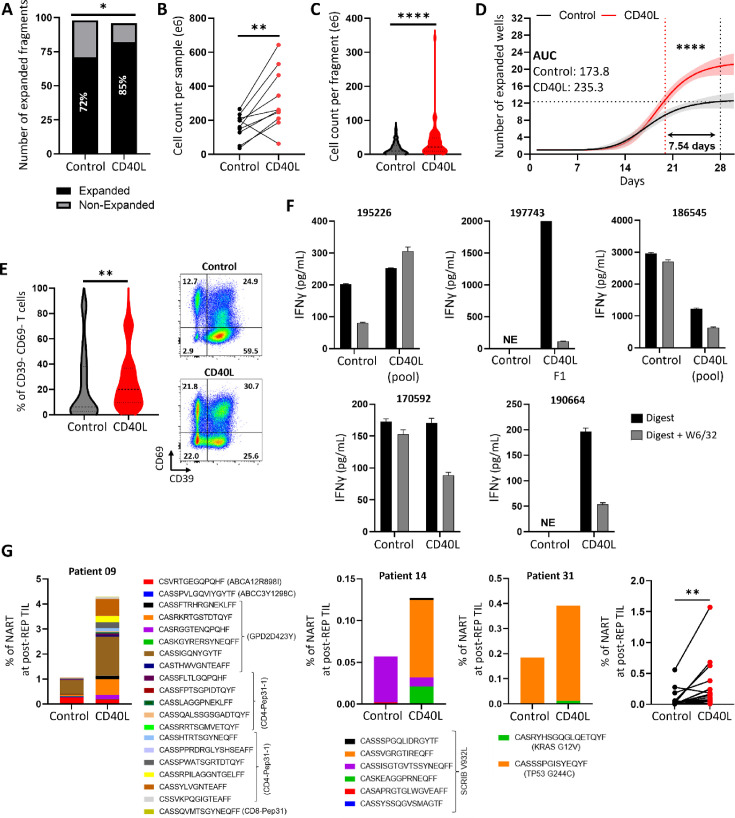
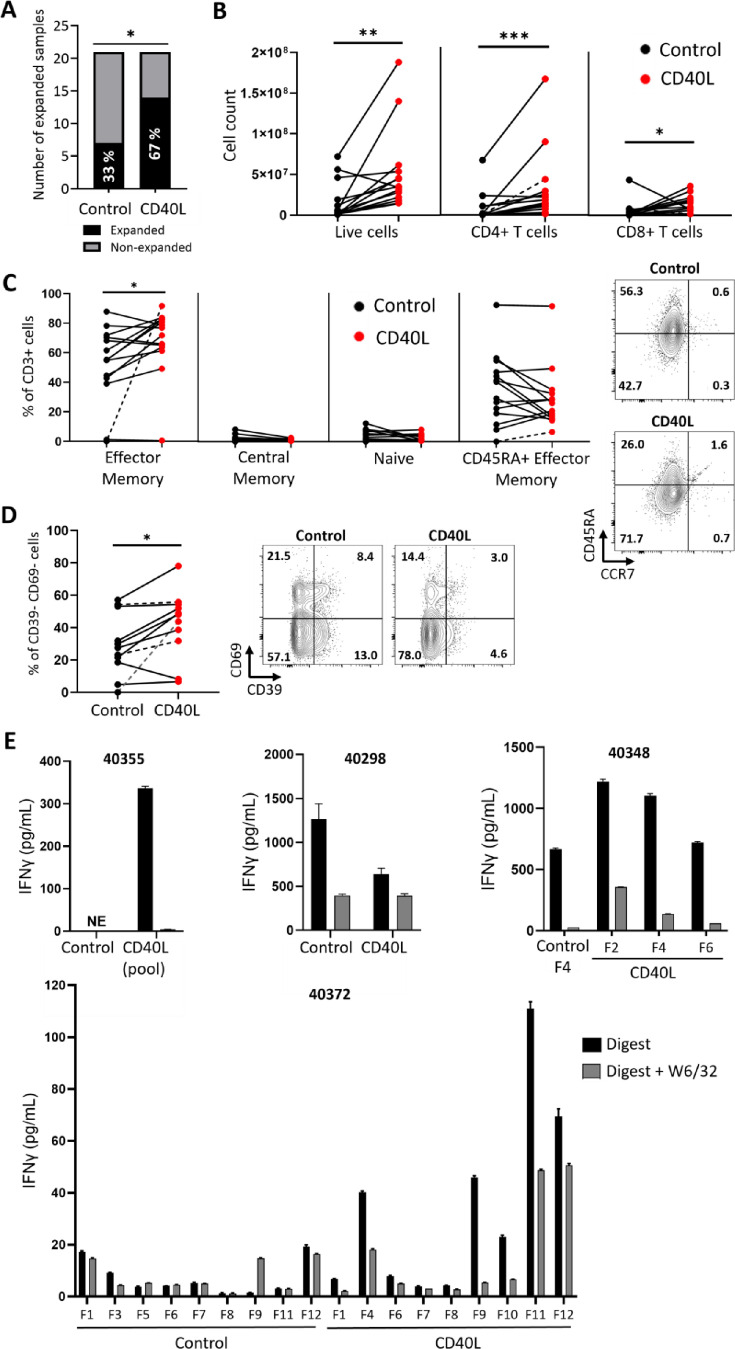
Tumors from TIL clinical responders had greater abundance of class-switched B-cells (p=0.007) and a greater TLS score (p=0.03) than those of NRs. In addition, greater abundance of B-cells (p≤0.05) and switched memory B-cells (CD27 IgD-, p≤0.05) in the tumors were associated with greater TIL expansion. Stimulation of TIL-B through addition of CD40L during TIL ex vivo culture improved their expansion success rate from 33% to 67% (p=0.03). Similarly, the addition of CD40L to non-small cell lung cancer (NSCLC) TIL cultures shortened the manufacturing period by 1 week. Moreover, CD40L-enhanced TIL showed more stem-like T-cells (CD39 CD69, p≤0.05) and an enrichment of neoantigen-reactive T-cell clones in NSCLC TIL. Gene expression analysis showed that CD40L induced gene expression changes in TIL-B after 48 hours in culture (126 differentially expressed genes (DEGs)), with minimal to no changes observed in other immune cell types (including 12 DEG in macrophages, 10 DEG in dendritic cells, and none in monocytes). B-cell DEGs included upregulated co-stimulatory ligands (CD83, CD58), chemokines (CCL22, CCL17), among others. CD40L-induced upregulation of CD58 by melanoma infiltrating B-cells was associated with successful TIL expansion.
Our results show that CD40L-stimulated B-cells can be leveraged to enhance the quality and quantity of TIL. Clinical trial NCT05681780 is currently testing this concept applied to NSCLC TIL.
过继性转移肿瘤浸润淋巴细胞(TIL)目前是美国食品药品监督管理局(FDA)批准的黑色素瘤治疗方法。虽然这是一个重大里程碑,但仍有改进空间,以提高临床缓解率并进一步优化TIL产品的制造。在本研究中,我们表征了肿瘤浸润B细胞(TIL-B)和三级淋巴结构(TLS)与TIL治疗临床反应的关联,并测试了肿瘤中B细胞的存在是否可用于优化TIL制造。
通过RNA测序分析TIL反应者(R,n = 9)和无反应者(NR,n = 11)的肿瘤切片,并在计算机上估计免疫细胞含量。为了研究B细胞与TIL扩增之间的关联,我们通过流式细胞术对B细胞亚群和TIL表型进行了定量。通过流式细胞术和单细胞RNA测序分析了CD40L对黑色素瘤浸润B细胞的诱导作用。
与NR患者相比,TIL临床反应者的肿瘤中类别转换B细胞丰度更高(p = 0.007),TLS评分更高(p = 0.03)。此外,肿瘤中B细胞(p≤0.05)和转换记忆B细胞(CD27 IgD-,p≤0.05)丰度更高与TIL扩增更强相关。在TIL体外培养期间通过添加CD40L刺激TIL-B可将其扩增成功率从33%提高到67%(p = 0.03)。同样,在非小细胞肺癌(NSCLC)TIL培养物中添加CD40L可将制造周期缩短1周。此外,CD40L增强的TIL在NSCLC TIL中显示出更多的干细胞样T细胞(CD39 CD69,p≤0.05)和新抗原反应性T细胞克隆的富集。基因表达分析表明,CD40L在培养48小时后诱导TIL-B中的基因表达变化(126个差异表达基因(DEG)),在其他免疫细胞类型中观察到的变化极小或没有变化(包括巨噬细胞中的12个DEG、树突状细胞中的10个DEG,单核细胞中无变化)。B细胞DEG包括共刺激配体(CD83、CD58)、趋化因子(CCL22、CCL17)等上调。黑色素瘤浸润B细胞通过CD40L诱导的CD58上调与TIL的成功扩增相关。
我们的结果表明,CD40L刺激的B细胞可用于提高TIL的质量和数量。临床试验NCT05681780目前正在测试将这一概念应用于NSCLC TIL。