Qin Ruixi, Li Jiajia, Zhou Liangru, Li Ruifeng
School of Management, Beijing University of Chinese Medicine, NO.11 Of North Three-ring East Road, Chao Yang District, Beijing, 100029, China.
BMC Med Educ. 2025 Apr 8;25(1):498. doi: 10.1186/s12909-025-07053-6.
Intergenerational transmission refers to the transfer of occupations, knowledge, or skills across generations. There is a consensus in the medical field that children of doctors are more likely to want to become doctors and that doctors from medical families are more likely to be trusted by their patients. This study explores the current state of intergenerational transmission in Chinese medical universities and its impact on students' academic and professional development, which towards more supportive policies for medical manpower development in low- and middle-income countries.
A survey was conducted among 434 students at the universities of Chinese medicine in Beijing and Nanjing. This study assessed the prevalence of intergenerational transmission and its influence on student competencies in medical thinking, practice, and innovation.
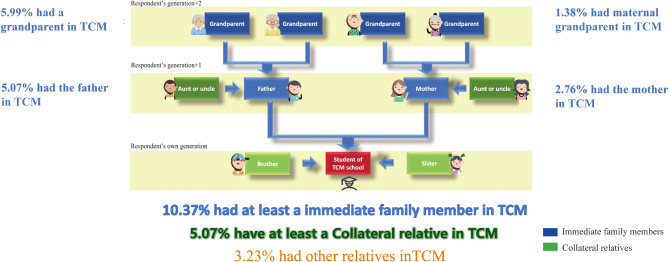
Approximately 18.66% of the students reported intergenerational inheritance of medicine, with 10.37% from direct lineage, 5.07% from collateral lineage, and 3.23% from other relatives. A majority (77.88%) of the respondents believed that doctors' family backgrounds positively impacted the learning and growth of medical students. Students with direct or collateral intergenerational inheritance demonstrated significantly higher innovation ability ([Formula: see text]=12.28, p < 0.05) and medical thinking skills (Coefficient = 9.52,p < 0.05) compared to those without such backgrounds. Regional factors and family inheritance influence students' overall competencies in medical studies.
Nearly one in five students had a family background in medicine, and most recognized its positive impact on their learning. Intergenerational transmission enhances innovation and medical thinking among students. Medical universities should incorporate intergenerational experiences into their training programs and encourage cross-cultural and intergenerational exchanges to develop students' critical thinking skills, practical skills, and innovation capacities.
代际传承是指职业、知识或技能在代与代之间的传递。医学领域存在一种共识,即医生的子女更有可能想要成为医生,且出身医学世家的医生更有可能获得患者的信任。本研究探讨了中国医科大学代际传承的现状及其对学生学业和职业发展的影响,旨在为低收入和中等收入国家的医学人力发展制定更具支持性的政策。
对北京和南京的中医药大学的434名学生进行了一项调查。本研究评估了代际传承的发生率及其对学生医学思维、实践和创新能力的影响。
约18.66%的学生报告有医学的代际传承,其中10.37%来自直系亲属,5.07%来自旁系亲属,3.23%来自其他亲属。大多数(77.88%)受访者认为医生的家庭背景对医学生的学习和成长有积极影响。与没有这种背景的学生相比,有直系或旁系代际传承的学生表现出显著更高的创新能力([公式:见正文]=12.28,p<0.05)和医学思维能力(系数=9.52,p<0.05)。地区因素和家庭传承会影响学生在医学学习方面的整体能力。
近五分之一的学生有医学家庭背景,且大多数人认识到其对自身学习的积极影响。代际传承提高了学生的创新能力和医学思维能力。医科大学应将代际经验纳入其培训计划,并鼓励跨文化和代际交流,以培养学生的批判性思维能力、实践技能和创新能力。