Salmeron Covarrubias Luis Pablo, Beluri Kavitha, Mohammadi Yasaman, Easmin Nusrat, Palacios Oskar A, Sharifan Hamidreza
Department of Earth, Environmental and Resource Sciences, University of Texas at El Paso, El Paso, Texas 79968, United States.
Environmental Science and Engineering Program, University of Texas at El Paso, El Paso, Texas 79968, United States.
ACS Appl Bio Mater. 2025 Apr 21;8(4):3513-3524. doi: 10.1021/acsabm.5c00300. Epub 2025 Apr 9.
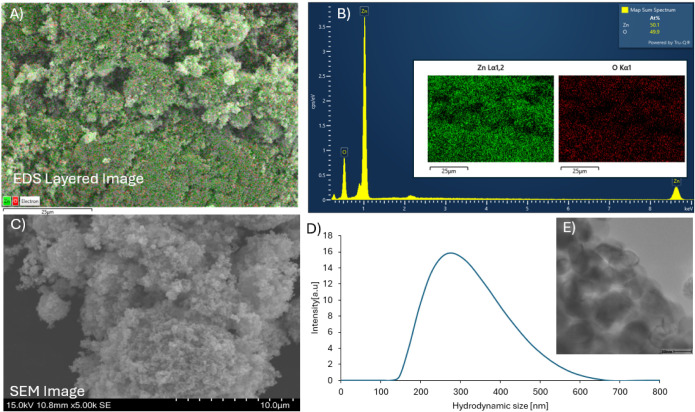
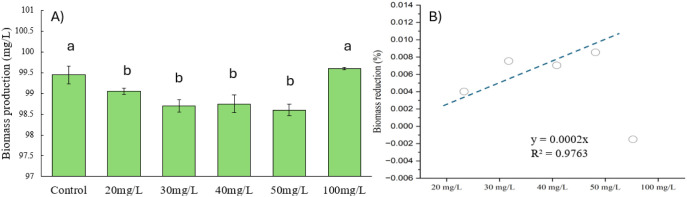
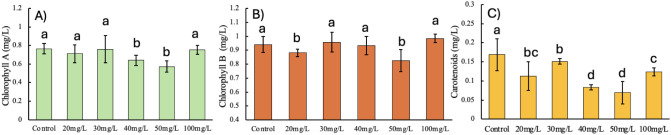
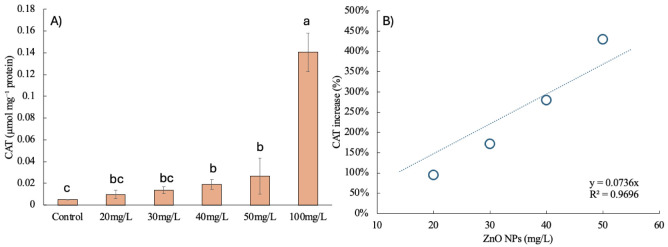
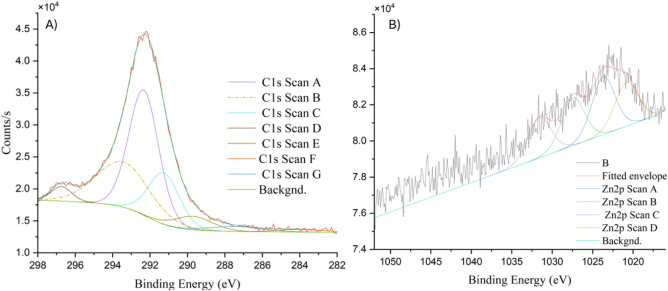
The growing demand for renewable energy has positioned microalgae, such as , as a promising feedstock for sustainable biofuel production. Leveraging nanotechnology, this study explores the multifaceted impacts of zinc oxide (ZnO) nanoparticles (NPs) on , focusing on lipid biosynthesis, oxidative stress, biomass productivity, and photosynthetic pigment retention. The morphology of NPs and algae and their interactions were extensively studied using scanning electron microscopy (SEM), confocal microscopy, energy-dispersive X-ray spectroscopy (EDS), and X-ray photoelectron spectroscopy (XPS). The ZnO NP-enabled microalgae system enhanced lipid accumulation to as high as 48% at 50 mg/L. Biomass production and pigment content remained stable within the applied dose of NPs (20-50 mg/L), highlighting the resilience of under NP exposure. However, at 100 mg/L, photosynthetic efficiency was disrupted, pigment content was reduced, and lipid yield declined to 30%. The enzymatic activity of catalase (CAT) revealed significant upregulation at higher ZnO NP concentrations, further corroborating the stress-induced metabolic shifts. This study also introduced a model for the Biofuel Suitability Score (BSS), which integrates lipid content, biomass productivity, oxidative stress levels, and pigment retention to identify the optimal conditions for biofuel production. The BSS peaked at moderate ZnO NP concentrations (30-50 mg/L), indicating a balance between lipid biosynthesis and cellular integrity. Beyond this threshold, oxidative damage compromises the biofuel potential, emphasizing the critical need for precise control of NP exposure. These findings highlight the potential of ZnO NPs to induce lipid accumulation through targeted stress modulation while maintaining biomass quality, advancing the application of nanotechnology in sustainable bioenergy systems. This study provides a scalable framework for integrating nanotechnology into renewable energy.
对可再生能源日益增长的需求使微藻(如 )成为可持续生物燃料生产的一种有前景的原料。本研究利用纳米技术,探讨了氧化锌(ZnO)纳米颗粒(NPs)对 的多方面影响,重点关注脂质生物合成、氧化应激、生物质生产力和光合色素保留。使用扫描电子显微镜(SEM)、共聚焦显微镜、能量色散X射线光谱(EDS)和X射线光电子能谱(XPS)对纳米颗粒和藻类的形态及其相互作用进行了广泛研究。含ZnO NP的微藻系统在50 mg/L时脂质积累提高至高达48%。在纳米颗粒的应用剂量(20 - 50 mg/L)范围内,生物质产量和色素含量保持稳定,突出了 在NP暴露下的恢复力。然而,在100 mg/L时,光合效率受到干扰,色素含量降低,脂质产量降至30%。过氧化氢酶(CAT)的酶活性在较高的ZnO NP浓度下显示出显著上调,进一步证实了应激诱导的代谢变化。本研究还引入了生物燃料适用性评分(BSS)模型,该模型整合了脂质含量、生物质生产力、氧化应激水平和色素保留,以确定生物燃料生产的最佳条件。BSS在中等ZnO NP浓度(30 - 50 mg/L)时达到峰值,表明脂质生物合成与细胞完整性之间的平衡。超过这个阈值,氧化损伤会损害生物燃料潜力,强调了精确控制NP暴露的迫切需求。这些发现突出了ZnO NPs通过靶向应激调节诱导脂质积累同时保持生物质质量的潜力,推动了纳米技术在可持续生物能源系统中的应用。本研究为将纳米技术整合到可再生能源中提供了一个可扩展的框架。