Church Rachel J, Anchang Benedict, Bennett Brian D, Bushel Pierre R, Watkins Paul B
Division of Pharmacotherapy and Experimental Therapeutics, University of North Carolina Eshelman School of Pharmacy, Chapel Hill, NC, United States.
Biostatistics and Computational Biology Branch, National Institute of Environmental Health Sciences, Research Triangle Park, NC, United States.
Front Genet. 2025 Mar 25;16:1524433. doi: 10.3389/fgene.2025.1524433. eCollection 2025.
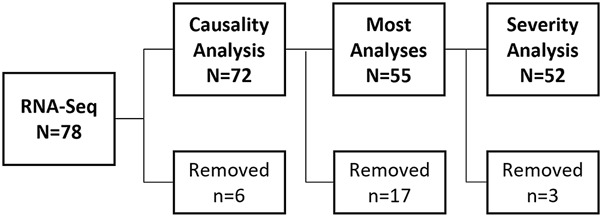
Accurate diagnosis, assessment, and prognosis of idiosyncratic drug-induced liver injury (IDILI) is problematic, in part due to the shortcomings of traditional blood biomarkers. Studies in rodents and healthy volunteers have supported that RNA transcript changes in whole blood may address some of these shortcomings. In this study, we conducted RNA-Seq analysis on peripheral blood samples collected from 55 patients with acute IDILI and 17 patients with liver injuries not attributed to IDILI. Three differentially expressed genes (DEGs; , , and ) were identified as significantly associated with IDILI vs. other liver injuries. No DEGs were identified comparing IDILI patients to the 5 patients with autoimmune hepatitis, suggesting possible common underlying mechanisms. Two genes ( and ) were significantly associated with hepatocellular injury compared to mixed/cholestatic injury. When patients with severe vs. milder IDILI were compared, we identified over 500 DEGs. The top pathways identified from these DEGs had in common down regulation of multiple T-cell specific genes. Further analyses confirmed that these changes could largely be accounted for by a fall in the concentration of circulating T-cells during severe DILI, perhaps due to exhaustion or sequestration of these cells in the liver. Exploration of DEGs specific for the individual causal agents was largely unsuccessful, but isoniazid-induced IDILI demonstrated 25 DEGs compared to other non-isoniazid IDILI cases. Finally, among the 14 IDILI patients that had hepatocellular jaundice (i.e., Hy's Law cases), we identified 39 DEGs between the 4 patients with fatal or liver transplantation outcomes compared to those that recovered. These findings suggest the potential for blood-based transcriptomic biomarkers to aid in the diagnosis and prognostic stratification of IDILI.
特异质性药物性肝损伤(IDILI)的准确诊断、评估和预后存在问题,部分原因是传统血液生物标志物存在缺陷。对啮齿动物和健康志愿者的研究表明,全血中的RNA转录本变化可能会弥补其中一些缺陷。在本研究中,我们对55例急性IDILI患者和17例非IDILI所致肝损伤患者采集的外周血样本进行了RNA测序分析。鉴定出三个差异表达基因(DEGs; 、 和 )与IDILI和其他肝损伤显著相关。将IDILI患者与5例自身免疫性肝炎患者进行比较时,未发现差异表达基因,提示可能存在共同的潜在机制。与混合性/胆汁淤积性损伤相比,两个基因( 和 )与肝细胞损伤显著相关。比较重度与轻度IDILI患者时,我们鉴定出500多个差异表达基因。从这些差异表达基因中鉴定出的主要通路共同下调了多个T细胞特异性基因。进一步分析证实,这些变化很大程度上可归因于重度药物性肝损伤期间循环T细胞浓度的下降,这可能是由于这些细胞在肝脏中耗竭或被隔离所致。对个体致病因子特异性差异表达基因的探索大多未成功,但与其他非异烟肼所致IDILI病例相比,异烟肼所致IDILI显示出25个差异表达基因。最后,在14例发生肝细胞性黄疸的IDILI患者(即Hy法则病例)中,我们在4例出现致命或肝移植结局的患者与康复患者之间鉴定出39个差异表达基因。这些发现表明,基于血液的转录组生物标志物有可能辅助IDILI的诊断和预后分层。