
喀尔巴阡生态区域土壤线虫动物群沿环境变化梯度的α和β多样性趋势差异
Divergent alpha and beta diversity trends of soil nematode fauna along gradients of environmental change in the Carpathian Ecoregion.
作者信息
Archidona-Yuste Antonio, Ciobanu Marcel, Kardol Paul, Eisenhauer Nico
机构信息
Institute for Sustainable Agriculture (IAS), Spanish National Research Council (CSIC), Avenida Menéndez Pidal s/n, Campus de Excelencia Internacional Agroalimentario, ceiA3, Córdoba, Spain.
Institute of Biological Research Cluj, National Institute of Research and Development for Biological Sciences, Cluj-Napoca, Cluj County, Romania.
出版信息
Commun Biol. 2025 Apr 9;8(1):587. doi: 10.1038/s42003-025-07994-0.
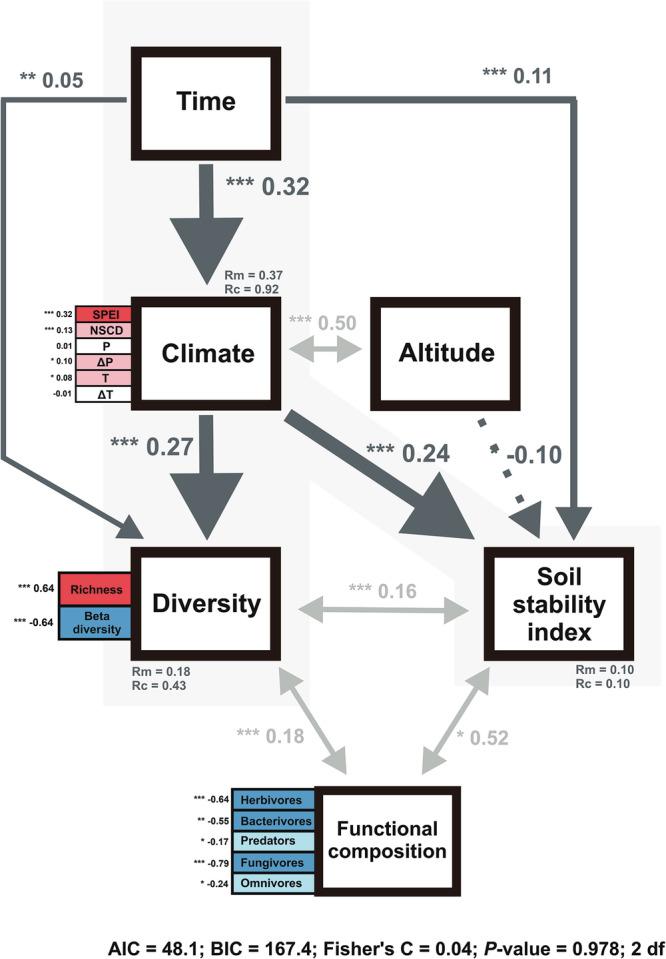
There is a significant lack of research on how climate change influences long-term temporal trends in the biodiversity of soil organisms. Nematodes may be specifically adequate to test soil biodiversity changes, because they account for ~80% of all Metazoans and play key roles in the functioning of terrestrial ecosystems. Here, we report on the first synthesis study focused on temporal trends of nematode fauna over a period of 14 years (1986-1999) across the Carpathian Ecoregion. We provide new evidence that wetter conditions associated to global change contributes to driving nematode diversity at genus/family level. We observed opposite trends in soil nematode alpha diversity (increase) and beta diversity (decrease) consistent across ecosystem types and soil horizons, providing strong evidence for the influence of climate change on soil biodiversity at large spatial scales. An increase in the community functional uniformity along with a decline in beta diversity indicated more homogenous soil conditions over time. The Soil Stability Index (metric devised to assess soil homeostasis based on the functional composition of nematode communities) increased over time, indicating a decline of soil disturbances and more complex soil food webs. Our results highlight the importance of nematodes as powerful indicators of soil biodiversity trends affected by multiple facets of environmental change in long-term soil monitoring.
关于气候变化如何影响土壤生物多样性的长期时间趋势,目前存在显著的研究不足。线虫可能特别适合用于测试土壤生物多样性的变化,因为它们占所有后生动物的约80%,并在陆地生态系统的功能中发挥关键作用。在此,我们报告了第一项综合研究,该研究聚焦于喀尔巴阡生态区域14年(1986 - 1999年)期间线虫动物区系的时间趋势。我们提供了新的证据,表明与全球变化相关的更湿润条件有助于推动属/科水平的线虫多样性。我们观察到土壤线虫的α多样性(增加)和β多样性(减少)呈现相反趋势,且在不同生态系统类型和土壤层中一致,这为气候变化在大空间尺度上对土壤生物多样性的影响提供了有力证据。随着时间推移,群落功能均匀度增加以及β多样性下降表明土壤条件变得更加同质化。土壤稳定性指数(基于线虫群落功能组成设计的用于评估土壤稳态的指标)随时间增加,表明土壤干扰减少且土壤食物网更加复杂。我们的结果凸显了线虫作为长期土壤监测中受环境变化多方面影响的土壤生物多样性趋势的有力指标的重要性。


 Zotero 插件