Li Congcong, Xu Dazhao, Lu Linyao, Peng Shu, Zhao Haiyang, Zeng Chuxiong, Hu Lina, Guo Xianzhi, Liu Li, Huo Feifei, Rong Xiumei, Geng Zhenying, Lin Ping, Zhou Xinna, Wang Xiaoli, Hobeika Amy, Morse Michael A, Lyerly Herbert Kim, Ren Jun
Department of Medical Oncology, Fudan University Pudong Medical Center, 2800 Gongwei Road, Pudong New Area, Shanghai, 201399, China.
Department of Medical Oncology, Beijing Zhongguancun Hospital, Chinese Academy of Sciences, Beijing, China.
Infect Agent Cancer. 2025 Apr 9;20(1):23. doi: 10.1186/s13027-025-00654-2.
The concurrent presence of COVID-19 infection in advanced cancer patients has increased the mortality since the compromised immunity was inevitably worsen. The role and clinical impact of autologous adoptive T cell immunotherapy (ACT) designed for anti-cancer treatment were not known in such circumstances. The safety and potential immune reconstitution of concurrent ACT in advanced cancer patients with active COVID-19 infection have yet unknown as well. The effect of infused ACT on the symptom severity manifestation should be summarized.
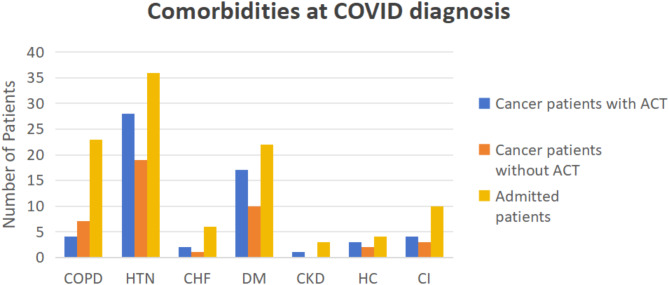
In this respectively clinical observation study, patients were non-randomized enrolled from the two centers according to the regular therapeutic plans including stage IV cancer patients for scheduled ACT, chemotherapy, cancer patients with symptomatic COVID-19 but without ACT, neither cancer or non-ACT but symptomatic cases of COVID-19 infection. We have incorporated the age-adjusted Charlson comorbidity index (aCCI) for each patient to compare the prognosis of the three groups. All patients were planned for the scheduled standard anti-cancer therapeutic considerations, chemotherapy plus ACT as planned as well as the supportive care.The clinical efficacy and impact of ACT on cancer patients within the 3 months from the peripheral blood apheresis, dendritic cell (DC) and cytokine induced killer T cell (CIK-T ) infusion and subsequent co-existence of COVID-19 infection were recorded as the primary objective. During the same period, the cancer cases without ACT and others were collected to compare the occurrence of both severe and death rate respectively.
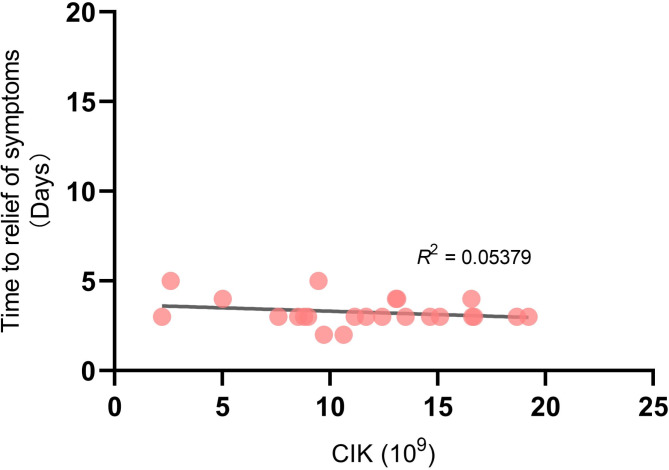
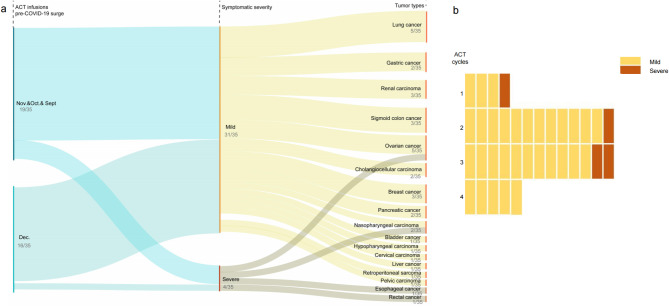
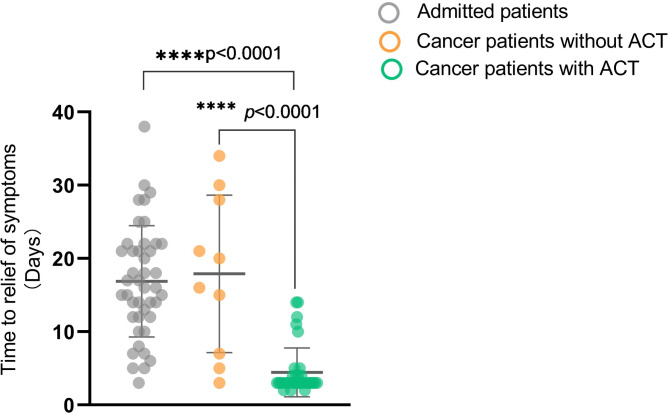
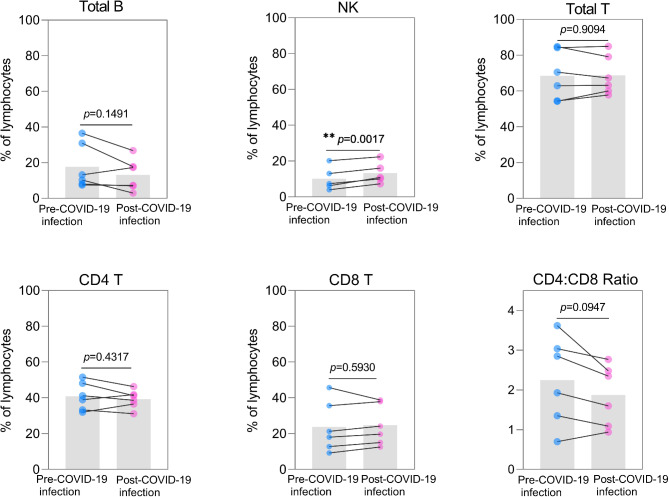
There were 123 patients (35 of ACT, 23 of non-ACT, 65 of non-cancer) with similar aCCI. There were similar cohort-level COVID-19 in-hospital case fatality rates consistent with previously reported data for non-cancer (26.2%, 17/65) and non-ACT cancer (52.2%, 12/23) among those admitted severe cases after the adjustment.There were little overlapped adverse reactions during the ACT therapeutic period even in the presence of active COVID-19 infection. No death case was occurred (0/35) when those exposed to ACT regimen. Cancer patients receiving ACT had a shorter mean time to alleviation of symptoms compared with non-ACT and non-cancer (4.46 versus 16.88 and 17.90 days respectively) as well as the lowered severity incidence of symptoms (P = 0.0010). The infused ACT has not significant impact on peripheral blood count whereas the amount of CD3CD16CD56 NK cells increased (P = 0.0017). The quantity of infused ACT was favorable for augmentation of possibility of severe to mild symptom shift.
These data demonstrate the clinical safety profiles while ACT infusions with active COVID-19 infection.The intervention of ACT for cancer patients could generate the benefit for symptom alleviation with improved recovery time. The concurrent ACT for advanced cancer patients during such infectious pandemic might simultaneously leverage and reduce the risk of immune compromised situation for subsequent chemotherapy complications.
晚期癌症患者同时感染新冠病毒(COVID-19)会增加死亡率,因为其受损的免疫力不可避免地会进一步恶化。在这种情况下,用于抗癌治疗的自体过继性T细胞免疫疗法(ACT)的作用和临床影响尚不清楚。晚期癌症患者合并活动性COVID-19感染时同时进行ACT的安全性和潜在的免疫重建情况也尚不明确。应总结输注ACT对症状严重程度表现的影响。
在这项分别进行的临床观察研究中,根据常规治疗方案从两个中心非随机纳入患者,包括计划进行ACT的IV期癌症患者、接受化疗的患者、有症状的COVID-19但未进行ACT的癌症患者、既无癌症也未进行ACT但有症状的COVID-19感染病例。我们纳入了每位患者的年龄调整Charlson合并症指数(aCCI)以比较三组的预后。所有患者都计划进行预定的标准抗癌治疗考量、按计划进行化疗加ACT以及支持性护理。记录从外周血采集、树突状细胞(DC)和细胞因子诱导杀伤性T细胞(CIK-T)输注后3个月内ACT对癌症患者的临床疗效和影响,以及随后COVID-19感染的共存情况作为主要目标。同期收集未进行ACT的癌症病例及其他病例以分别比较严重程度和死亡率的发生情况。
共有123例患者(35例接受ACT,23例未接受ACT,65例非癌症患者),aCCI相似。在调整后的重症患者中,非癌症患者(26.2%,17/65)和未接受ACT的癌症患者(52.2%,12/23)的队列水平COVID-19院内病死率与先前报告的数据相似。即使在存在活动性COVID-19感染的情况下,ACT治疗期间的不良反应也几乎没有重叠。接受ACT方案的患者未发生死亡病例(0/35)。与未接受ACT和非癌症患者相比,接受ACT的癌症患者症状缓解的平均时间更短(分别为4.46天、16.88天和17.90天),且症状严重程度发生率更低(P = 0.0010)。输注ACT对外周血细胞计数没有显著影响,但CD3CD16CD56自然杀伤细胞(NK细胞)数量增加(P = 0.0017)。输注ACT的量有利于增加症状从严重向轻度转变的可能性。
这些数据证明了在合并活动性COVID-19感染时输注ACT的临床安全性。对癌症患者进行ACT干预可产生缓解症状的益处,缩短恢复时间。在这种传染性大流行期间,晚期癌症患者同时进行ACT可能会同时利用并降低后续化疗并发症导致免疫功能受损情况的风险。