Quinn Rimini, Masters Sophie, Starling Melissa, White Peter John, Mills Kathryn, Raubenheimer David, McGreevy Paul
Sydney School of Veterinary Science (SSVS), Faculty of Science, University of Sydney, Camperdown, NSW, Australia.
Charles Perkins Centre, University of Sydney, Camperdown, NSW, Australia.
Front Vet Sci. 2025 Mar 26;12:1499933. doi: 10.3389/fvets.2025.1499933. eCollection 2025.
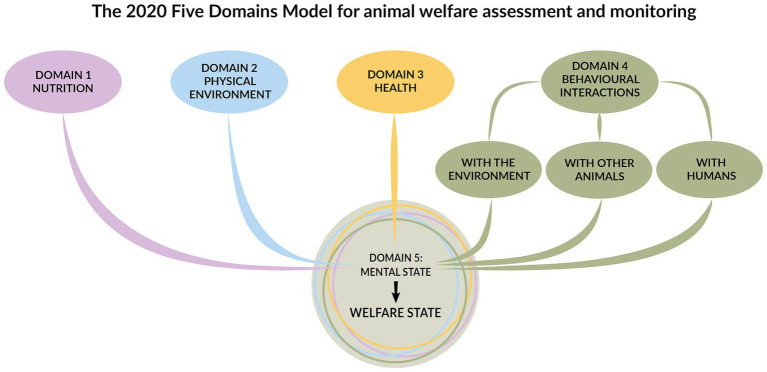
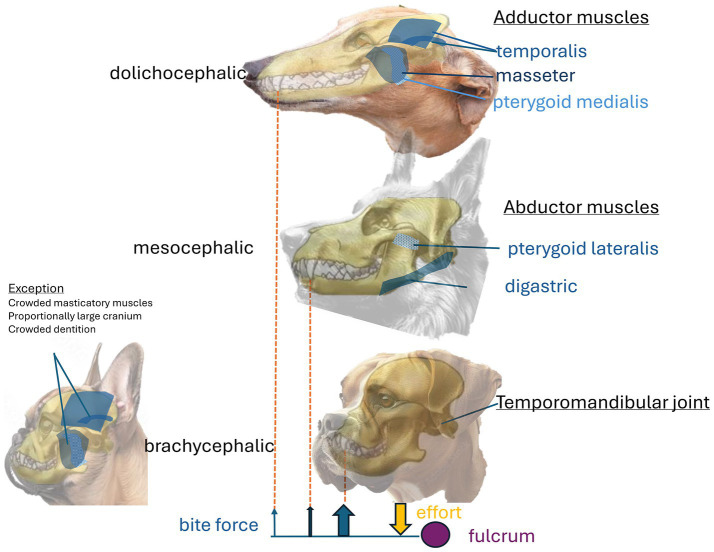
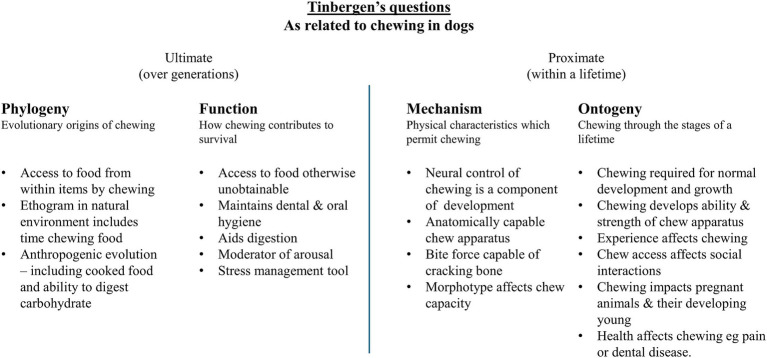
Dogs chew on both nutritive and non-nutritive items as part of their food acquisition, ingestive behaviour, self-care, and social interactions. Various definitions distinguish chewing from related oral activities, such as gnawing, masticating, and biting. Surprisingly, despite chewing being a ubiquitous behaviour in dogs, its relevance to a dog's comfort, health, and purpose remains unclear. Additionally, the risk of dental fractures or other injuries may lead veterinarians to advise against feeding bones to dogs. This article explores the literature on chewing in dogs through the ethological framework of "Tinbergen's Four Questions" and the Five Domains framework for animal welfare assessment. Evidence is gathered from wild and domestic canids and from human and animal models where shared physiological or biological processes provide insight. Chewing appears to promote biological fitness, providing benefits such as dental and oral hygiene, digestive health, bone strength, psychological health, and stress management. Furthermore, this article discusses the evolutionary importance of chewing, the mechanisms underlying bite force, chew rate and morphology, and the development of chewing throughout a dog's life, from primary teeth eruption to senescence. Application of the Five Domains framework for animal welfare helps assess the impact of chewing, or lack thereof, on a dog's welfare. A dog's preference for chew items is primarily driven by odour, taste, and mouthfeel. Macronutrient proportions may also play a role in food preferences, which, in turn, can affect the selection of chewable items. A lack of preferred chew items may result in redirected chewing toward less appropriate items, such as non-food chews that could be harmful to dentition or the gastrointestinal tract (GIT). Chewing on such inappropriate items may also lead to the adoption of alternative oral behaviours or reduced their contentment by impeding telos. Overall, chewing positively impacts a dog's physical and psychological health, contributing to its welfare and appearing essential as a regular part of a dog's daily life. However, the significant benefits of chewing must be carefully weighed against potential risks.
狗会啃咬营养性和非营养性物品,这是它们获取食物、摄食行为、自我护理以及社交互动的一部分。各种定义将啃咬与相关的口腔活动区分开来,如啃、咀嚼和咬。令人惊讶的是,尽管啃咬在狗身上是一种普遍存在的行为,但其与狗的舒适度、健康状况及目的之间的关联仍不明确。此外,牙齿骨折或其他损伤的风险可能导致兽医建议不要给狗喂骨头。本文通过“廷伯根的四个问题”的行为学框架以及动物福利评估的五领域框架来探讨有关狗啃咬行为的文献。证据收集自野生和家养犬科动物以及人类和动物模型,在这些模型中,共享的生理或生物学过程能提供相关见解。啃咬似乎能促进生物适应性,带来诸如牙齿和口腔卫生、消化健康、骨骼强度、心理健康及压力管理等益处。此外,本文还讨论了啃咬行为在进化上的重要性、咬合力、啃咬速度和形态背后的机制,以及狗从乳牙萌出到衰老一生之中啃咬行为的发展过程。应用动物福利的五领域框架有助于评估啃咬行为或缺乏啃咬行为对狗福利的影响。狗对啃咬物品的偏好主要由气味、味道和口感驱动。宏量营养素比例也可能在食物偏好中起作用,而食物偏好反过来又会影响可咀嚼物品的选择。缺乏偏好的啃咬物品可能导致狗将啃咬行为转向不太合适的物品,比如可能对牙齿或胃肠道有害的非食物类啃咬物。啃咬这类不合适的物品还可能导致狗采取其他口腔行为,或者因阻碍其目的而降低它们的满足感。总体而言,啃咬对狗的身心健康有积极影响,有助于其福利,并且作为狗日常生活的常规部分显得至关重要。然而必须仔细权衡啃咬行为带来的显著益处与潜在风险。