Schouwstra Kirsten J, Scheenstra René, de Kleine Ruben H, de Meijer Vincent E, Bontemps Sander T H, Verkade Henkjan J, Sival Deborah A
Pediatric Neurology, Department of Neurology, University of Groningen, University Medical Center Groningen, Groningen, the Netherlands.
Pediatric Gastroenterology/Hepatology, Department of Pediatrics, University of Groningen, University Medical Center Groningen, Groningen, the Netherlands.
Pediatr Transplant. 2025 May;29(3):e70076. doi: 10.1111/petr.70076.
Pediatric Acute Liver Failure (PALF) frequently requires liver transplantation (LTx). The neurological condition can deteriorate rapidly, but the difficulty in assessing the (ir)reversibility of neurological symptoms can hamper therapeutic decision-making, including transplantation. We aimed to determine the association between pupillary reflexes (PR), brain stem reflexes (BSR), radiological signs of brain herniation, and subsequent neurological outcome.
We analyzed a retrospective, observational cohort of PALF patients with severe hepatic encephalopathy (grade III-IV), admitted to our national pediatric liver transplantation center between 1993 and 2023. We subdivided the patients into groups with PR present or PR absent. We compared the two groups for pre-treatment neurological and neuro-radiological parameters and related the findings to neurological outcomes.
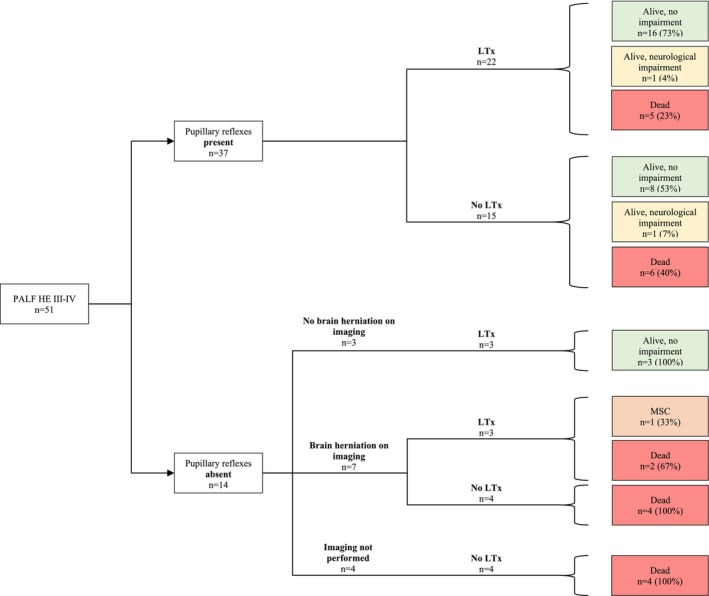
Survival rate in patients with PR present was higher compared to patients with PR absent [70% (26/37) and 29% (4/14); resp., p = 0.008]. In the absence of PR, neurological outcome could still be favorable after LTx (n = 3/6). Presence or absence of BSR was not related to the outcome in terms of survival or death. Radiologically proven brain herniation was associated with mortality (6/7) or minimally conscious state (1/7), irrespective of undergoing a LTx or not.
Although absence of PR is associated with a poor prognosis, the neurological outcome can still be favorable after LTx. Radiological signs of brain herniation are strongly associated with mortality or severe neurological outcomes, irrespective of subsequent transplantation. We therefore advocate that absence of PR should be an indication for radiological imaging to assess brain herniation before making major treatment decisions.
小儿急性肝衰竭(PALF)常常需要进行肝移植(LTx)。神经系统状况可能迅速恶化,但评估神经症状的(不)可逆性存在困难,这可能会妨碍包括移植在内的治疗决策。我们旨在确定瞳孔反射(PR)、脑干反射(BSR)、脑疝的影像学征象与随后的神经学转归之间的关联。
我们分析了1993年至2023年间入住我国国家小儿肝移植中心的患有严重肝性脑病(III - IV级)的PALF患者的回顾性观察队列。我们将患者分为有PR组和无PR组。我们比较了两组治疗前的神经学和神经影像学参数,并将结果与神经学转归相关联。
有PR的患者生存率高于无PR的患者[分别为70%(26/37)和29%(4/14);p = 0.008]。在无PR的情况下,肝移植后神经学转归仍可能良好(n = 3/6)。BSR的存在与否与生存或死亡的转归无关。经影像学证实的脑疝与死亡率(6/7)或最低意识状态(1/7)相关,无论是否接受肝移植。
虽然无PR与预后不良相关,但肝移植后神经学转归仍可能良好。脑疝的影像学征象与死亡率或严重神经学转归密切相关,无论后续是否进行移植。因此,我们主张在做出重大治疗决策前,无PR应作为进行影像学检查以评估脑疝的指征。