
用于蛋白质亚细胞定位预测的深度生成模型。
Deep generative model for protein subcellular localization prediction.
作者信息
Yuan Guo-Hua, Li Jinzhe, Yang Zejun, Chen Yao-Qi, Yuan Zhonghang, Chen Tao, Ouyang Wanli, Dong Nanqing, Yang Li
机构信息
Center for Molecular Medicine, Children's Hospital of Fudan University and Shanghai Key Laboratory of Medical Epigenetics, International Laboratory of Medical Epigenetics and Metabolism, Ministry of Science and Technology, Institutes of Biomedical Sciences, Fudan University, 131 Dongan Road, Xuhui District, Shanghai 200032, China.
Shanghai Artificial Intelligence Laboratory, 129 Longwen Road, Xuhui District, Shanghai 200232, China.
出版信息
Brief Bioinform. 2025 Mar 4;26(2). doi: 10.1093/bib/bbaf152.
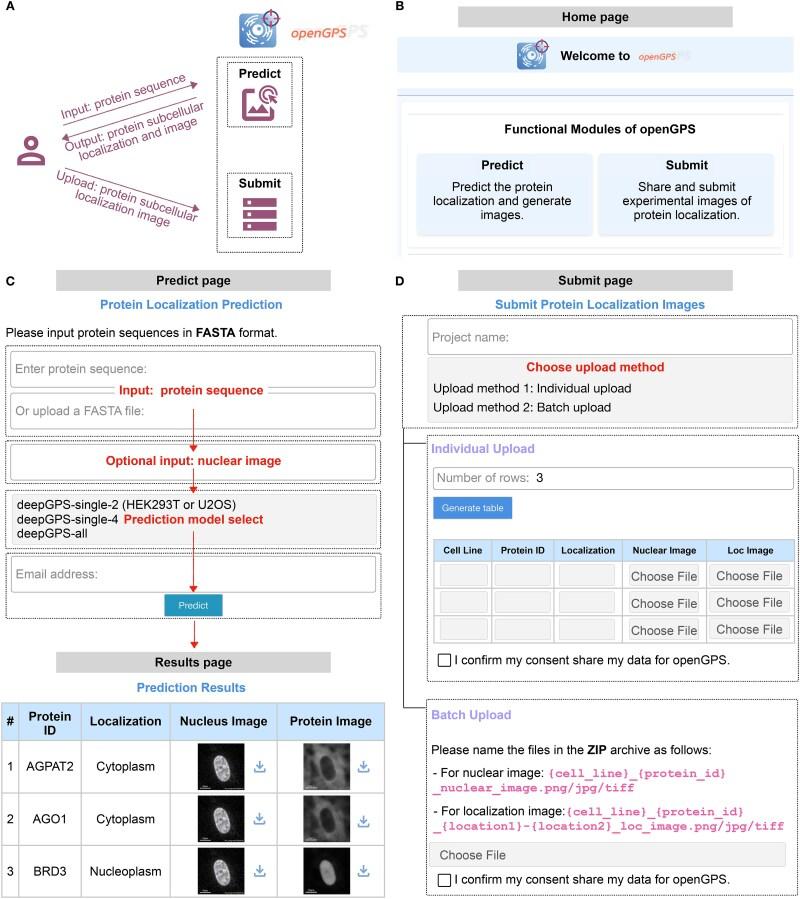
Protein sequence not only determines its structure but also provides important clues of its subcellular localization. Although a series of artificial intelligence models have been reported to predict protein subcellular localization, most of them provide only textual outputs. Here, we present deepGPS, a deep generative model for protein subcellular localization prediction. After training with protein primary sequences and fluorescence images, deepGPS shows the ability to predict cytoplasmic and nuclear localizations by reporting both textual labels and generative images as outputs. In addition, cell-type-specific deepGPS models can be developed by using distinct image datasets from different cell lines for comparative analyses. Moreover, deepGPS shows potential to be further extended for other specific organelles, such as vesicles and endoplasmic reticulum, even with limited volumes of training data. Finally, the openGPS website (https://bits.fudan.edu.cn/opengps) is constructed to provide a publicly accessible and user-friendly platform for studying protein subcellular localization and function.
蛋白质序列不仅决定其结构,还为其亚细胞定位提供重要线索。尽管已有一系列人工智能模型被报道用于预测蛋白质亚细胞定位,但其中大多数仅提供文本输出。在此,我们展示了deepGPS,一种用于蛋白质亚细胞定位预测的深度生成模型。在用蛋白质一级序列和荧光图像进行训练后,deepGPS能够通过同时输出文本标签和生成图像来预测细胞质和细胞核定位。此外,通过使用来自不同细胞系的不同图像数据集进行比较分析,可以开发细胞类型特异性的deepGPS模型。而且,即使训练数据量有限,deepGPS也显示出进一步扩展用于其他特定细胞器(如囊泡和内质网)的潜力。最后,构建了openGPS网站(https://bits.fudan.edu.cn/opengps),为研究蛋白质亚细胞定位和功能提供一个可公开访问且用户友好的平台。


 Zotero 插件