Krishna Swathy, Olickal Jeby Jose, Sarma P Sankara, Thankappan Kavumpurathu Raman
Department of Public Health, Amrita Institute of Medical Sciences, Kochi, IND.
Cureus. 2025 Mar 10;17(3):e80374. doi: 10.7759/cureus.80374. eCollection 2025 Mar.
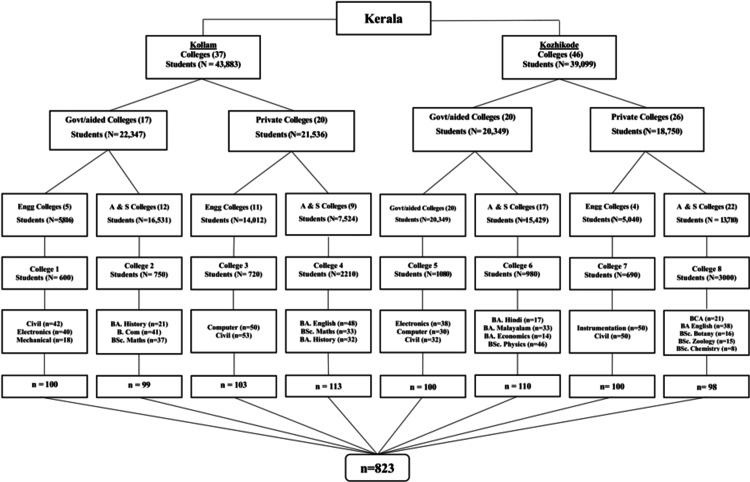
Introduction Unhealthy diets are a major contributor to the global burden of disease, with eating disorders (EDs) being among the most prevalent psychological disorders affecting youth worldwide. Despite their increasing recognition, there is limited research quantifying ED risk in India. Therefore, we aimed to estimate the risk of ED in the Indian state of Kerala and to find the sociodemographic factors associated with it. Methods We conducted this study among 823 students (females: 60%) aged 18-22 years in randomly selected colleges in two of the 14 districts in Kerala. Data were collected using the self-administered Eating Attitudes Test-26 (EAT-26). Information on social media disorder was collected using the Bergen Social Media Addiction Scale (BSMAS). Log binomial regression analysis was done to find the factors associated with ED risk, and adjusted prevalence ratios (APR) with a 95% confidence interval (CI) were calculated. Results ED risk was reported by 242 students (29.4%, 95% CI: 26.3-32.6). Home-staying students are more likely to report a higher risk of ED compared to hostel or paying guest students (APR = 1.40; 95% CI: 1.08-1.80). Similarly, students belonging to high-income groups of social class I (APR = 9.60; 95% CI: 5.11-18.04), social class II (APR = 5.51; 95% CI: 2.89-10.47), and social class III (APR = 3.18; 95% CI: 1.54-6.56) were more likely to report ED risk compared to their counterparts. Additionally, students who were underweight (APR = 1.60; 95% CI: 1.24-2.05), overweight/obese (APR = 2.42; 95% CI: 1.96-3.01), and those with social media disorder (APR = 1.69; 95% CI: 1.27-2.24) had a higher likelihood of reporting ED risk. Conclusion Nearly one-third of college students were at risk of ED. Measures to reduce ED risk are required among students prioritizing those belonging to high-income groups, overweight/obese, underweight, and those having social media disorder.
引言
不健康的饮食是全球疾病负担的主要促成因素,饮食失调是影响全球青少年的最常见心理障碍之一。尽管人们对其认识不断提高,但在印度,量化饮食失调风险的研究有限。因此,我们旨在估计印度喀拉拉邦饮食失调的风险,并找出与之相关的社会人口学因素。
方法
我们在喀拉拉邦14个区中的两个区随机选取的学院中,对823名年龄在18 - 22岁的学生(女性占60%)进行了这项研究。使用自填式饮食态度测试26项问卷(EAT - 26)收集数据。使用卑尔根社交媒体成瘾量表(BSMAS)收集关于社交媒体失调的信息。进行对数二项回归分析以找出与饮食失调风险相关的因素,并计算调整患病率比(APR)及95%置信区间(CI)。
结果
242名学生报告有饮食失调风险(29.4%,95% CI:26.3 - 32.6)。与寄宿或付费房客学生相比,居家学生更有可能报告更高的饮食失调风险(APR = 1.40;95% CI:1.08 - 1.80)。同样,与同龄人相比,属于社会阶层I高收入群体的学生(APR = 9.60;95% CI:5.11 - 18.04)、社会阶层II的学生(APR = 5.51;95% CI:2.89 - 10.47)和社会阶层III的学生(APR = 3.18;95% CI:1.54 - 6.56)更有可能报告饮食失调风险。此外,体重过轻的学生(APR = 1.60;95% CI:1.24 - 2.05)、超重/肥胖的学生(APR = 2.42;95% CI:1.96 - 3.01)以及有社交媒体失调的学生(APR = 1.69;95% CI:1.27 - 2.24)报告饮食失调风险的可能性更高。
结论
近三分之一的大学生有饮食失调风险。需要针对学生采取措施降低饮食失调风险,优先关注高收入群体、超重/肥胖、体重过轻以及有社交媒体失调的学生。