Pai Radhika R, Banerjee Sourjya, George Linu Sara, George Anice, Ongole Ravikiran
Fundamentals of Nursing Department, Manipal College of Nursing, Manipal Academy of Higher Education, Manipal, India.
Department of Radiation Oncology, Kasturba Hospital, Mangalore, India.
BMC Oral Health. 2025 Apr 11;25(1):539. doi: 10.1186/s12903-025-05877-8.
Head and neck cancer patients receiving chemotherapy and radiation therapy may experience a notable and frequently sudden decline in their oral health. These alterations include oral mucositis that develops during and shortly after treatment, candida infections, trouble speaking, difficulty eating, bleeding gums, and tissue fibrosis.
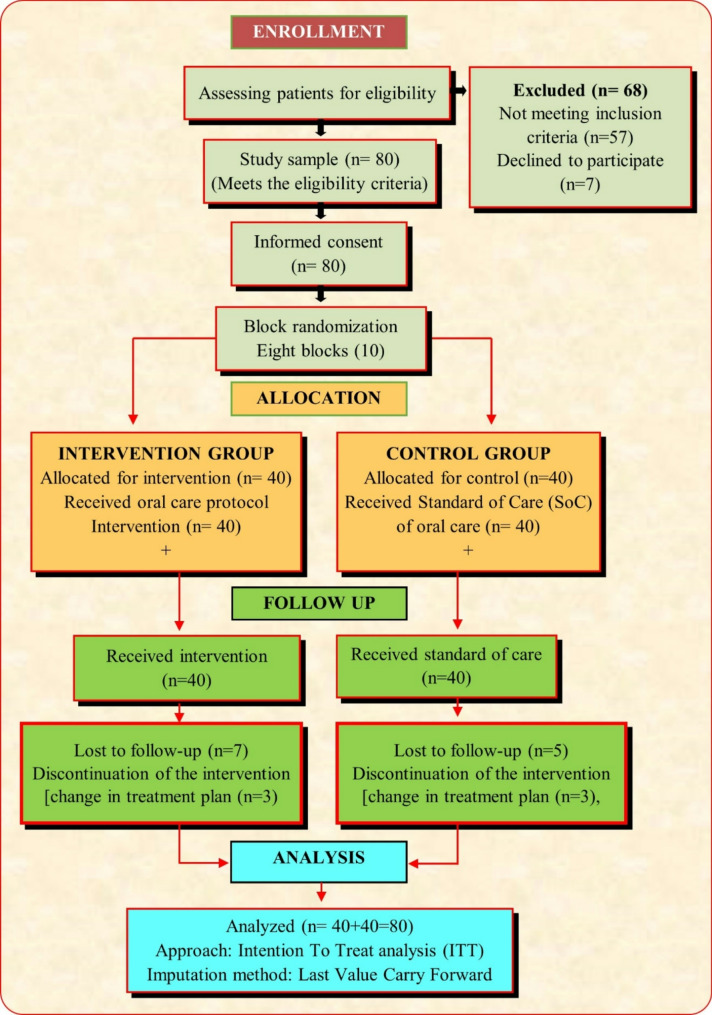
This study aimed to determine the effectiveness of oral care intervention protocol (OCIP) on oral health and oral complications. The experimental group received a structured oral care protocol, and the control group received oral care as per the standard of care of the study setting. These patients were observed every week for up to 6 weeks until the completion of radiation therapy/chemoradiation. An experimental design using a randomized controlled trial was adopted for the study. After providing informed consent, the data were collected from 80 head and neck cancer patients.
The maximum number of patients, i.e., 42.5% in the experimental group and 32.5% in the control group, were diagnosed with tongue cancer. Most of the participants, i.e., 57.5% in the experimental group and 67.5% in the control group, received chemoradiation as the treatment plan. Among all the oral complications, the median days to develop mucositis (p =.015), swallowing difficulty (p =.009), and chewing difficulty (p =.032) were significantly different from those of the control, indicating that the intervention was effective. As treatment progressed over the weeks, the severity of the oral problems increased in both groups (p =.001). Compared with routine care, oral care intervention improved oral health scores among cancer patients receiving head and neck radiation therapy/chemoradiation [F (401.982), p =.001].
These data suggest that the OCIP is clinically helpful in maintaining overall oral health among cancer patients receiving head and neck radiation/chemoradiation. The OCIP effectively delays the incidence of oral complications arising from head and neck radiation therapy/chemotherapy but does not prevent them. The findings of this study can also contribute to providing evidence for the use of an oral care kit, including all evidence-based interventions for patients receiving head and neck radiation/chemoradiation.
接受化疗和放疗的头颈癌患者可能会出现口腔健康显著且常常突然下降的情况。这些变化包括治疗期间及治疗后不久出现的口腔黏膜炎、念珠菌感染、说话困难、进食困难、牙龈出血和组织纤维化。
本研究旨在确定口腔护理干预方案(OCIP)对口腔健康和口腔并发症的有效性。实验组接受结构化口腔护理方案,对照组按照研究机构的护理标准进行口腔护理。每周观察这些患者,为期6周,直至放疗/放化疗结束。本研究采用随机对照试验的实验设计。在获得知情同意后,从80名头颈癌患者中收集数据。
患者数量最多的是,实验组为42.5%,对照组为32.5%,被诊断为舌癌。大多数参与者,实验组为57.5%,对照组为67.5%,接受放化疗作为治疗方案。在所有口腔并发症中,发生黏膜炎的中位天数(p = 0.015)、吞咽困难(p = 0.009)和咀嚼困难(p = 0.032)与对照组有显著差异,表明干预是有效的。随着治疗在数周内推进,两组的口腔问题严重程度均增加(p = 0.001)。与常规护理相比,口腔护理干预提高了接受头颈放疗/放化疗的癌症患者的口腔健康评分[F(401.982),p = 0.001]。
这些数据表明,OCIP在临床上有助于维持接受头颈放疗/放化疗的癌症患者的整体口腔健康。OCIP有效延迟了头颈放疗/化疗引起的口腔并发症的发生,但不能预防这些并发症。本研究结果还可为使用口腔护理套件提供证据,包括为接受头颈放疗/放化疗的患者提供的所有循证干预措施。