Ilkowski Jan, Guzik Przemysław, Kaluźniak-Szymanowska Aleksandra, Rzymski Piotr, Chudek Jerzy, Wieczorowska-Tobis Katarzyna
Department of Emergency Medicine, Poznan University of Medical Sciences, 61-701 Poznan, Poland.
Department of Cardiology-Intensive Therapy, Poznan University of Medical Sciences, 61-701 Poznan, Poland.
Nutrients. 2025 Apr 6;17(7):1278. doi: 10.3390/nu17071278.
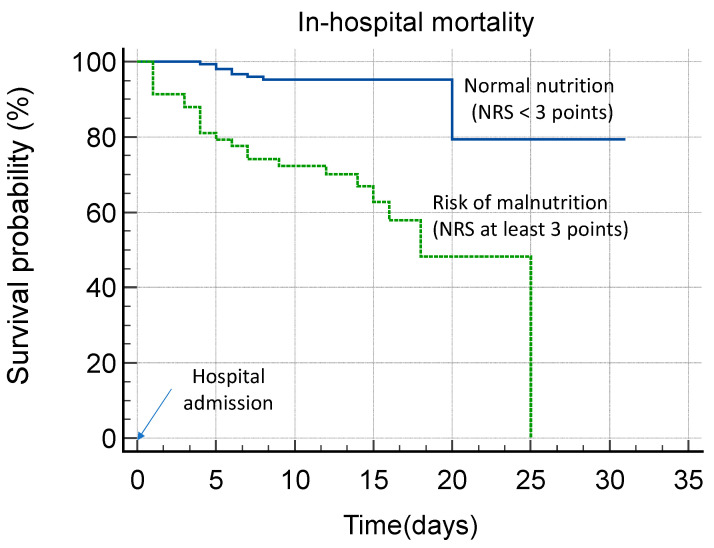
: Malnutrition is an often-overlooked yet potentially crucial factor influencing COVID-19 outcomes. Poor nutritional status weakens immune function, increases infection susceptibility, and worsens prognoses in hospitalized patients. However, its specific role in COVID-19 mortality remains insufficiently characterized. The aim of the study was to assess the impact of malnutrition, as determined by the Nutritional Risk Score (NRS-2002), on in-hospital mortality. : This retrospective, single-center study analyzed 222 patients hospitalized with COVID-19 during the Delta variant predominance. Thirty-one patients died during hospitalization. Malnutrition (NRS ≥ 3) emerged as a strong predictor of in-hospital mortality in univariate Cox proportional hazard models, both before and after adjustment for potential confounders. Adjusted analyses used 10 different sets of three out of five mortality-related variables. : Hazard ratios for malnutrition ranged from 3.19 to 5.88 ( < 0.01 for all models), highlighting its substantial impact on mortality risk. The high Nagelkerke's R values (0.66-0.77) indicate that the models explained a significant proportion of mortality variance. Nutritional status plays a critical role in COVID-19 survival among hospitalized patients. : Given its simplicity and effectiveness, integrating the NRS-2002 into routine clinical assessments may help identify high-risk patients early. Future research should explore whether early nutritional interventions can mitigate the mortality risks associated with malnutrition in severe COVID-19 cases or patients with other infectious diseases or acute inflammation.
营养不良是一个常常被忽视但可能对新冠病毒疾病(COVID-19)的预后至关重要的因素。营养状况不佳会削弱免疫功能,增加感染易感性,并使住院患者的预后恶化。然而,其在COVID-19死亡率中的具体作用仍未得到充分描述。本研究的目的是评估由营养风险评分(NRS-2002)确定的营养不良对住院死亡率的影响。
这项回顾性单中心研究分析了在Delta变异株占主导期间因COVID-19住院的222例患者。31例患者在住院期间死亡。在单变量Cox比例风险模型中,无论是否对潜在混杂因素进行调整,营养不良(NRS≥3)都是住院死亡率的有力预测因素。调整后的分析使用了五组与死亡率相关变量中的三组,共10种不同组合。
营养不良的风险比范围为3.19至5.88(所有模型P<0.01),突出了其对死亡风险的重大影响。较高的Nagelkerke's R值(0.66 - 0.77)表明模型解释了很大比例的死亡差异。营养状况在住院COVID-19患者的生存中起着关键作用。
鉴于其简单性和有效性,将NRS-2002纳入常规临床评估可能有助于早期识别高危患者。未来的研究应探索早期营养干预是否可以减轻重症COVID-19病例或其他传染病或急性炎症患者中与营养不良相关的死亡风险。