Su Yu, Mou Siyu, Song Yifan, Zhang Huanglong, Zhang Qian
Fujian Key Laboratory on Conservation and Sustainable Utilization of Marine Biodiversity, Fuzhou Institute of Oceanography, College of Geography and Oceanography, Minjiang University, Fuzhou, 350108, China.
Bureau of Agriculture and Rural Affairs, Quanzhou, 362100, Hui'an County, China.
Sci Rep. 2025 Apr 13;15(1):12709. doi: 10.1038/s41598-025-97772-z.
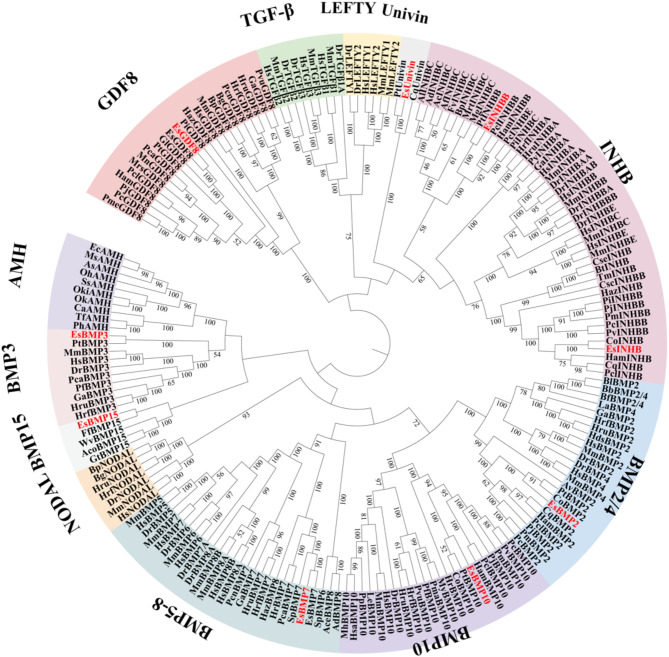
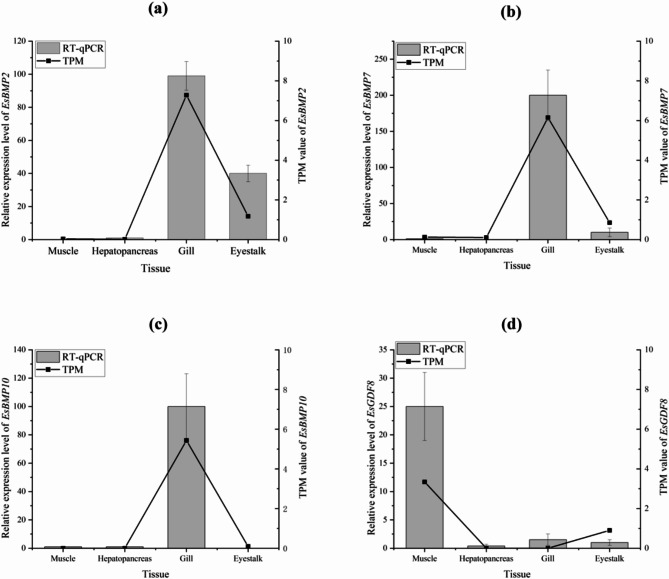
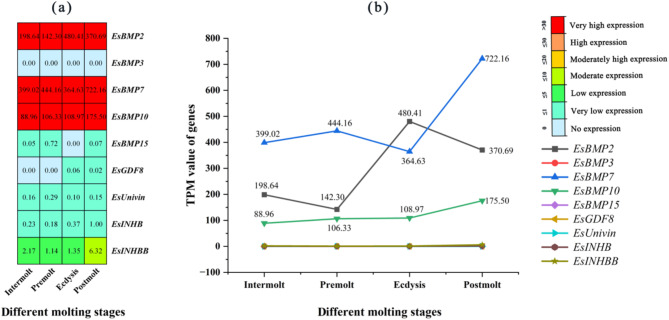
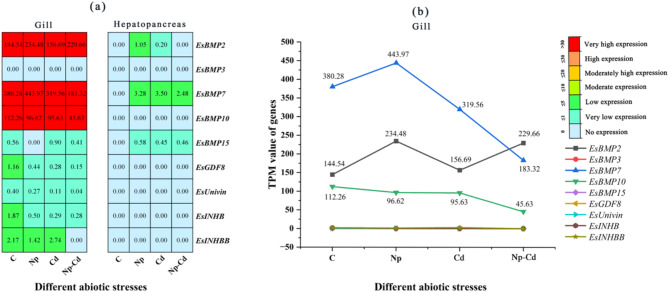
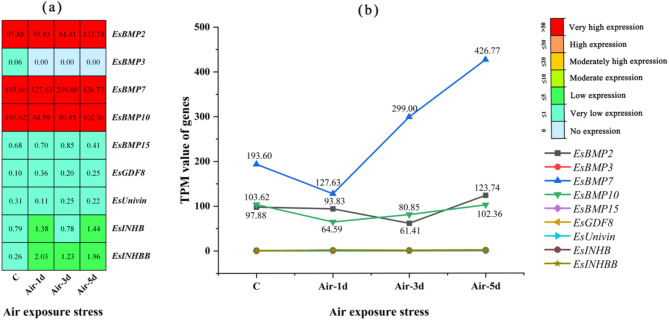
Transforming growth factor-β superfamily genes are multifunctional cytokines that play central roles in the regulation of cell proliferation, differentiation, apoptosis, adhesion, and migration. Identifying the TGF-β superfamily in crabs could provide a basis for elucidating the genetic regulatory mechanism of growth, development, sex differentiation and environmental adaptation. To understand the complexity and evolution of the TGF-β superfamily in the Chinese mitten crab Eriocheir sinensis, this study comprehensively and systematically analysed this superfamily in the genome of E. sinensis. A total of 9 TGF-β superfamily genes have been identified, including EsBMP2, EsBMP3, EsBMP7, EsBMP10, EsBMP15, EsGDF8, EsUnivin, EsINHB and EsINHBB. A wide variation in the number of motifs and CDSs was found among different subfamilies. The expression of EsBMP2 and EsBMP7 suggested that these genes may be the main genes controlling embryonic development in E. sinensis. EsBMP2, EsBMP7 and EsBMP10 are very highly expressed in the gills. The TGF-β superfamily genes presented different expression patterns during limb regeneration and molting. In addition, this gene family also responds to environmental stresses, including nanoplastic stress, cadmium stress, air exposure, and high-salinity stress, which provides a new perspective for understanding the strong tolerance and adaptability of crabs to environmental stress. To our knowledge, this study is the first genome-wide investigation of the TGF-β superfamily in crabs. This study identified the sequence structure, phylogenetic relationship, and gene expression profiles of the TGF-β superfamily genes in the Chinese mitten crab, and the above results lay a foundation for further investigation of the evolution and biological functions of this gene family.
转化生长因子-β超家族基因是多功能细胞因子,在细胞增殖、分化、凋亡、黏附和迁移的调节中发挥核心作用。鉴定蟹类中的转化生长因子-β超家族可为阐明生长、发育、性别分化和环境适应的遗传调控机制提供依据。为了解中华绒螯蟹中转化生长因子-β超家族的复杂性和进化情况,本研究对中华绒螯蟹基因组中的该超家族进行了全面系统的分析。共鉴定出9个转化生长因子-β超家族基因,包括EsBMP2、EsBMP3、EsBMP7、EsBMP10、EsBMP15、EsGDF8、EsUnivin、EsINHB和EsINHBB。不同亚家族之间的基序数量和编码序列存在很大差异。EsBMP2和EsBMP7的表达表明这些基因可能是控制中华绒螯蟹胚胎发育的主要基因。EsBMP2、EsBMP7和EsBMP10在鳃中表达量非常高。转化生长因子-β超家族基因在肢体再生和蜕皮过程中呈现出不同的表达模式。此外,该基因家族还对环境胁迫作出反应,包括纳米塑料胁迫、镉胁迫、空气暴露和高盐胁迫,这为理解蟹类对环境胁迫的强耐受性和适应性提供了新的视角。据我们所知,本研究是首次对蟹类转化生长因子-β超家族进行全基因组研究。本研究鉴定了中华绒螯蟹中转化生长因子-β超家族基因的序列结构、系统发育关系和基因表达谱,上述结果为进一步研究该基因家族的进化和生物学功能奠定了基础。