Considine Julie, Blencowe Philippa, Lumsden Naida, Schlieff Jordana, Currey Judy
School of Nursing and Midwifery and Centre for Quality and Patient Safety in the Institute for Health Transformation, Deakin University, Geelong, Victoria 3220, Australia.
Eastern Health, Box Hill, Victoria 3128, Australia.
J Nurs Manag. 2025 Mar 27;2025:6498541. doi: 10.1155/jonm/6498541. eCollection 2025.
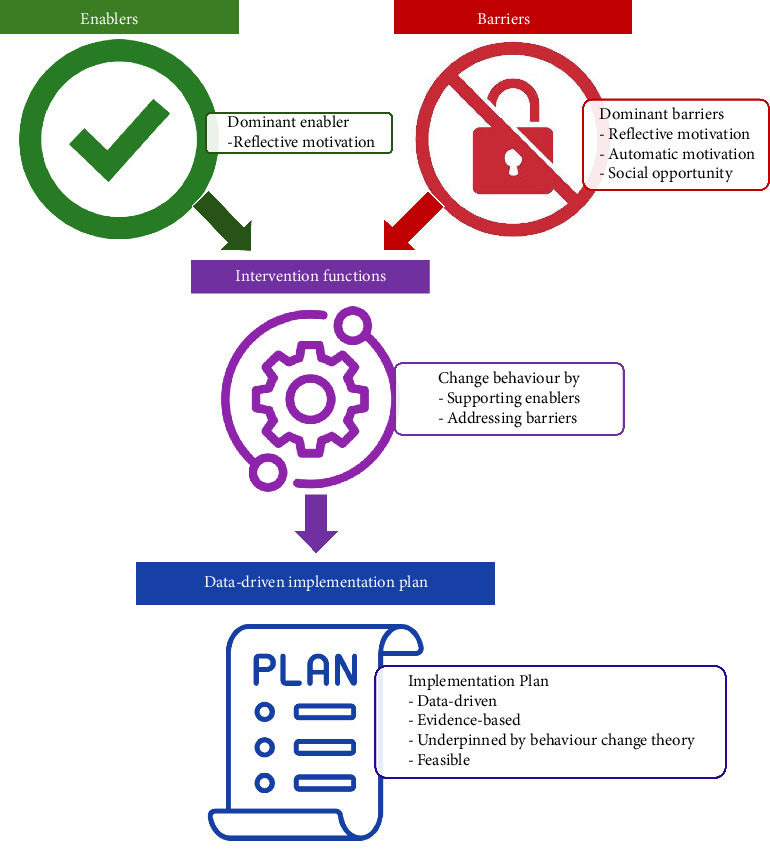
Effective nursing and midwifery leadership benefits patients, staff and organisations. In February 2024, all nurse/midwife managers ( = 89) across one organisation transitioned to five allocated leadership days per week. For many nurse/midwife managers, whose default was to assume the clinical shift leader role when the unit was busy or short staffed, optimising use of five allocated leadership days per week required significant behaviour change. The aims of this study were to: (i) examine the enablers and barriers to nurse/midwife managers using allocated leadership time to fulfil their core responsibilities and (ii) develop a theory-informed implementation plan to optimise allocated leadership time use. A survey of all nurse/midwife managers, underpinned by the Theoretical Domains Framework, enabled identification of enablers and barriers to using allocated leadership time. The Behaviour Change Wheel was used to map enablers and barriers, identify intervention functions and behaviour change techniques to form an implementation plan. The APEASE criteria (acceptability, practicability, effectiveness, affordability, side effects/safety and equity) were applied to ensure effective and feasible strategies were selected. The response rate was 62.5% (55/89). Reflective motivation was the dominant enabler (clear goals, intentions and optimism). The most common barriers were reflective motivation (feeling responsible if an adverse event impacted staff or patients; perceptions of lack of control); automatic motivation (feelings of guilt, anxiety and stress if using allocated leadership time when their area is short staffed) and social opportunity (social influences and balancing the expectations of others). A range of intervention functions were necessary to support identified enablers and address identified barriers to nurse/midwife managers optimising their use of allocated leadership time. Behaviour change theory is useful for identifying real-world enablers and barriers of nurse/midwife managers' use of allocated leadership time and developing a theory-informed implementation plan to optimise use of their allocated leadership time.
有效的护理及助产士领导力对患者、员工和组织都有益处。2024年2月,一个机构内的所有护士/助产士管理人员(共89人)转变为每周有五个指定的领导工作日。对于许多护士/助产士管理人员来说,他们的默认做法是在科室忙碌或人员短缺时承担临床轮值领导的角色,因此要优化每周五个指定领导工作日的使用,就需要做出重大的行为改变。本研究的目的是:(i)研究护士/助产士管理人员利用指定领导时间履行其核心职责的促进因素和障碍;(ii)制定一个基于理论的实施计划,以优化指定领导时间的使用。在理论领域框架的支持下,对所有护士/助产士管理人员进行了一项调查,从而确定了使用指定领导时间的促进因素和障碍。行为改变轮被用来梳理促进因素和障碍,确定干预功能和行为改变技巧,以形成一个实施计划。采用了APEASE标准(可接受性、实用性、有效性、可承受性、副作用/安全性和公平性),以确保选择有效且可行的策略。回复率为62.5%(55/89)。反思性动机是主要的促进因素(明确的目标、意图和乐观态度)。最常见的障碍是反思性动机(如果不良事件影响到员工或患者会感到有责任;感觉缺乏掌控感);自动性动机(当所在区域人员短缺时使用指定领导时间会感到内疚、焦虑和压力)以及社会机会(社会影响和平衡他人的期望)。需要一系列干预功能来支持已确定的促进因素,并解决已确定的护士/助产士管理人员在优化使用指定领导时间方面的障碍。行为改变理论有助于识别护士/助产士管理人员使用指定领导时间在现实世界中的促进因素和障碍,并制定一个基于理论的实施计划,以优化他们对指定领导时间的使用。