Zeleke Agerie Mengistie, Ferede Yeshiewas Ayale, Tassew Worku Chekol, Gonete Yosef Aragaw
Department of Midwifery, Debark University College of Health Science, Debark, Ethiopia (Zeleke and Gonete).
Department of Midwifery, Tedda Health Science College, Gondar, Ethiopia (Ferede).
AJOG Glob Rep. 2025 Feb 18;5(2):100456. doi: 10.1016/j.xagr.2025.100456. eCollection 2025 May.
Achieving positive obstetric health outcomes is a global priority, and the implementation of pharmacological and evidence-based interventions for pain relief during labor is strongly recommended. However, there is a notable scarcity of systematic review evidence concerning the practice of pharmacological labor pain management services. Therefore, this study aimed to evaluate the pooled practices of pharmacological labor pain management and the associated factors among healthcare providers in Ethiopia.
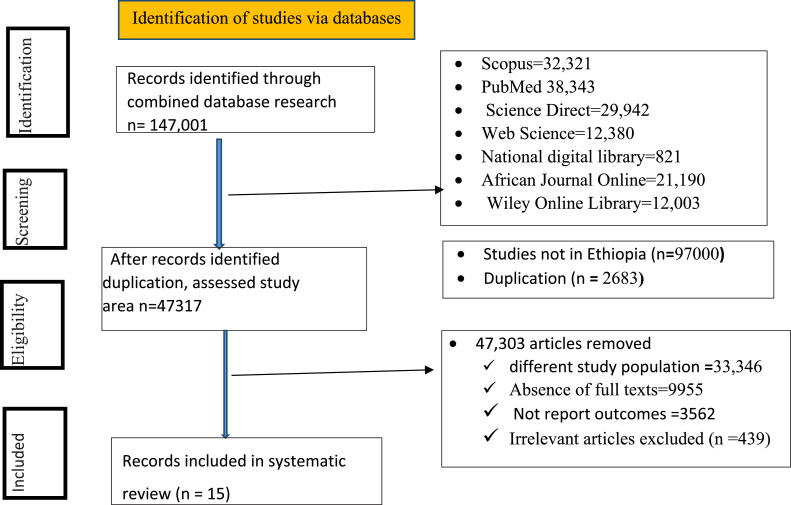
Studies systematically searched electronic databases including Scopus, Medline/PubMed, Web of Science, Science Direct, African Journal Online, the Wiley Online Library, and National Digital Library repositories from April 1, 2024, to April 30, 2024. Data extracted from Microsoft Excel were imported into STATA version 11 for further analysis. A modified version of the Newcastle-Ottawa scale employed for cross-sectional studies used for quality assessment. A random-effects model was used to estimates pooled prevalence. Cochran's test and statistics were used to assess the heterogeneity of the studies. Percentages and odds ratios (OR) with 95% CI were used to pool the effect measure. The symmetry of the funnel plot and Egger's test were used to check for publication bias. A subgroup analysis was done on the study years, and sample sizes.
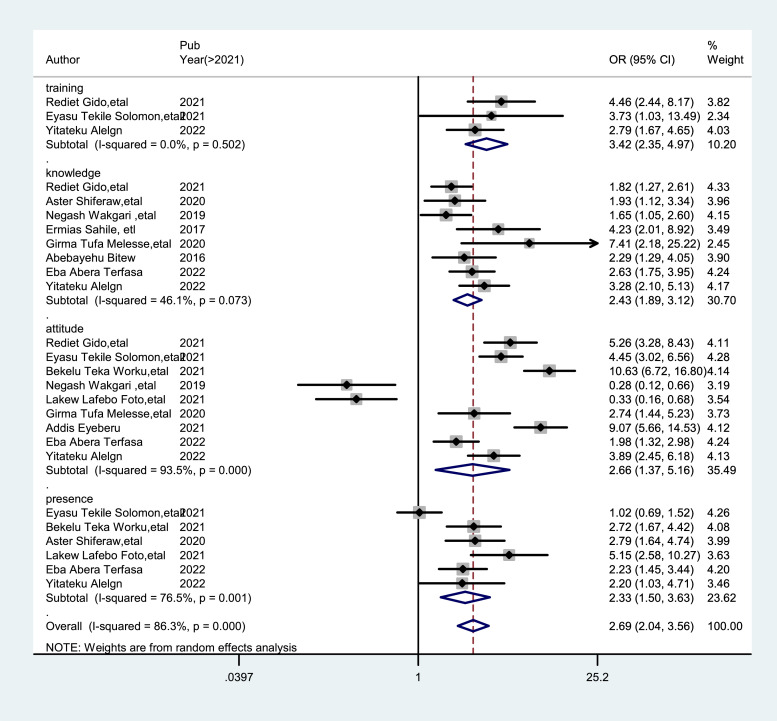
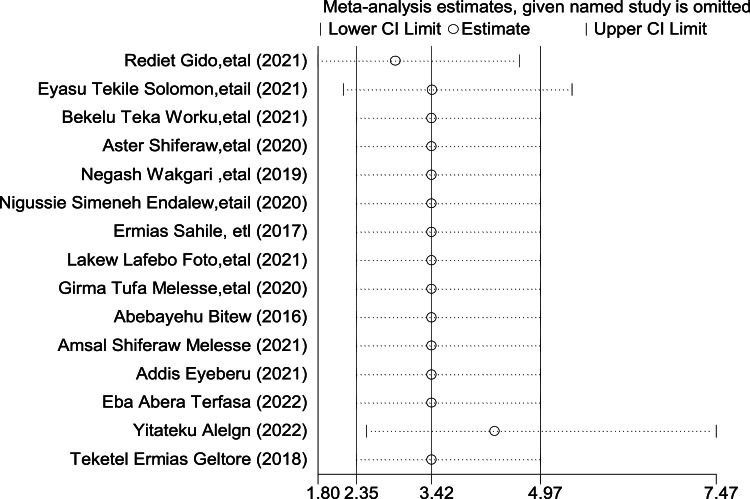
The pooled practice of pharmacological labor pain management services among healthcare providers was found to be 43.83% (95% CI: 37.45-50.20). Caregivers with sufficient knowledge (AOR: 2.36; 95% CI: 1.99-2.81), those who held positive attitudes (AOR: 3.66; 95% CI: 3.13-4.31), caregivers who received training related to obstetric protocols (AOR: 3.42; 95% CI: 2.36-4.97), laboring mothers expressed a preference for such interventions (AOR=2.33; 95% CI: 1.50, 3.63) were associated with practicing pharmacological labor pain management.
The overall pooled practice of pharmacological labor pain management among healthcare providers was found to be inadequate. Key factors such as obstetric care-related training, knowledge, attitudes, and the availability of options for labor pain management were strongly associated with this outcome. Therefore, it is crucial to provide training on labor pain management techniques to enhance healthcare providers' knowledge and attitudes toward these interventions across all levels of the healthcare system. Moreover, recommend that all healthcare providers offer pain relief in a manner that aligns with the preferences of laboring women, ensuring that care is both responsive and respectful.
实现良好的产科健康结局是全球优先事项,强烈建议实施药物和循证干预措施以缓解分娩疼痛。然而,关于药物分娩疼痛管理服务实践的系统评价证据明显匮乏。因此,本研究旨在评估埃塞俄比亚医疗服务提供者药物分娩疼痛管理的综合实践情况及相关因素。
于2024年4月1日至2024年4月30日,系统检索电子数据库,包括Scopus、Medline/PubMed、Web of Science、Science Direct、非洲期刊在线、Wiley在线图书馆和国家数字图书馆存储库。从Microsoft Excel中提取的数据被导入到STATA 11版本中进行进一步分析。采用用于横断面研究的纽卡斯尔-渥太华量表的修改版进行质量评估。使用随机效应模型估计合并患病率。采用 Cochr an检验和统计量评估研究的异质性。使用百分比和95%置信区间的比值比(OR)合并效应量。采用漏斗图的对称性和Egger检验检查发表偏倚。对研究年份和样本量进行亚组分析。
发现医疗服务提供者中药物分娩疼痛管理服务的综合实践率为43.83%(95%置信区间:37.45 - 50.20)。知识充足的护理人员(调整后比值比:2.36;95%置信区间:1.99 - 2.81)、态度积极的护理人员(调整后比值比:3.66;95%置信区间:3.13 - 4.31)、接受过产科协议相关培训的护理人员(调整后比值比:3.42;95%置信区间:2.36 - 4.97)、分娩母亲对这类干预措施表示偏好(调整后比值比 = 2.33;95%置信区间:1.50,3.63)与实施药物分娩疼痛管理相关。
发现医疗服务提供者中药物分娩疼痛管理的总体综合实践情况不足。与产科护理相关的培训、知识、态度以及分娩疼痛管理选项的可用性等关键因素与这一结果密切相关。因此,至关重要的是提供分娩疼痛管理技术培训,以提高医疗服务提供者在医疗系统各级对这些干预措施的知识和态度。此外,建议所有医疗服务提供者以符合分娩妇女偏好的方式提供疼痛缓解,确保护理既响应需求又尊重患者。