
使用机器学习和功能连接对精神分裂症谱系障碍进行分类:重新审视临床应用
Classification of schizophrenia spectrum disorder using machine learning and functional connectivity: reconsidering the clinical application.
作者信息
Li Chao, Chen Ji, Dong Mengshi, Yan Hao, Chen Feng, Mao Ning, Wang Shuai, Liu Xiaozhu, Tang Yanqing, Wang Fei, Qin Jie
机构信息
Department of Radiology, The Third Affiliated Hospital of Sun Yat-Sen University, 600 Tianhe Rd, Guangzhou, 510630, China.
Center for Brain Health and Brain Technology, Global Institute of Future Technology, Institute of Psychology and Behavioral Science, Shanghai Jiao Tong University, Shanghai, China.
出版信息
BMC Psychiatry. 2025 Apr 14;25(1):372. doi: 10.1186/s12888-025-06817-0.
BACKGROUND
Early identification of Schizophrenia Spectrum Disorder (SSD) is crucial for effective intervention and prognosis improvement. Previous neuroimaging-based classifications have primarily focused on chronic, medicated SSD cohorts. However, the question remains whether brain metrics identified in these populations can serve as trait biomarkers for early-stage SSD. This study investigates whether functional connectivity features identified in chronic, medicated SSD patients could be generalized to early-stage SSD.
METHODS
Data were collected from 502 SSD patients and 575 healthy controls (HCs) across four medical institutions. Resting-state functional connectivity (FC) features were used to train a Support Vector Machine (SVM) classifier on individuals with medicated chronic SSD and HCs from three sites. The remaining site, comprising both chronic medicated and first-episode unmedicated SSD patients, was used for independent validation. A univariable analysis examined the association between medication dosage or illness duration and FC.
RESULTS
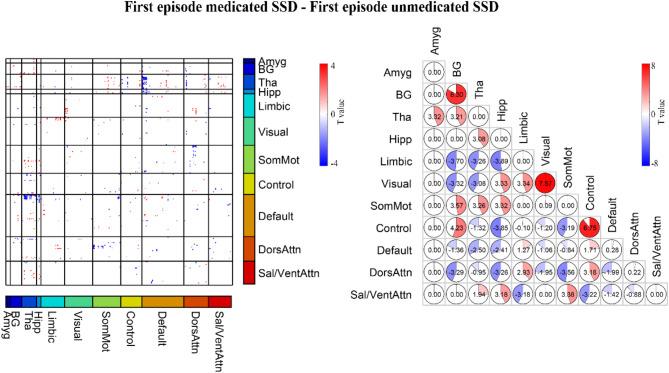
The classifier achieved 69% accuracy (p = 0.002), 63% sensitivity, 75% specificity, 0.75 area under the receiver operating characteristic curve, 69% F1-score, 72% positive predictive rate, and 67% negative predictive rate, when tested on an independent dataset. Subgroup analysis showed 71% sensitivity (p = 0.04) for chronic medicated SSD, but poor generalization to first-episode unmedicated SSD (sensitivity = 48%, p = 0.44). Univariable analysis revealed a significant association between FC and medication usage, but not disease duration.
CONCLUSIONS
Classifiers developed on chronic medicated SSD may predominantly capture state features of chronicity and medication, overshadowing potential SSD traits. This partially explains the current classifiers' non-generalizability across SSD patients with different clinical states, underscoring the need for models that can enhance the early detection of schizophrenia neural pathology.
背景
精神分裂症谱系障碍(SSD)的早期识别对于有效干预和改善预后至关重要。以往基于神经影像学的分类主要集中在慢性、接受药物治疗的SSD队列。然而,这些人群中确定的脑指标是否可作为早期SSD的特质生物标志物仍是个问题。本研究调查了在慢性、接受药物治疗的SSD患者中确定的功能连接特征是否可推广到早期SSD。
方法
从四个医疗机构的502名SSD患者和575名健康对照(HC)中收集数据。静息态功能连接(FC)特征用于在来自三个地点的接受药物治疗的慢性SSD患者和HC个体上训练支持向量机(SVM)分类器。其余地点包括慢性接受药物治疗和首发未接受药物治疗的SSD患者,用于独立验证。单变量分析检查了药物剂量或病程与FC之间的关联。
结果
在独立数据集上进行测试时,该分类器的准确率达到69%(p = 0.002),灵敏度为63%,特异性为75%,受试者工作特征曲线下面积为0.75,F1分数为69%,阳性预测率为72%,阴性预测率为67%。亚组分析显示,慢性接受药物治疗的SSD的灵敏度为71%(p = 0.04),但对首发未接受药物治疗的SSD的泛化性较差(灵敏度 = 48%,p = 0.44)。单变量分析显示FC与药物使用之间存在显著关联,但与病程无关。
结论
基于慢性接受药物治疗的SSD开发的分类器可能主要捕捉到慢性和药物治疗的状态特征,掩盖了潜在的SSD特质。这部分解释了当前分类器在不同临床状态的SSD患者中不可推广的原因,强调了需要能够加强精神分裂症神经病理学早期检测的模型。


 Zotero 插件