Lam Tam Duc, Dau Nhung Thi Tuyet, Nguyen Pham Thao-Ngan, Le Bao Huy, Pham Loc Dac, Phan Nghi Vinh, Nguyen Thu Thi, Nguyen Hung Tan, Quan Phung Kim, Doan Dien Thanh, Nguyen Huong-Dung Thi, Truyen Thien Tan Tri Tai
Can Tho University of Medicine and Pharmacy, Can Tho, Vietnam (T.D.L., N.T.T.D., L.D.P., N.V.P., T.T.N., H.T.N., P.K.Q., and D.T.D.).
University of Medicine and Pharmacy, Ho Chi Minh City, Vietnam (T.N.N.P.).
AJOG Glob Rep. 2025 Mar 8;5(2):100473. doi: 10.1016/j.xagr.2025.100473. eCollection 2025 May.
Adolescent pregnancy remains a pressing concern in the Pacific and Southeast Asia, with birth rates of 51 and 43 per 1000 girls. Teenage mothers face a heightened risk of complications and mortality, while their newborns are more likely to experience challenges such as preterm birth, low birth weight, and poor Apgar scores. In Vietnam, however, evidence on this issue remains limited.
Our research aims to examine the socioeconomic characteristics and outcomes of adolescent pregnancy in Vietnam.
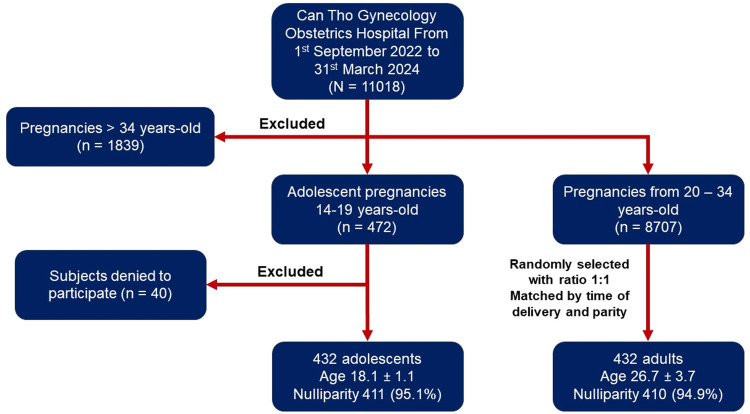
We conducted a cross-sectional study recruiting pregnant women aged 10 to 19 hospitalized for delivery at Can Tho Gynecology Obstetrics Hospital from September 1st, 2022, to March 31, 2024. For reference, we established a cohort of pregnant women aged 20 to 34 years who presented at our hospital during the same study period. This cohort was randomly selected (1:1 ratio) and matched with our adolescent cohort based on the delivery date and parity. Primary outcomes included maternal and neonatal outcomes.
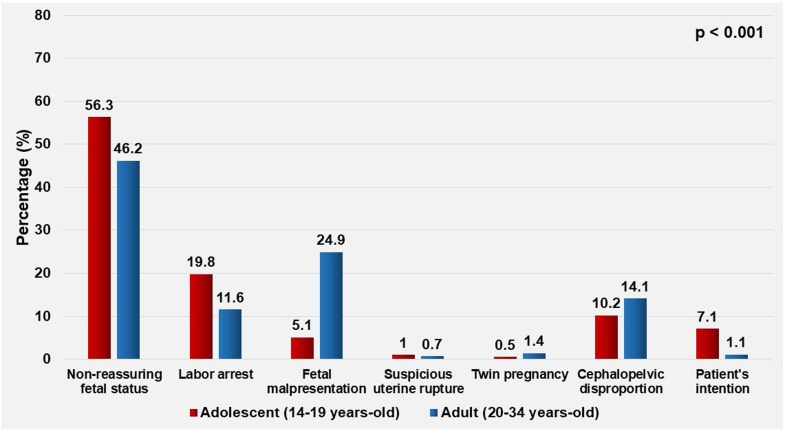
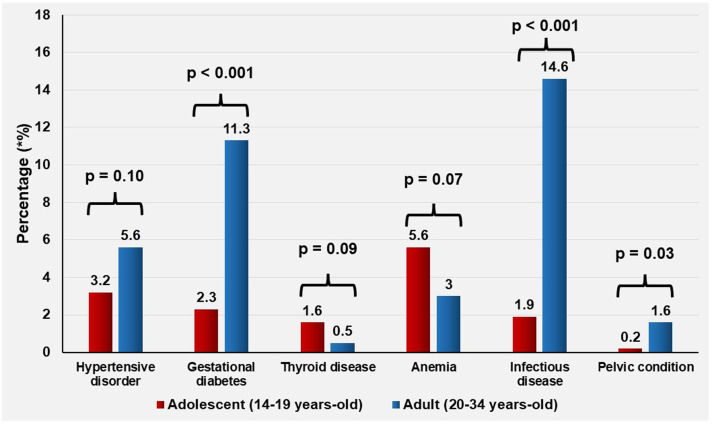
Our final analysis included 432 adolescents and 432 adults with mean ages of 18.1±1.1 years and 26.7±3.7 years, respectively. Adolescent pregnancies were more likely to have disadvantageous sociodemographic backgrounds with limited resources, including ethnic minorities, rural residences, and low education. Adolescent individuals had lower prepregnancy weight (48 [43-53] kg vs 50 [46-55] kg, <.001) and BMI (19.2 [17.7-21.8] vs 20 [18.7-22], <.001) compared to adults. Their weight gain during pregnancy was also lower (12.8±5.2 kg vs 15.6±6.8 kg, <.001). Regarding comorbidities, adolescents had fewer chronic conditions (14.4% vs 34.3%, <.001). However, they tended to have a higher percentage of thyroid disease (1.6% vs 0.5%, =.09) and anemia (5.6% vs 3.0%, =.07) compared to adults. Adolescents experienced a higher percentage of maternal adverse outcomes (4.2% vs 1.6%, =.03), particularly infection/sepsis (3.2% vs 1.2%, =.04). Regarding indications for cesarean delivery, adolescents had a higher proportion of nonreassuring fetal status (56.3% vs 46.2%) and labor arrest (19.8% vs 11.6%) but lower percentages of fetal malpresentation (5.1% vs 24.9%) and cephalopelvic disproportion (10.2% vs 14.1%) compared to adults. Their newborns had higher rates of preterm birth (15.0% vs 7.2%, <.001), low birth weight (12.0% vs 6.3%, <.001), and a 1-minute Apgar score of less than 7 (3.9% vs 1.2%, <.001).
Adolescent pregnancies had more adverse maternal and neonatal outcomes than adult pregnancies. Further policies and studies are warranted to address socioeconomic disadvantages and develop specific pregnancy care standards for this group.
青少年怀孕仍是太平洋地区和东南亚的一个紧迫问题,每1000名女孩的出生率分别为51和43。青少年母亲面临并发症和死亡风险增加的问题,而她们的新生儿更有可能经历早产、低出生体重和阿氏评分低等挑战。然而,在越南,关于这个问题的证据仍然有限。
我们的研究旨在调查越南青少年怀孕的社会经济特征和结局。
我们进行了一项横断面研究,招募了2022年9月1日至2024年3月31日期间在芹苴妇产科医院住院分娩的10至19岁孕妇。作为对照,我们建立了一个在同一研究期间到我院就诊的20至34岁孕妇队列。该队列是随机选取的(1:1比例),并根据分娩日期和产次与我们的青少年队列进行匹配。主要结局包括孕产妇和新生儿结局。
我们的最终分析纳入了432名青少年和432名成年人,平均年龄分别为18.1±1.1岁和26.7±3.7岁。青少年怀孕更有可能具有社会人口学背景不利、资源有限的情况,包括少数民族、农村居住和低教育水平。与成年人相比,青少年孕前体重(48[43 - 53]kg对50[46 - 55]kg,<.001)和体重指数(19.2[17.7 - 21.8]对20[18.7 - 22],<.001)更低。她们孕期体重增加也更低(12.8±5.2kg对15.6±6.8kg,<.001)。关于合并症,青少年慢性病较少(14.4%对34.3%,<.001)。然而,与成年人相比,她们甲状腺疾病(1.6%对0.5%,=.09)和贫血(5.6%对3.0%,=.07)的比例往往更高。青少年孕产妇不良结局的比例更高(4.2%对1.6%,=.03),尤其是感染/败血症(3.2%对1.2%,=.04)。关于剖宫产指征,青少年胎儿状况不佳(56.3%对46.2%)和产程停滞(19.8%对11.6%)的比例更高,但与成年人相比,胎位异常(5.1%对24.9%)和头盆不称(10.2%对14.1%)的比例更低。她们的新生儿早产率(15.0%对7.2%,<.001)、低出生体重率(12.0%对6.3%,<.001)和1分钟阿氏评分低于7分的比例(3.9%对1.2%,<.001)更高。
青少年怀孕比成年怀孕有更多不良的孕产妇和新生儿结局。需要进一步的政策和研究来解决社会经济劣势,并为该群体制定具体的孕期护理标准。