Yamamoto Kayo, Saito Yuichi, Ohno Yuji, Oka Norikiyo, Takahara Masayuki, Suzuki Sakuramaru, Uchiyama Raita, Suzuki Masahiro, Matsumoto Tadahiro, Iwata Yo, Kobayashi Yoshio
Department of Cardiovascular Medicine, Chiba University Graduate School of Medicine, Chiba, Japan.
Department of Cardiovascular Medicine, Chiba University Graduate School of Medicine, Chiba, Japan.
JACC Asia. 2025 Jun;5(6):744-754. doi: 10.1016/j.jacasi.2025.01.018. Epub 2025 Apr 15.
The 2024 European Society of Cardiology (ESC) guidelines for peripheral arterial disease (PAD) propose the dedicated high ischemic risk (HIR) and high bleeding risk (HBR) criteria.
The purpose of this study was to validate the ESC-HIR and HBR criteria using real-world data.
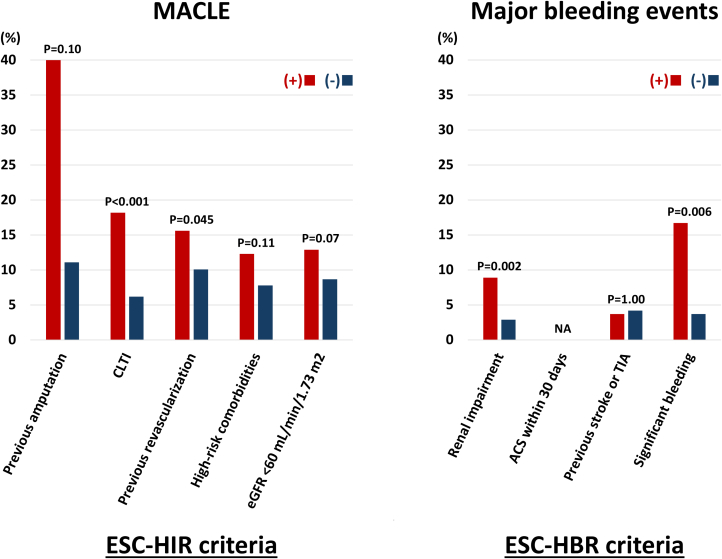
From January 2019 to December 2022, this multicenter retrospective registry included 824 patients undergoing endovascular treatment for aortoiliac and femoropopliteal PAD. The ESC-HIR criteria include previous amputation, critical limb-threatening ischemia, previous revascularization, high-risk comorbidities (heart failure, diabetes, polyvascular disease), and estimated glomerular filtration rate <60 mL/min/1.73 m, while the ESC-HBR criteria include dialysis or renal impairment (estimated glomerular filtration rate <15 mL/min/1.73 m), acute coronary syndrome <30 days, history of stroke or transient ischemic attack, and active or clinically significant bleeding. Although patients were initially divided into 4 groups according to the presence or absence of HIR and HBR, patients with HBR and no HIR were excluded caused by the small sample size (n = 2). Major adverse cardiovascular and limb events and bleedings were evaluated.
Of the 822 patients, 62 (7.5%), 467 (56.8%), and 293 (35.6%) were grouped in the HIR (-)/HBR (-), HIR (+)/HBR (-), and HIR (+)/HBR (+). During the median follow-up period of 726 days, major adverse cardiovascular and limb events occurred in 0%, 9.5%, and 16.4% among the 3 groups (P = 0.005). The incidence of major bleeding events was 4.8%, 2.4%, and 6.8%, respectively (P = 0.009).
The ESC-HIR and HBR criteria successfully stratified ischemic and bleeding risks in patients with PAD undergoing endovascular treatment.
2024年欧洲心脏病学会(ESC)外周动脉疾病(PAD)指南提出了专门的高缺血风险(HIR)和高出血风险(HBR)标准。
本研究旨在使用真实世界数据验证ESC-HIR和HBR标准。
2019年1月至2022年12月,这项多中心回顾性注册研究纳入了824例行主髂动脉和股腘动脉PAD血管内治疗的患者。ESC-HIR标准包括既往截肢、严重肢体缺血、既往血运重建、高危合并症(心力衰竭、糖尿病、多血管疾病)以及估计肾小球滤过率<60 mL/min/1.73 m²,而ESC-HBR标准包括透析或肾功能损害(估计肾小球滤过率<15 mL/min/1.73 m²)、30天内的急性冠状动脉综合征、中风或短暂性脑缺血发作史以及活动性或临床显著出血。尽管患者最初根据是否存在HIR和HBR分为4组,但由于样本量小(n = 2),排除了有HBR但无HIR的患者。评估主要不良心血管和肢体事件及出血情况。
在822例患者中,62例(7.5%)、467例(56.8%)和293例(35.6%)分别被归为HIR(-)/HBR(-)、HIR(+)/HBR(-)和HIR(+)/HBR(+)组。在726天的中位随访期内,3组中主要不良心血管和肢体事件的发生率分别为0%、9.5%和16.4%(P = 0.005)。主要出血事件的发生率分别为4.8%、2.4%和6.8%(P = 0.009)。
ESC-HIR和HBR标准成功地对接受血管内治疗的PAD患者的缺血和出血风险进行了分层。