
实现用于公共卫生风险评估的透明毒代动力学建模。
Enabling transparent toxicokinetic modeling for public health risk assessment.
作者信息
Davidson-Fritz Sarah E, Ring Caroline L, Evans Marina V, Schacht Celia M, Chang Xiaoqing, Breen Miyuki, Honda Gregory S, Kenyon Elaina, Linakis Matthew W, Meade Annabel, Pearce Robert G, Sfeir Mark A, Sluka James P, Devito Michael J, Wambaugh John F
机构信息
Center for Computational Toxicology and Exposure, Office of Research and Development, United States Environmental Protection Agency, Cincinnati, Ohio, United States of America.
Center for Computational Toxicology and Exposure, Office of Research and Development, United States Environmental Protection Agency, Research Triangle Park, North Carolina, United States of America.
出版信息
PLoS One. 2025 Apr 16;20(4):e0321321. doi: 10.1371/journal.pone.0321321. eCollection 2025.
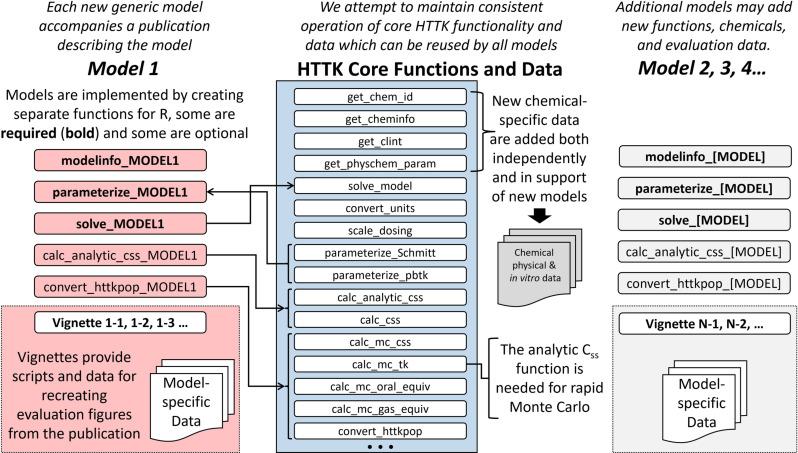
Toxicokinetic modeling describes the absorption, distribution, metabolism, and elimination of chemicals by the body. Chemical-specific in vivo toxicokinetic data is often unavailable for the thousands of chemicals in commerce. However, predictions from generalized toxicokinetic models allow for extrapolation from in vitro toxicological data, obtained via new approach methods (NAMs), to predict in vivo human health outcomes and provide key information on chemicals for public health risk assessment. The httk R package provides an open-source software tool containing a suite of generalized toxicokinetic models covering various exposure scenarios, a library of chemical-specific data from peer-reviewed high-throughput toxicokinetic (HTTK) studies, and other utility functions to parameterize and evaluate toxicokinetic models. Generalized HTTK models in httk use the open-source language MCSim to describe the compartmental and physiologically based toxicokinetics (PBTK). New HTTK models may be integrated into httk with a model description code file (C script generated via MCSim) and a model documentation file (R script). httk provides a series of functionalities such as model parameterization, in vivo-derived data for evaluating model predictions, unit conversion, Monte Carlo simulations for uncertainty propagation and biological variability, and other model utilities. Here, we describe in detail how to add new HTTK models into the httk package to leverage its pre-existing data and functionality. As a demonstration, we describe the integration of a gas inhalation PBTK model. The intention of httk is to provide a transparent, open-source tool for toxicokinetics, bioinformatics, and public health risk assessment that makes use of publicly available data on more than one thousand chemicals.
毒物动力学建模描述了机体对化学物质的吸收、分布、代谢和排泄过程。对于商业中存在的数千种化学物质,通常无法获得特定化学物质的体内毒物动力学数据。然而,通用毒物动力学模型的预测能够从通过新方法(NAMs)获得的体外毒理学数据进行外推,以预测体内人类健康结果,并为公共卫生风险评估提供有关化学物质的关键信息。httk R包提供了一个开源软件工具,其中包含一套涵盖各种暴露场景的通用毒物动力学模型、一个来自同行评审的高通量毒物动力学(HTTK)研究的化学物质特定数据集,以及用于参数化和评估毒物动力学模型的其他实用函数。httk中的通用HTTK模型使用开源语言MCSim来描述房室模型和基于生理学的毒物动力学(PBTK)。新的HTTK模型可以通过模型描述代码文件(通过MCSim生成的C脚本)和模型文档文件(R脚本)集成到httk中。httk提供了一系列功能,如模型参数化、用于评估模型预测的体内衍生数据、单位转换、用于不确定性传播和生物变异性的蒙特卡罗模拟以及其他模型实用工具。在这里,我们详细描述如何将新的HTTK模型添加到httk包中,以利用其现有的数据和功能。作为演示,我们描述了气体吸入PBTK模型的集成。httk的目的是提供一个透明的、开源的工具,用于毒物动力学、生物信息学和公共卫生风险评估,该工具利用了关于一千多种化学物质的公开可用数据。


 Zotero 插件