Kim Jiyeong, Chen Michael L, Rezaei Shawheen J, Hernandez-Boussard Tina, Chen Jonathan H, Rodriguez Fatima, Han Summer S, Lal Rayhan A, Kim Sun H, Dosiou Chrysoula, Seav Susan M, Akcan Tugce, Rodriguez Carolyn I, Asch Steven M, Linos Eleni
Stanford Center for Digital Health, Department of Medicine, Stanford University, Palo Alto, CA, USA.
Department of Biomedical Data Science, School of Medicine, Stanford University, Stanford, CA, USA.
NPJ Digit Med. 2025 Apr 16;8(1):210. doi: 10.1038/s41746-025-01604-3.
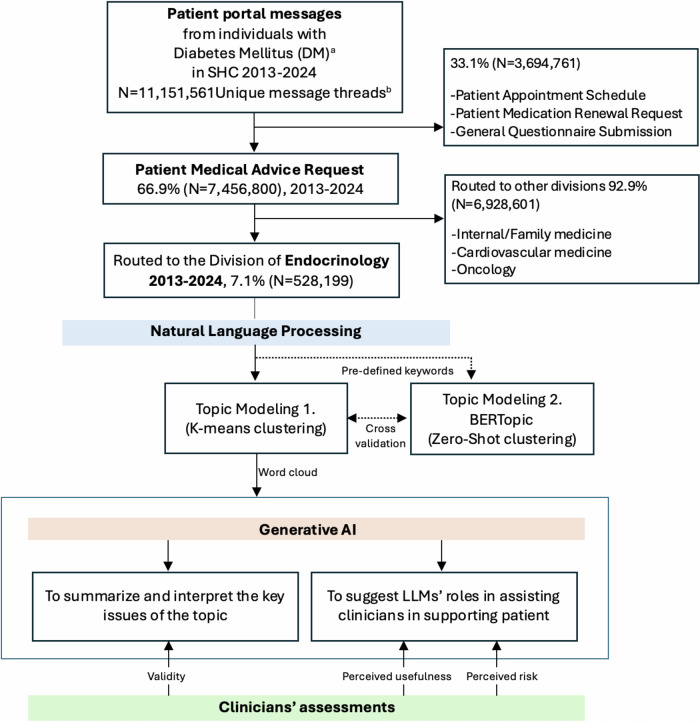
Artificial intelligence (AI) tools to support clinicians in providing patient-centered care can contribute to patient empowerment and care efficiency. We aimed to draft potential AI tools for tailored patient support corresponding to patients' needs and assess clinicians' perceptions about the usefulness of those AI tools. To define patients' issues, we analyzed 528,199 patient messages of 11,123 patients with diabetes by harnessing natural language processing and AI. Applying multiple prompt-engineering techniques, we drafted a series of AI tools, and five endocrinologists evaluated them for perceived usefulness and risk. Patient education and administrative support for timely and streamlined interaction were perceived as highly useful, yet deeper integration of AI tools into patient data was perceived as risky. This study proposes assorted AI applications as clinical assistance tailored to patients' needs substantiated by clinicians' evaluations. Findings could offer essential ramifications for developing potential AI tools for precision patient care for diabetes and beyond.
支持临床医生提供以患者为中心的护理的人工智能(AI)工具,有助于增强患者权能并提高护理效率。我们旨在起草与患者需求相对应的、用于量身定制患者支持的潜在人工智能工具,并评估临床医生对这些人工智能工具有用性的看法。为了明确患者的问题,我们利用自然语言处理和人工智能分析了11123名糖尿病患者的528199条患者信息。通过应用多种提示工程技术,我们起草了一系列人工智能工具,五名内分泌学家对其有用性和风险进行了评估。患者教育以及对及时、简化互动的行政支持被认为非常有用,但将人工智能工具更深入地整合到患者数据中则被认为存在风险。本研究提出了各种人工智能应用,作为根据临床医生评估结果量身定制的、满足患者需求的临床辅助手段。研究结果可能为开发用于糖尿病及其他疾病精准患者护理的潜在人工智能工具带来重要影响。